Hi, what do you want to do?






Biology Junction
Strawberry DNA
Humans eat around 93,205 miles of DNA in an average meal. Scholars learn how to extract DNA from a strawberry using a presentation. It walks through each step and explains why the process works. Comprehension questions encourage...

Curated OER
Bird Flu:Bioethical Debate
Students define the role of vaccines and antiviral drug. They identify the bioethical issues involved in the distribution of medicine during a possible bird flu epidemic.

Curated OER
Science: Designer genes
Students engineer new organisms using biotechnology. In small groups, they write procedures, list benefits and drawbacks, and explain how their new organism might affect the environment. After creating their new organisms, they present...

Curated OER
Genetic Engineering
Learners examine the advantages and disadvantages of genetic engineering. In this genetics lesson students simulate the genetic engineering of a human insulin gene.

Curated OER
Science Lesson: Chocolate Flavored Cherries
Students are able to identify start and stop sequences in DNA. They are able to model using restriction enzyme and ligase to remove sections of DNA and reattach them. Students are introduced to the process of recombinat DNA through the...

Curated OER
Population Growth in Yeasts
Students design an investigation using yeast. In this environmental engineering lesson, students design an investigation to determine how environmental factors affect the growth of yeast. They will collect quantitative data and discuss...

Curated OER
Mussel Ecology
Pupils are introduced to the marine environment of the mussel. The emphasis of the lesson is upon what human factors are present to influence the environment in positive and negative ways. They brainstorm in groups in order to conduct...

Curated OER
TE Activity: Yeast Cells Respire, Too (But Not Like Me and You)
Student observe and quantify the respiration that occurs in yeast-molasses cultures. They complete an effective experiment in order to examine how to think critically about the results.

Curated OER
What Do Bread and Beer Have in Common?
Students listen to an explanation of yeast cells and how they effect bread and beer. They discuss the ways alcohol affects the human body and participate in an indirect observation about cell respiration in yeast-molasses cultures.

Curated OER
Recombinant DNA to Protect Crops
Students are asked to recount their greatest hopes and fears concerning DNA. One article states how worthwhile gene manipulation in plants can be. Classroom discussions arise after reading one article on this issue.

Curated OER
Genetic Engineering
Students are introduced to the concept of genetic engineering. In groups, they participate in a variety of experiments, in which they analyze the effect of chemicals on different substances. Using the internet, they research gossypol,...

Curated OER
Science: Comparing Beer and Bread
Students compare and contrast cellular respiration in yeast and plant and animal cells. After discovering the role of yeast in making beer and bread, they describe the short and long term effects of alcohol on the nervous and digestive...

Curated OER
Water in the Environment
In this water in the environment learning exercise, students match 10 terms related to water to their definitions. They identify 10 sentences as true or false related to groundwater, layering and landfills. They fill in the blanks for 2...

Curated OER
Field Of Beans
Students investigate the concept of crop farming. They plant small fields to test different theories of agriculture. Students keep care over the fields, including pest and weed control. Students make and record daily observations to...

Curated OER
Genetic Decision Making Model
Students examine case studies involving bioethics. They write a paragraph explaining the problem. Students construct a list of values that are involved in the conflict. They list probable solutions to the problem and consequences to...

Curated OER
Investigating the Uses of Backyard Bacteria
Students discover that the answers to some of society's waste and clean-up problems may be no further than the soil beneath their feet. They perform a Gram stain on the colonies to determine some of their characteristics.
![Biotechnology Institute: Your World: Plant Biotechnology [Pdf] Article](https://static.lp.lexp.cloud/images/attachment_defaults/resource/large/FPO-knovation.png "Biotechnology Institute: Your World: Plant Biotechnology [Pdf] Article")
Biotechnology Institute
Biotechnology Institute: Your World: Plant Biotechnology [Pdf]
As humans try to reach the goal of growing enough food to feed all the people, find out how biotechnology is used to help.
Biotechnology Institute
Biotechnology Institute: Your World: A World of Change [Pdf]
The introduction of genetically modified organisms (animals, microbes, and plants) into agriculture has been accompanied by controversies over their potential impact on human health, the environment, and farming systems. Management of...
US Department of Agriculture
China's Food and Agriculture: Issues for the 21st Cent.
A series of reports published but the United States Department of Agriculture in April of 2002 (in PDF format) from the USDA that covers "China's food consumption, marketing, international trade, agricultural policy, transportation...
Biotechnology Institute
Biotechnology Institute: Your World: Genetically Modified Food Crops [Pdf]
This issue of Your World will help students unravel conflicting reports about agricultural biotechnology. Is it safe and environmentally friendly or an out-of-control experiment? Students will learn how plants with specific traits are...
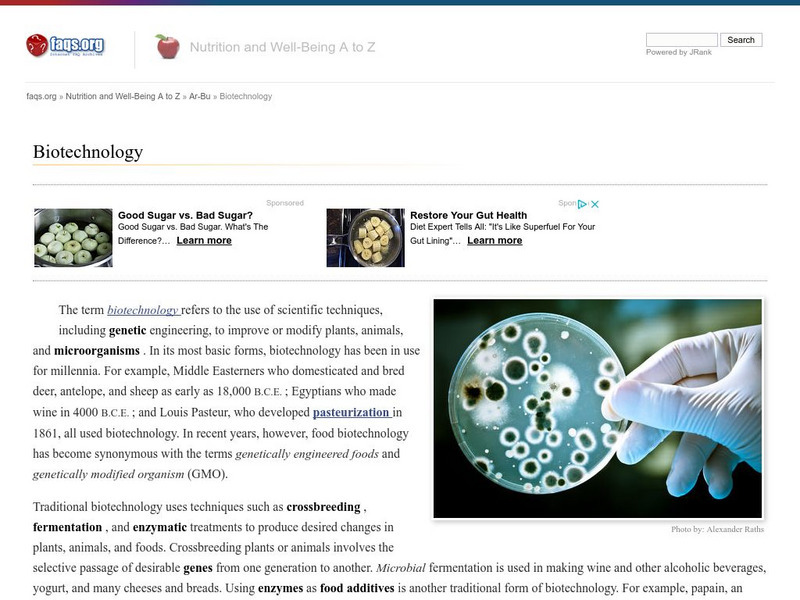
Internet FAQ Archive
Faq Archives: Nutrition and Well Being a to Z: Biotechnology
This is a fascinating site that presents an overview of genetic engineering. It discusses concerns with food production and labeling, and global health with biotechnology.

CK-12 Foundation
Ck 12: Life Science: Biotechnology in Agriculture
[Free Registration/Login may be required to access all resource tools.] The majority of the corn in the United States is genetically engineered. Corn syrup is used to sweeten many things, like Coke. Corn is also fed to the cows. Learn...
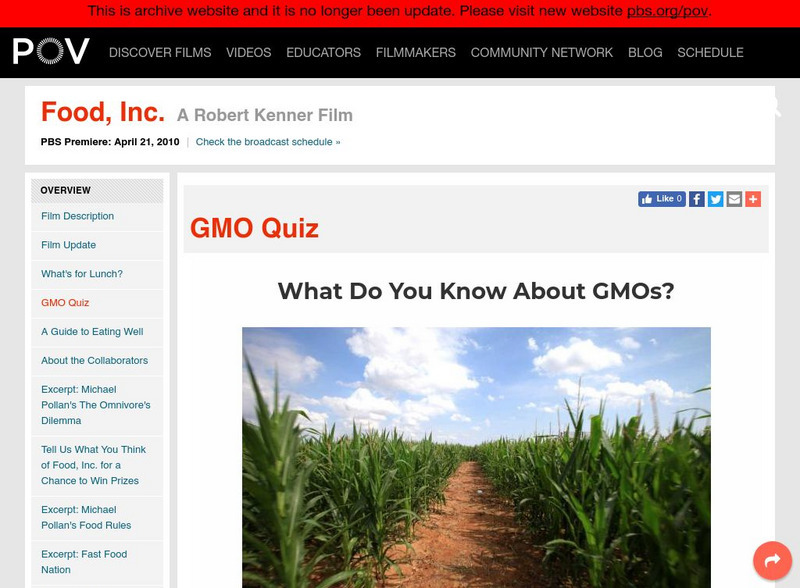
PBS
Pbs: Pov Documentaries: Food, Inc.: What Do You Know About Gm Os?
Take this eleven-question quiz to test your knowledge of GMOs. After the quiz, learn more about genetically modified foods by reviewing the correct answers.

TED Talks
Ted: Ted Ed: The Beneficial Bacteria That Make Delicious Food
Erez Garty shows how your kitchen functions as a sort of biotechnology lab, manned by microorganisms that culture your cuisine. [4:39]