Hi, what do you want to do?






Teach Engineering
Glowing Flowers
What a bright idea! Young scientists conduct an experiment on flowers to finish the last of a six-lesson unit on Cells. Putting the stems into dye-injected water and leaving it overnight results in flowers that glow. This is to simulate...

Reading Resource
Flower Building Long Vowel Game
Reading can be as lovely as a walk through the garden! Sets of flowers host words that share long vowel sounds, which kids match to the correct flowerpots.

Curated OER
Fruit Flowers
Make a fun and healthy snack to celebrate Earth Day! Included are the directions for making a flower out of strawberries, kiwi, mint leaves, and raspberry licorice. Just provide your class with the materials and watch them make edible...

Curated OER
Fabric Scrap Flower Garden
Crafting is fun, it increases eye-hand coordination, and it is a great way to accent any lesson. Celebrate Earth Day by creating scrap fabric flowers for a pop-stick flower garden. Children of all ages will love gluing, cutting, and...

Curated OER
Filter Fun Flower
Students create a flower out of a coffee filter and decorating gels. In this flower lesson plan, students display these flowers in their classroom windows.

Teach Engineering
Design Inspired by Nature
Let nature guide your engineering designs. By taking apart a flower, pupils learn about reverse engineering. They use the results to brainstorm designs for new products or ideas. This is the seventh installment of a nine-part Life...

Curated OER
A Sweet Flower!
Students create a flower made of candy for a special person. Students glue hershey kisses bottom to bottom, wrap them in cellophane, tie ribbon on them and give them as gifts.

Curated OER
Vegetable Flowers with Homemade Ranch Dip
Vegetables aren't just things we can grow to eat; now they are things we can grow to create art! Use this cute and kid-friendly recipe during your next Earth Day celebration. It includes step-by-step instructions on how to turn...

Curated OER
Mother's Day Flower Poem
Students create Mother's Day card. In this art lesson, students cut flowers from construction paper, use handprints, and attach a poem to the card.

Curated OER
Fingerprint Spring Flowers
Students create spring flowers. In this art lesson, students paint stems with brushes and then use their fingers to create flowers.

New South Wales Department of Education
History of Plant Classification
Bamboo, the fastest growing plant in the world, can grow up to 35 inches in one day! Pupils learn how plants historically have been classified and determine if these traits are appropriate to use in this 17th lesson of 20. They will also...

Curated OER
Apple for the Teacher
Students use apples to create a fall flower gift. In this art lesson, students core apples, and place a floral vial with a flower in the apple. Students give the project as a gift.

Curated OER
Mother's Day Handprint
Students make a Mother's Day flower out of one's hand print. In this art lesson, students paint the palm of one of their hands with red keeping the fingers and thumb together pressing the hand onto the top half of a...

New South Wales Department of Education
Plant Features
Pine needles are actually modified leaves. In the 16th installment of 20, young scientists explore plants. Through an analysis of leaves — shape, veins, and edges — pupils see how to classify plants based on structural features.

Horticultural Society of New York
Dress Up Your Salad
Salad dressings use a variety of different ingredients, but it's important to have a healthy balance of greens to create a delicious mix. Young chefs examine five types of herbs including chives, basil, dill, parsley, and thyme to...

New South Wales Department of Education
Plant Groups
Bryophytes can grow in temperatures just above zero degrees. This 17th installment in a series of 20 introduces learners to the five groups of plants: algae, bryophytes, pteridophytes, gymnosperms, and angiosperms. Classes then explore...

Curated OER
Sock Walk (Seed Dispersal)
Students collect seeds from field plants as part of understanding seed dispersal.

Technovation
Curiosity Machine: Challenge: Build a Blooming Flower
Can you create a blooming flower that would attract pollinators? This Curiosity Machine project challenges students to make this flower using common household items. Site includes a place for students to document their process as well as...
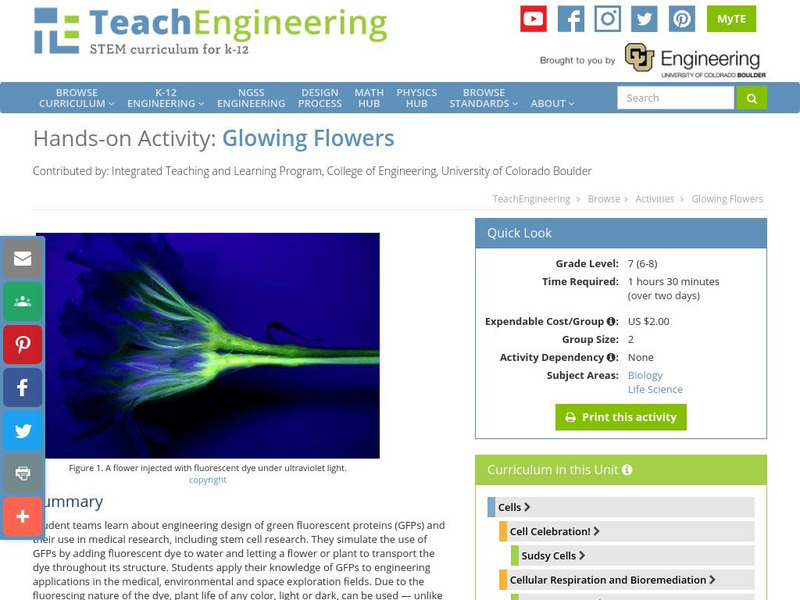
TeachEngineering
Teach Engineering: Glowing Flowers
Student teams learn about engineering design of green fluorescent proteins (GFPs) and their use in medical research, including stem cell research. They simulate the use of GFPs by adding fluorescent dye to water and letting a flower or...
Museum of Science
Museum of Science and Industry: Online Science: Color Changing Carnations
A popular plant experiment where food coloring is added to the water that flowers sit in, to see how this affects the color of the flowers. It demonstrates how water travels through the xylem of a flower stem.
TeachEngineering
Teach Engineering: Design Inspired by Nature
Students discover how engineers can use biomimicry to enhance their designs. They learn how careful observation of nature can lead to new innovations and products. In this activity, students reverse engineer a flower to glean design...
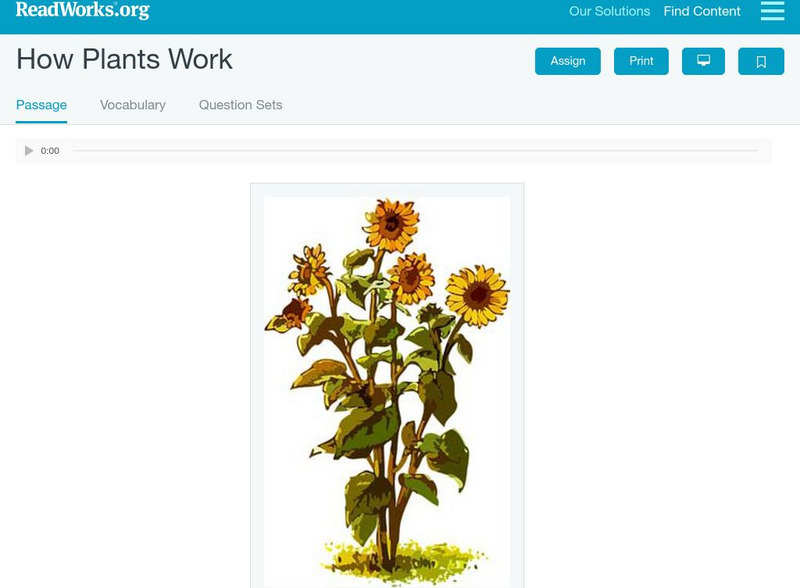
Read Works
Read Works: How Plants Work
[Free Registration/Login Required] An informational text about the different parts of a plant: the leaves, stem, roots, and flowers. A question sheet is available to help students build skills in reading comprehension.
University of Illinois
University of Illinois Extension: The Great Plant Escape
Inspector LePlant and his friends look at the world of plants in this site for younger students. Features include the parts of plants and the seven basic requirements that plants need to survive as well as a short quiz.