Hi, what do you want to do?





ReadWriteThink
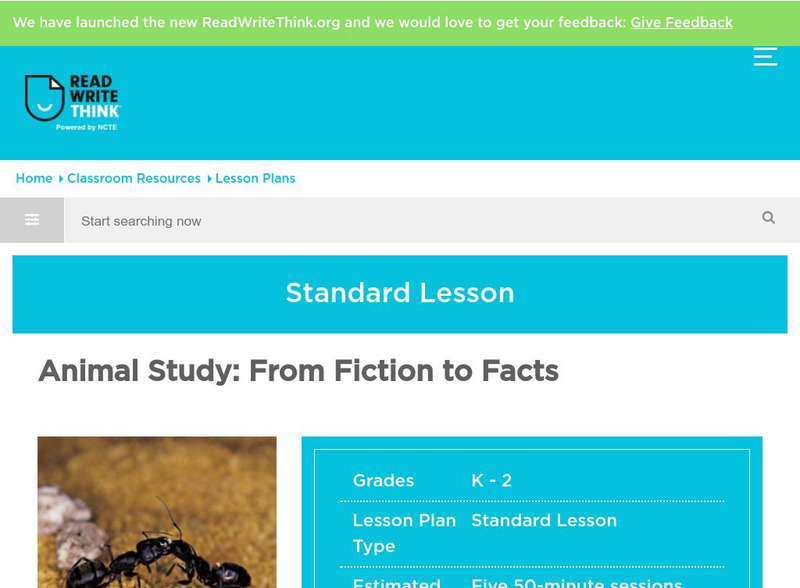
Read Write Think: Animal Study From Fiction to Facts
Contains plans for five 50-minute lessons that ask students to compare and research information about animals from fiction and nonfiction texts. In addition to student objectives and standards, these instructional plans contains links to...
![Florida Center for Reading Research: Fiction and Nonfiction Sort [Pdf] Lesson Plan](https://content.lessonplanet.com/knovation/original/509105-4469283d2301f2d80ae09183a55b8e2c.jpg?1661786967 "Florida Center for Reading Research: Fiction and Nonfiction Sort [Pdf] Lesson Plan")
Florida Center for Reading Research
Florida Center for Reading Research: Fiction and Nonfiction Sort [Pdf]
A lesson plan in which students look at different books, write their titles, and sort them according to whether they are fiction or nonfiction. Materials are included.
Read Works
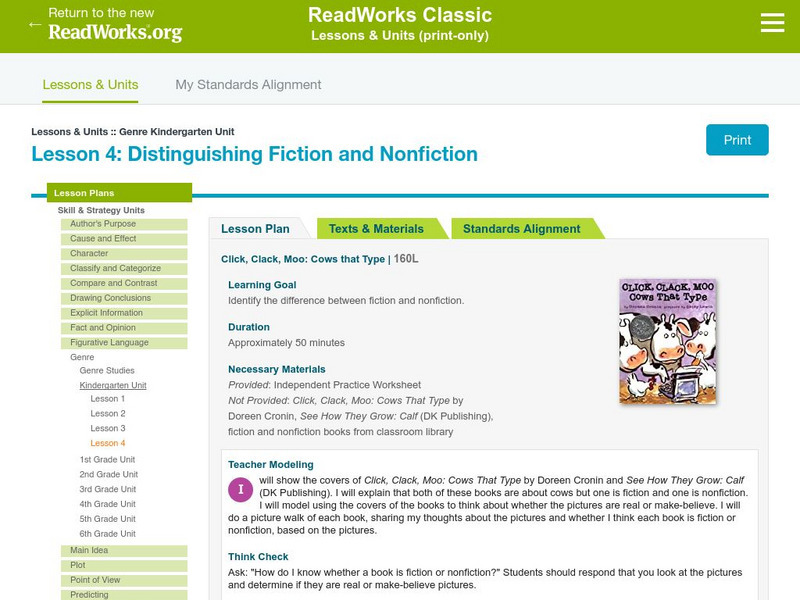
Read Works: Lessons: Click, Clack, Moo: Cows That Type
[Free Registration/Login Required] A lesson plan and materials to teach kindergarten students how to tell the difference between fiction and nonfiction.
Better Lesson
Better Lesson: Analyzing Text Complexity of Non Fiction Sources
This lesson plan will help young scholars read and comprehend nonfiction, specifically biographies, through determining criteria for text complexity. Included is a PDF and Smart Notebook titled Determining Text Complexity, and an example...

British Library
British Library: 19th Century Non Fiction Texts: Work & Welfare
This thematic collection will allow students to read and understand 19th-century non-fiction texts, and support them in identifying key features for a range of genres, audiences, and purposes. Each source is accompanied by original...
British Library
British Library: 19th Century Non Fiction Texts: Gender, Behaviour & Etiquette
This thematic collection will allow students to read and understand 19th-century non-fiction texts, and support them in identifying key features for a range of genres, audiences, and purposes. Each source is accompanied by original...
Utah Education Network
Uen: Balanced Diet
For this lesson, 2nd graders will learn about the components of a balanced diet. Students will analyze charts and then self-report their own foods in categories. Several fiction and nonfiction books are listed as additional resources.
Read Works
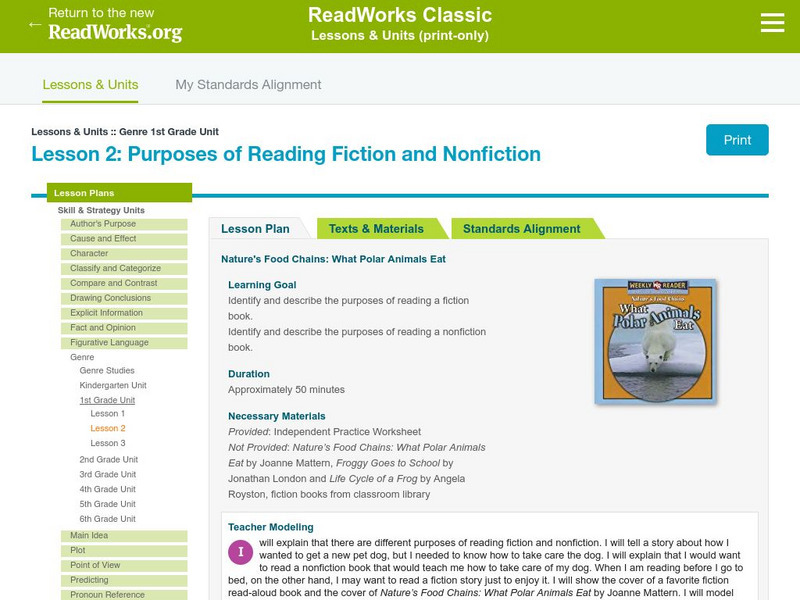
Read Works: 1st Grade Lesson: Purposes for Reading
[Free Registration/Login Required] A lesson in which learners use the books Nature's Food Chains: What Polar Animals Eat by Joanne Mattern, Life Cycle of a Frog by Angela Royston, and Froggy Goes to School by Jonathan London to learn to...
TES Global
Tes: Guided Reading Resources: Nonfiction
[Free Registration/Login Required] This learning module contains several guided reading resources. Students will be able to use the charts to guide themselves as they discuss informational texts and persuasive texts. Teachers can monitor...
South Carolina Educational Television
Know It All: Non Fiction Text Features
Fifth graders will use non-fiction books to identify and explain how text features help them as individual readers.
Read Works
Read Works: Compare and Contrast 3rd Grade Unit
[Free Registration/Login Required] A three-lesson unit on comparing and contrasting through which learners learn how to compare two items using key terms, compare and contrast two non-fiction texts on similar topics, and compare and...
ReadWriteThink
Read Write Think: Shhh! Bear's Sleeping: Learning About Nonfiction and Fiction
Students explore the distinction between the fiction story Bear Snores On and the nonfiction book Every Autumn Comes the Bear.
TES Global
Tes: Non Fiction Unit 4 Formal/impersonal Writing: Tourists
[Free Registration/Login Required] Young scholars will analyze tourism brochures to determine features related to nonfiction writing in this unit. Tourism websites may be used in lieu of the brochures. Cotswold and the North Leigh Roman...
ReadWriteThink
Read Write Think: Question and Answer Books From Genre Study to Report Writing
Contains plans for eight lessons that explore Question and Answer Books and ask students to do research in order to write their own. In addition to objectives and standards, these instructional plans contain links to sites used in the...
ReadWriteThink
Read Write Think: Text Features: Non Fiction [Pdf]
Compare the printed page to an electronic web page and use this activity to discuss the similarities and differences. A cross-curricular tie-in with ecosystems. Could easily be adapted to another subject area.

ReadWriteThink
Read Write Think: Exploring Cross Age Tutoring Activities With Lewis and Clark
Interaction and adventure draws high school and elementary school students together as they analyze stories about the Lewis and Clark expedition.
Read Works
Read Works: Explicit Information 1st Grade Unit
[Free Registration/Login Required] A two-lesson unit in which students learn how to identify explicit information in both fiction and non-fiction texts. The lessons utilize the books Frogs by Gail Gibbons and Stellaluna by Janell Cannon....
ReadWriteThink
Read Write Think: Let's Build a Snowman
These two lessons that teach students about how animals survive in the winter by reading fiction and nonfiction. In addition to objectives and standards, this instructional plan contains links to sites used in the lessons as well as...
Read Works
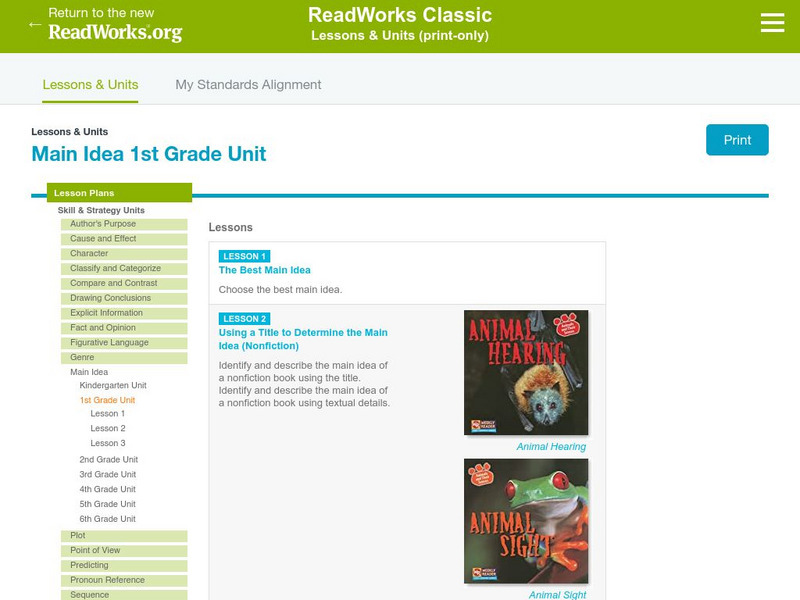
Read Works: Main Idea 1st Grade Unit
[Free Registration/Login Required] Students learn to use titles and supporting details in both fiction and non-fiction texts in order to identify the main idea of the book in this three-activity unit. The lessons utilize the books Animal...
Read Works
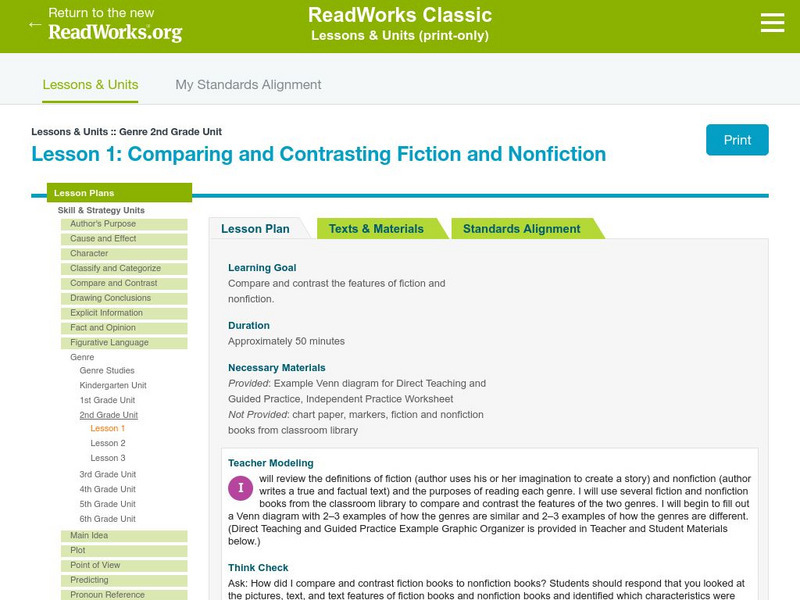
Read Works: 2nd Grade Lesson: Compare/contrast Genres
[Free Registration/Login Required] A lesson in which students use fiction and nonfiction books from a classroom library to identify the similarities and differences between fiction and nonfiction and to create a Venn diagram...
National Endowment for the Humanities
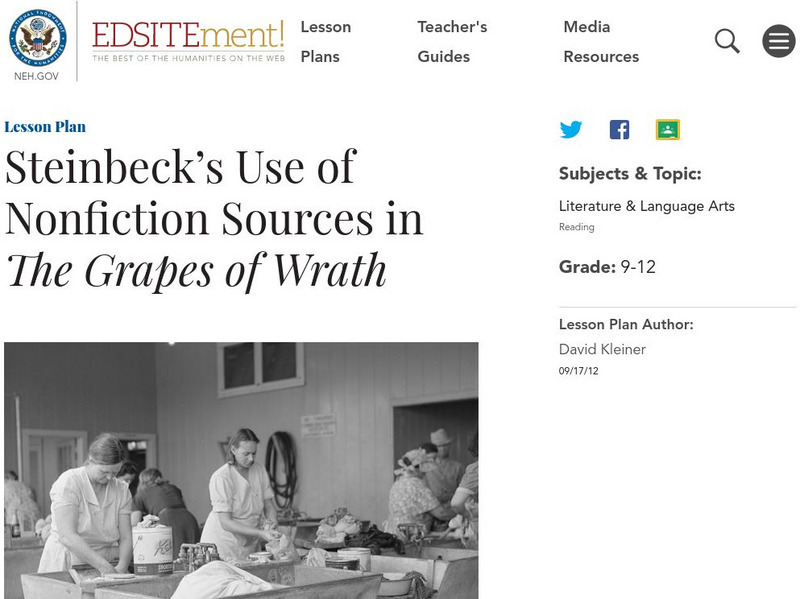
Neh: Edsit Ement: Steinbeck's Use of Nonfiction Sources in "The Grapes of Wrath"
In this lesson plan, students will consider Steinbeck's Use of Nonfiction Sources in "The Grapes of Wrath". Worksheets and other supporting materials can be found under the Resources tab. In this lesson students will compare nonfiction...
TES Global
Tes: Analyzing & Comparing Non Fiction
[Free Registration/Login Required] Resource notes to aid students as they analyze different types of nonfiction. The GAP (genre, audience, and purpose) acronym is provided to use when comparing nonfiction texts.
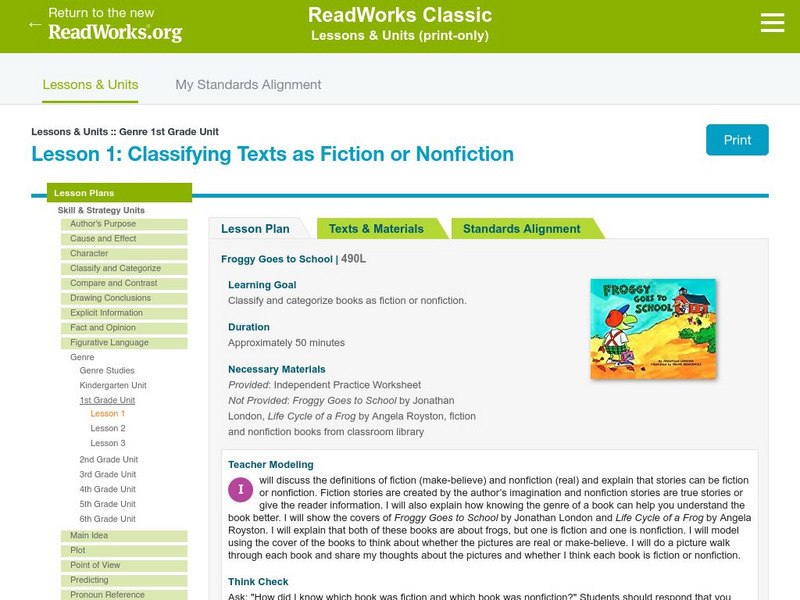
Read Works
Read Works: 1st Grade Lesson: Classifying Texts
[Free Registration/Login Required] A lesson in which learners use the books Froggy Goes to School by Jonathan London and Life Cycle of a Frog by Angela Royston to learn to classify texts as fiction or nonfiction. Lesson includes direct...
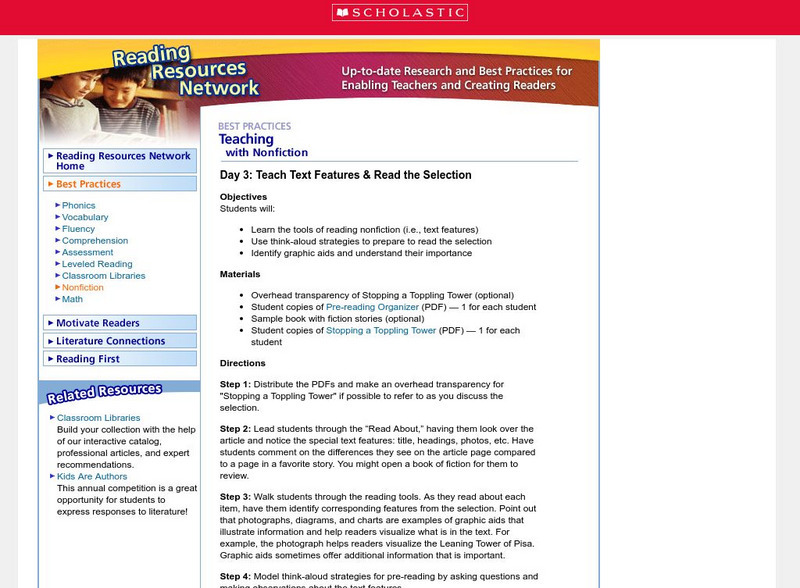
Scholastic
Scholastic: Teaching With Nonfiction: Teach Text Features
A brief lesson plan, this site offers an example of non-fiction text and a graphic organizer to help orient students to the features they need to use when reading for information.
Other popular searches
- Genre Fiction and Nonfiction
- Fiction and Nonfiction Text
- Nonfiction and Fiction
- Fiction and Nonfiction Events
- Compare Fiction and Nonfiction