Hi, what do you want to do?






Curated OER
Families of Functions
High schoolers investigate families of functions. In this families of functions lesson, students discuss how changing a functions parameters affect its' graph. High schoolers vary slope and y-intercepts of linear...

Curated OER
Families of Functions
Learners use sliders to change the parameters of functions and examine how shifting parameters affects a graph. They identify the parameters of functions, find vertical and horizontal stretches, then calculate the scale factor and other...

Curated OER
Midpoint of a Segment
Learners revisit midpoint and segments by graphing on the TI or computer. This activity can be done with pencil and paper, but is more interactive if it is done on a TI-navigator.

Curated OER
Math: Musical Patterns
Students employ their five senses to interpret and duplicate instrumental patterns. Following the teacher's patterns, students clap their hands and later use instruments such as bells, triangles, or cymbals to create their own "songs."

Curated OER
Exploring the Normal Curve Family
Learners find different characteristics of the bell curve. In this statistics instructional activity, students analyze a family for a specific characteristic. They identify the shape, center, spread and area as they analyze the...

Curated OER
Native American Lesson Plan: Someone's in the Kitchen
Students use vocabulary necessary to complete cooking activities and tell others about the food. They discuss similarities and differences between Native American and other nationalities' foods made in their families.

Curated OER
Our Class Record Book
Second graders, in groups, prepare a list of proposed record ideas for the class book.
Texas Instruments
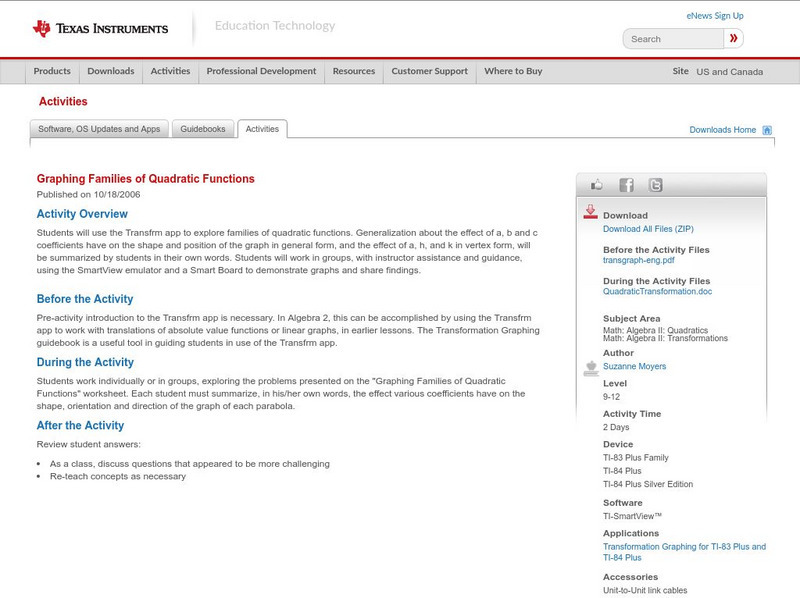
Texas Instruments: Graphing Families of Quadratic Functions
Students can use the Transform app to explore families of quadratic functions. Generalization about the effect of a, b and c coefficients have on the shape and position of the graph in general form, and the effect of a, h, and k in...
Texas Instruments
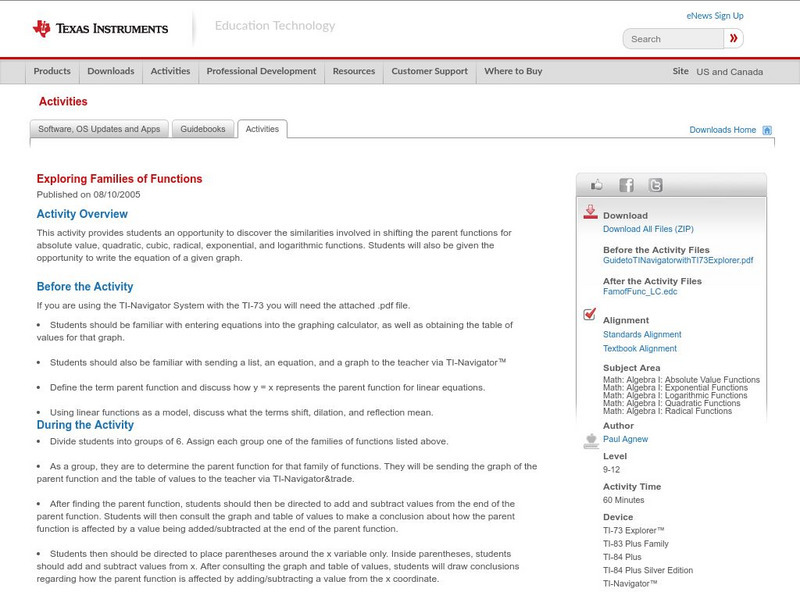
Texas Instruments: Exploring Families of Functions
This activity provides students an opportunity to discover the similarities involved in shifting the parent functions for absolute value, quadratic, cubic, radical, exponential, and logarithmic functions. Students will also be given the...
Texas Instruments
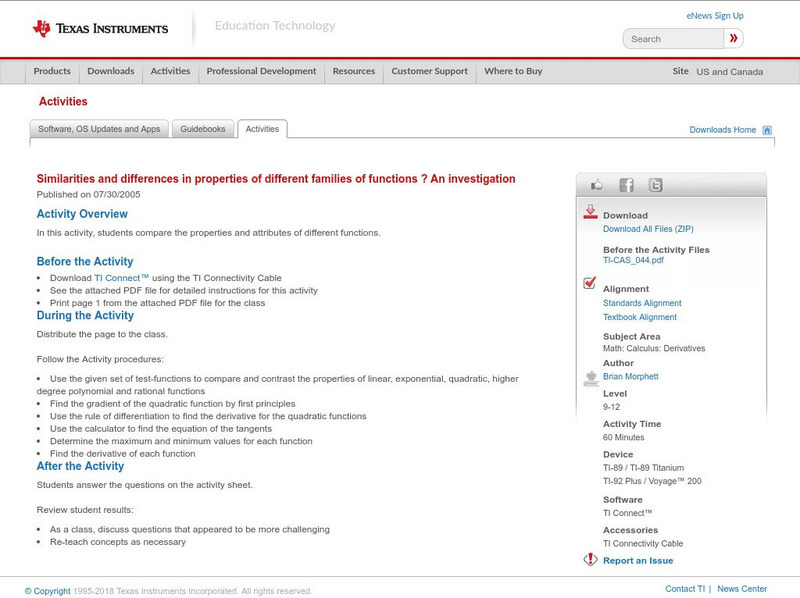
Texas Instruments: Similarities and Differences in Families of Functions
In this activity, students compare the properties and attributes of different functions.
Texas Instruments
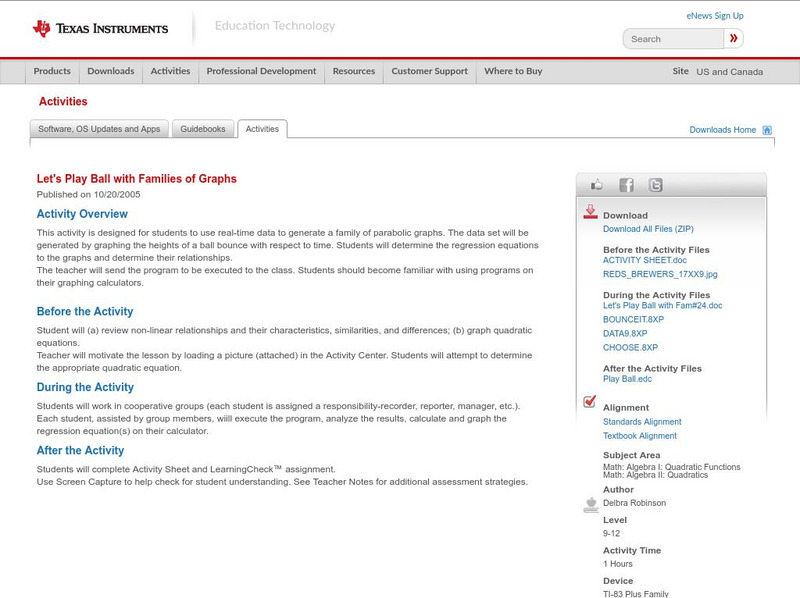
Texas Instruments: Let's Play Ball With Families of Graphs
This activity is designed for students to use real-time data to generate a family of parabolic graphs. The data set will be generated by graphing the heights of a ball bounce with respect to time. Students will determine the regression...
Texas Instruments
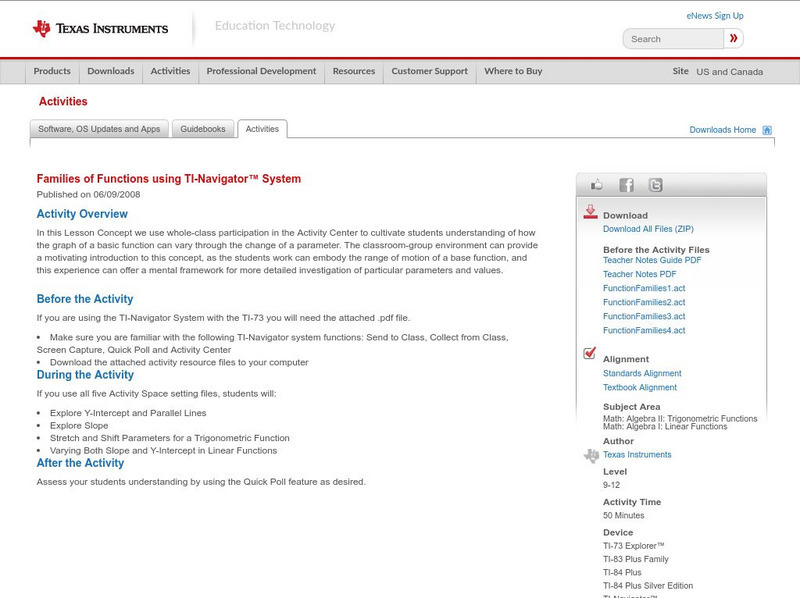
Texas Instruments: Families of Functions Using Ti Navigator System
In this Lesson Concept we use whole-class participation in the Activity Center to cultivate students understanding of how the graph of a basic function can vary through the change of a parameter. The classroom-group environment can...
Texas Instruments
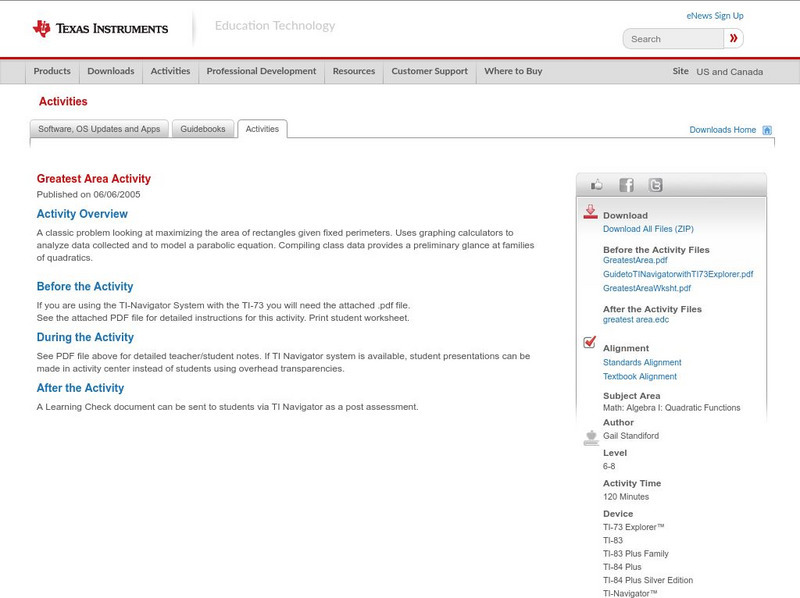
Texas Instruments: Greatest Area Activity
A classic problem looking at maximizing the area of rectangles given fixed perimeters. Uses graphing calculators to analyze data collected and to model a parabolic equation. Compiling class data provides a preliminary glance at families...

Texas Instruments
Texas Instruments: Biggest Box
A classic problem looking at maximizing volume by varying the height of a box. Uses graphing calculators to analyze data collected and to model a cubic equation. Look for points that maximize volume while developing a preliminary notion...

Texas Instruments
Texas Instruments: The Family of Linear Functions
Students can use a graphing calculator to explore families of linear functions. This Technology Lab accompanies Lesson 5-9 from the 2007 Holt, Rinehart and Winston textbook.
Texas Instruments
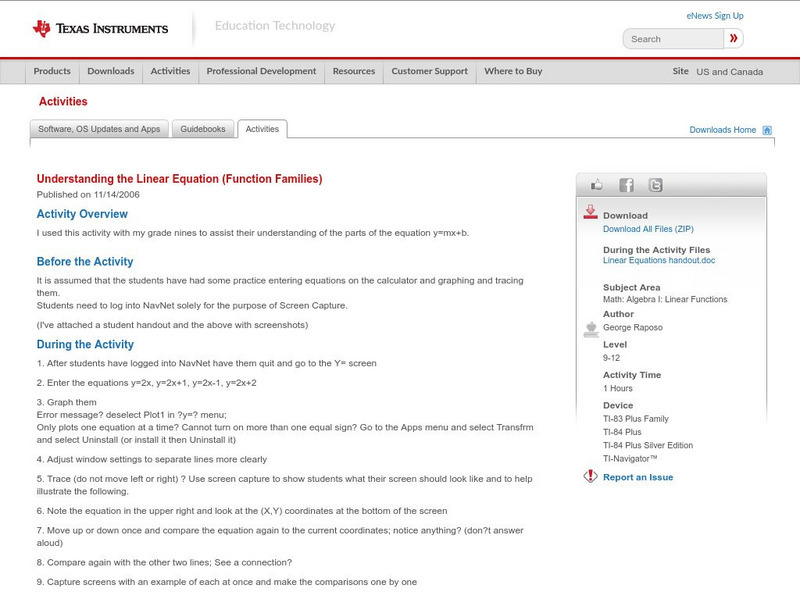
Texas Instruments: Understanding the Linear Equation (Function Families)
This activity can be used with ninth graders to assist their understanding of the parts of the equation y=mx+b.
Texas Instruments
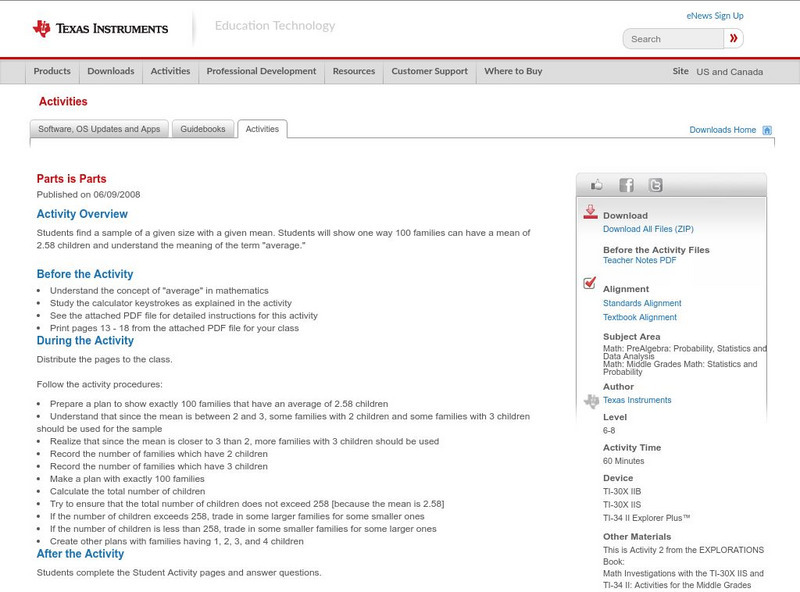
Texas Instruments: Parts Is Parts
Students find a sample of a given size with a given mean. In this activity, students show one way 100 families can have a mean of 2.58 children and understand the meaning of the term "average".
Texas Instruments
Texas Instruments: Numb3 Rs: Follow the Flock
Based off of the hit television show NUMB3RS, this lesson introduces students to the lesser-studied topic of Flock Theory. The lesson is framed in the context of groups of birds, which follow a few simple rules. By using this algorithm,...