Hi, what do you want to do?






Curated OER
A Very Bad Cold
For this online interactive reading comprehension worksheet, students respond to 8 fill in the blank questions regarding the information included in text of " A Very Bad Cold."

Curated OER
Parts of the Body (People)
For this human body parts worksheet, students read the names of 14 basic body parts. Students use these words to complete 14 sentences.

Curated OER
Monster Fun Learning the Five Senses: Science, Health
Students explore their five senses using Ken Baker's "Brave Little Monster" as a springboard.

Curated OER
Layers of the Earth
Third graders examine the layers of the earth during a teacher led discussion. They listen to a read aloud of "How to Dig a Hole to the Other Side of the World," as they "visit" each layer. They work a worksheet while small groups design...

Curated OER
Sense of Wonder, Part 1
Learners engage in an activity by using a leading question. They increase awareness for the wonders that are part of the real world. This is based upon personal observations that students make.

Curated OER
Twelfth Night
In this Twelfth Night worksheet, students fill in phrases which have been left out from Act One, Scene One of Twelfth Night. Instead of filling in Shakespeare's words, kids fill in the given translations for the words in order to better...


Curated OER
Crossword Puzzle - Parts of the Body
For this crossword puzzle worksheet, learners use the clues to complete the crossword puzzle with words about the human body. Students complete 10 clues.

Curated OER
Test Your Patience: Nonsense Quiz
In this testing patience worksheet, students read through the quiz that doesn't make sense. Students then try to answer the 20 questions to taste their patience.


Curated OER
Test- Parts of the Body
For this ESL parts of the body test worksheet, students analyze 7 pictures that depict parts of the body. Students match these pictures with the verbs that describe them. Note: All body parts are written in all capital letters.

Curated OER
New York State Testing Program: English/Language Arts Listening Selection, Grade 3
For this 3rd grade English/Language Arts standardized test practice worksheet, students listen to a fictional story that as their instructor reads it aloud 2 times. No questions accompany the worksheet.

Curated OER
Fractions
First graders are asked to put their fingers on their triangles that looks like the one that is on the overhead. They are asked to tell how they would write a fraction for this one part. Students go through step one until all of the...
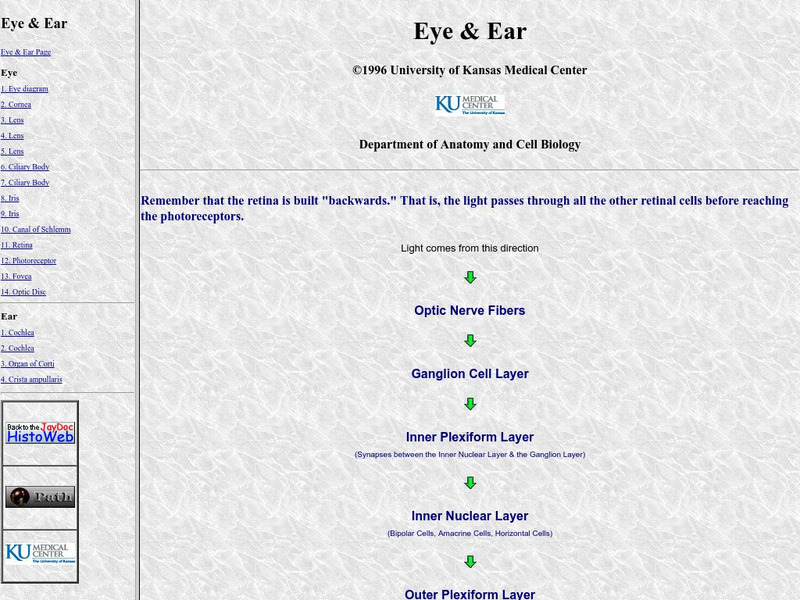
University of Kansas Medical Center
University of Kansas Medical Center: Eye & Ear
Understand the structure and function of the eye and ear cells by examining these microscopic tissue samples.
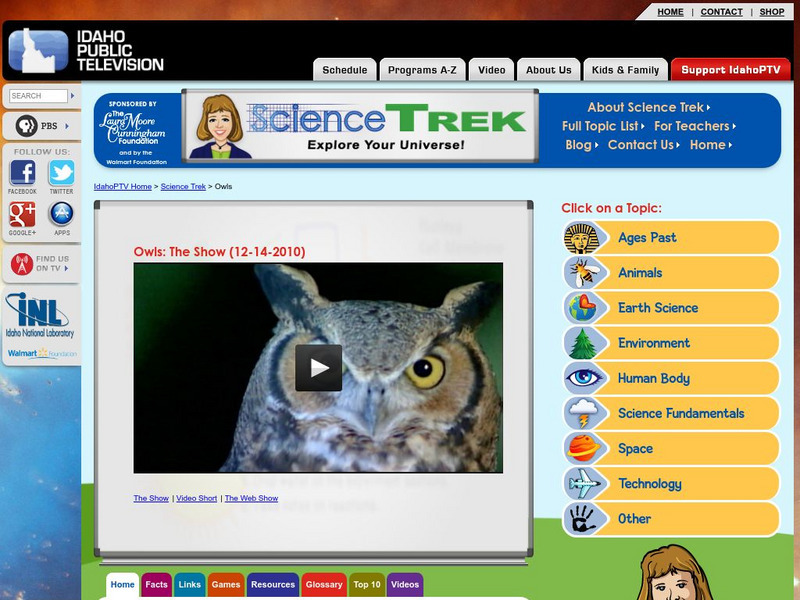
PBS
Idaho Public Tv: Owl Facts
Get to know all about the owl by clicking on any of the topics in the menu bar! Includes myths and legends, night life, diet, eyes and ears, reproduction, and a specific focus on the owls native to Idaho. [Requires Windows Media Player.]

PBS
Pbs Learning Media: Some Frequently Confused Words
Some words in English can look and sound similar, but have entirely different meanings. Keep an eye and ear out for them; beware of commonly confused words. [0:40]

Other
Life Extension: Macular Degeneration (Age Related)
This resource gives an overview of age-related Macular Degeneration. Includes a list of Nutritional Recommendations and Vitamins.

Smithsonian Institution
National Museum of Natural History: American Mammals: Coast Mole
Coast Moles are difficult to distinguish from Townsend's Moles where their ranges overlap in the Pacific Northwest. Both have velvety, dark-gray fur and tiny eyes and ears that are hidden under their fur. Learn more about the Scapanus...
Smithsonian Institution
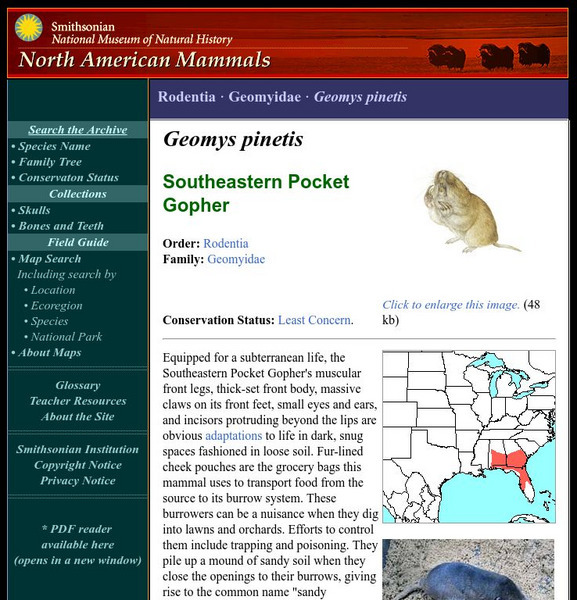
National Museum of Natural History: American Mammals: Southeastern Pocket Gopher
Equipped for a subterranean life, the Southeastern Pocket Gopher's muscular front legs, thick-set front body, massive claws on its front feet, small eyes and ears, and incisors protruding beyond the lips are obvious adaptations to life...
Smithsonian Institution
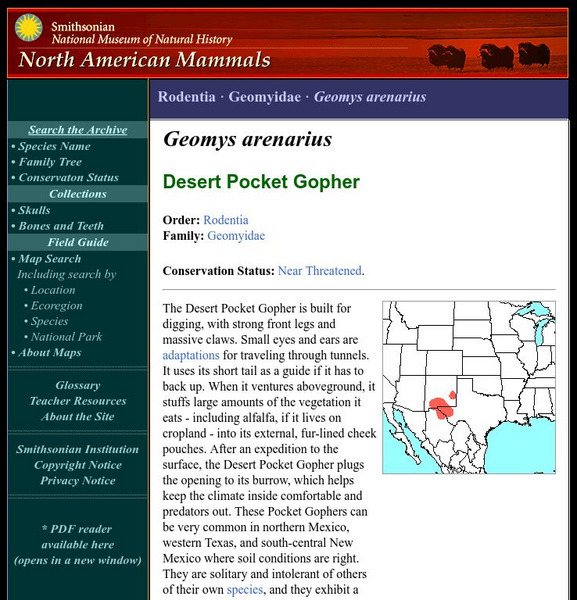
National Museum of Natural History: American Mammals: Desert Pocket Gopher
The Desert Pocket Gopher is built for digging, with strong front legs and massive claws. Small eyes and ears are adaptations for traveling through tunnels. Learn more about the Geomys arenarius, more commonly known as a Desert Pocket...
Smithsonian Institution
National Museum of Natural History: American Mammals: Mountain Beaver
Some scientists think the Mountain Beaver is the world's most primitive living rodent, similar in appearance and behavior to animals that lived 60 million years ago. They have small eyes and ears and luxurious whiskers, and are, like...

CPALMS
Cpalms: Reading With Our Eyes, Fingers, Toes, Ears and Nose
[Free Registration/Login Required] In this lesson, students are learning to identify sensory words in their reading, specifically in poetry. Students will gain a perspective on how authors use sensory words to portray their ideas. They...

PBS
Pbs: Scientific American Frontiers: Artificial Alan
Provides an update on the primary areas of research in bioengineering and bionics: eyes, ears, liver, hands, skin, blood, cartilage, and tendons.