Hi, what do you want to do?






Physics Classroom
The Physics Classroom: Circular and Satellite Motion: Centripetal Force
Through illustrated examples and practice problems, students explore the centripetal force requirement. So for an object moving in a circle, there must be an inward force acting upon it in order to cause its inward acceleration.
Physics Classroom
The Physics Classroom: Circular and Satellite Motion:circular Motion Mathematics
Using the values of speed, acceleration, and force, students explore and analyze the motion of objects in circles.
Physics Classroom
The Physics Classroom: Circular and Satellite Motion: Principles for Satellites
Students explore how a satellite's motion is governed by the same physics principles and described by the same mathematical equations.
Physics Classroom
The Physics Classroom: Circular and Satellite Motion: Roller Coaster Model
An interactive playground for students to explore the physics of roller coasters. Learners investigate by changing the variables of force, velocity, friction, and vectors. Energy bar charts are displayed as the coaster car moves along...
Physics Classroom
The Physics Classroom: Finding Individual Forces
Explore the world of finding individual forces. "The process of determining the value of the individual forces acting upon an object involve [sic] an application of Newton's Second law and an application of the meaning of the net force."
Physics Classroom
The Physics Classroom: Circular and Satellite Motion: Energy in Satellites
Through interactive practice problems and illustrated examples, students explore energy relationships for satellites.

Khan Academy
Khan Academy: Start: How Do Computers Simulate the Motion of Virtual Particles?
For this lesson we'll explore how we use fairly simple physics to draw particles which move according to the forces we feel in the real world (such as wind & gravity).
Science Education Resource Center at Carleton College
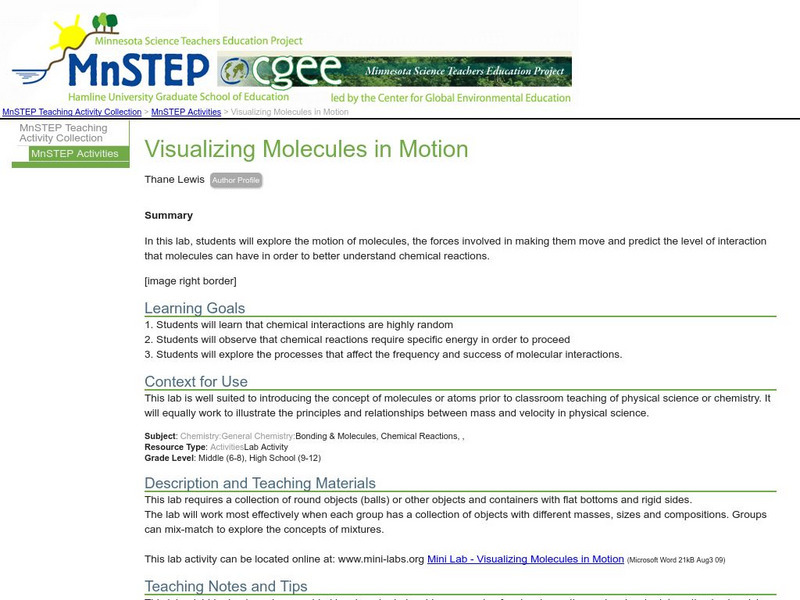
Serc: Visualizing Molecules in Motion
In this lab, students will explore the motion of molecules, the forces involved in making them move and predict the level of interaction that molecules can have in order to better understand chemical reactions.
TeachEngineering
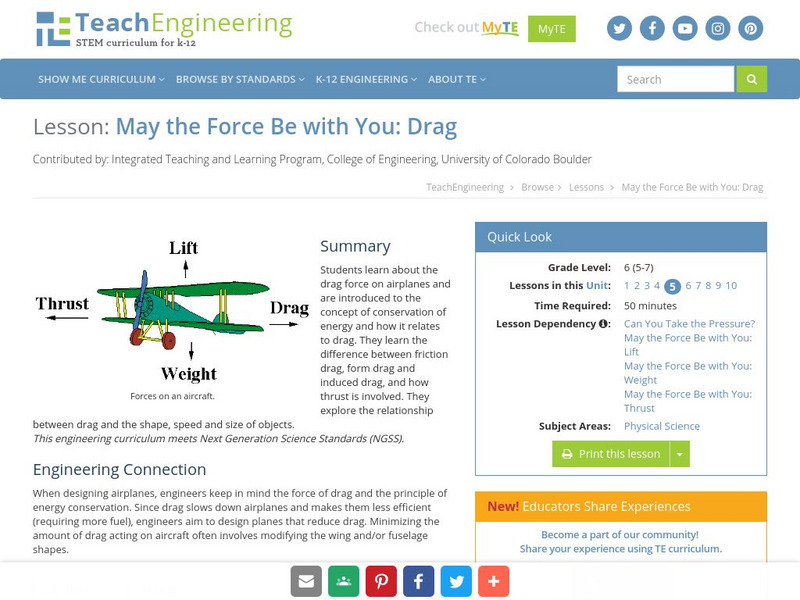
Teach Engineering: May the Force Be With You: Drag
This lesson explores the drag force on airplanes. The students will be introduced to the concept of conservation of energy and how it relates to drag. Students will explore the relationship between drag and the shape, speed and size of...
Science Education Resource Center at Carleton College
Serc: Exploring Newton's Second Law
Students conduct an experiment that will reinforce their understanding of Newton's Second Law. Using simple objects, students control force, mass, and acceleration, and how each is related to each other.

Science Education Resource Center at Carleton College
Serc: Exploring Acceleration Through Vectors
The goal of this activity is to get students to think about what is happening when velocity and acceleration vectors point in different directions. The pictures, sentences, and cars used allow the students to picture each situation in...

University of Florida
Florida Museum of Natural History: Physical Science
This guide focuses on four physical science topics that fascinate children and scientists alike. They are motion, magnets, sound, and light. With your guidance and support, these topics provide children with many opportunities to explore...
The Wonder of Science
The Wonder of Science: Ms Ps2 1: Collision Design Solution
Help your students explore how the motion of objects changes during a collision. This website includes work samples, phenomena, assessment templates, and videos that focus on collision design solution.
Physics Classroom
The Physics Classroom: Motion and Forces in Two Dimensions: Relative Velocity
Through illustrated examples and interactive practice problems, students explore problems that involve relative velocity- where the actual motion of an object is different than its motion relative to a stationary observer.
TeachEngineering
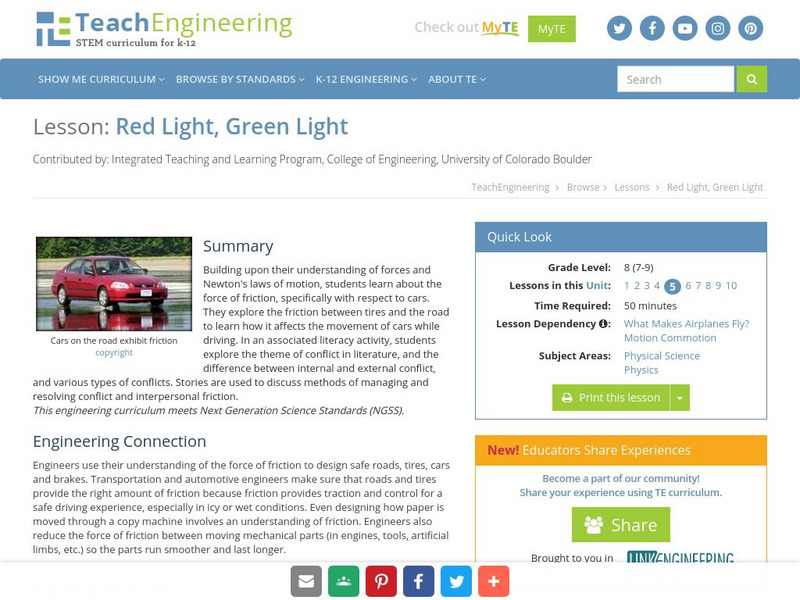
Teach Engineering: Red Light, Green Light
Building upon their understanding of forces and Newton's laws of motion, students learn about the force of friction, specifically with respect to cars. They explore the friction between tires and the road to learn how it affects the...
TryEngineering
Try Engineering: Tinkering With Tops
Lesson explores the history, design, and motion of spinning tops. Student teams design and build their own tops that can spin for at least 10 seconds within a circle 30 centimeters in diameter.
Texas Instruments
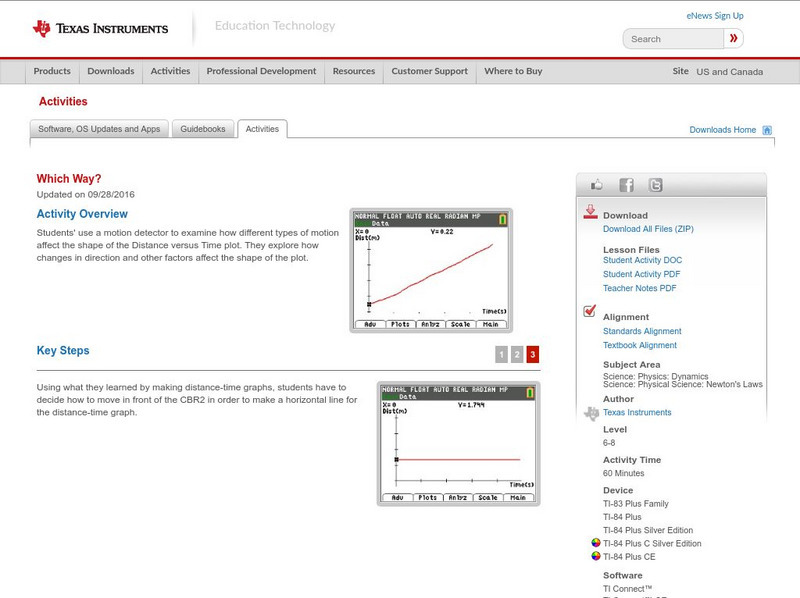
Texas Instruments: Which Way?
Students' use a motion detector to examine how different types of motion affect the shape of the distance versus time plot. They explore how changes in direction and other factors affect the shape of the plot.
Exploratorium
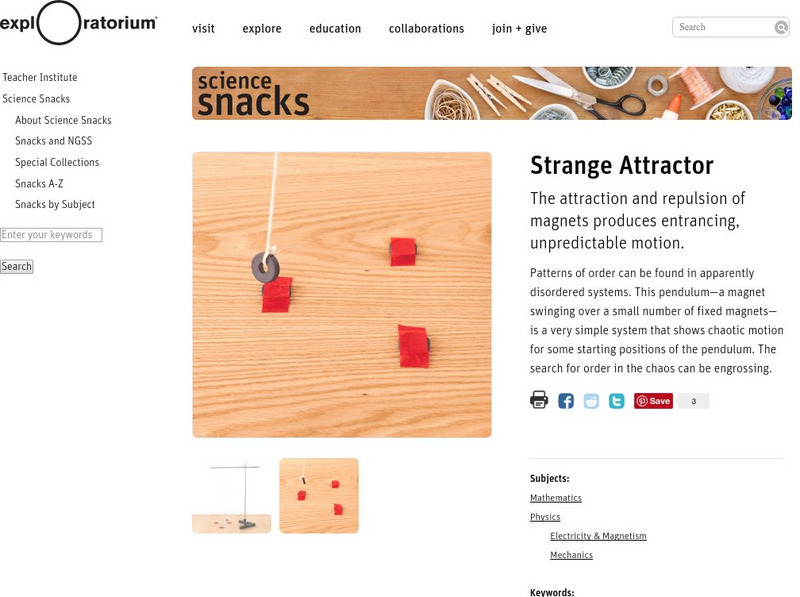
Exploratorium: Science Snacks: Strange Attractor
Explore the chaotic motion of a pendulum that is swinging above several magnets that are fixed in place and see what patterns you can find.
PBS
Pbs Learning Media: The Ruff Ruffman Show: Bottle Cap Hockey
Explore sports science and see how many points can you score with your bottle caps in Ruff's take on table hockey.
PBS
Pbs Learning Media: The Ruff Ruffman Show: Build It Up, Knock It Down
Explore structural science and compete in a building contest where each team builds a structure without using tape and then tries to knock the other one down using only paper.
PBS
Pbs Learning Media: The Ruff Ruffman Show: Tower Time
Explore structural science and try to stack a tall, stable tower in this building activity.
PBS
Pbs Learning Media: The Ruff Ruffman Show: Architecture Scavenger Hunt
Explore structural science and look for shapes around your school or in the buildings in your neighborhood.
Texas Instruments
Texas Instruments: Classroom Activities: Parachuting
This activity explores a parachutist and her position, velocity and acceleration. Graphing and calculating these functions will be required.
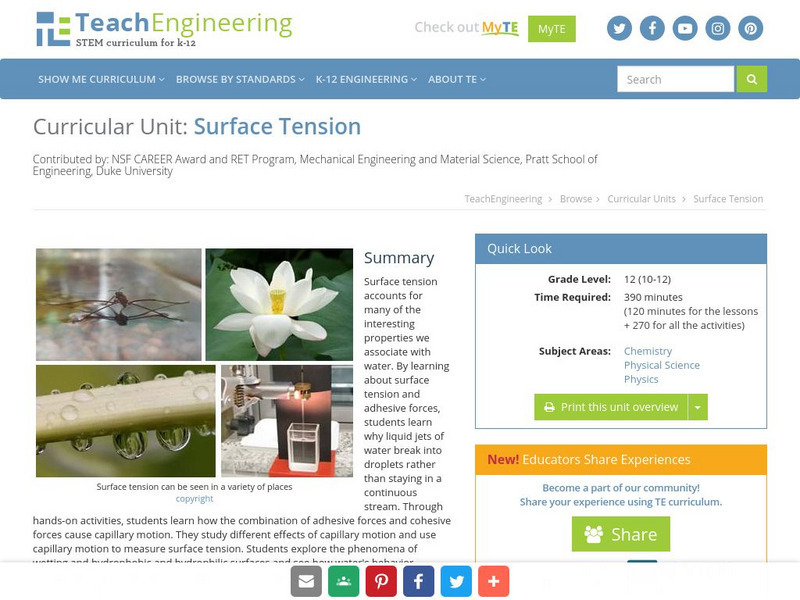
TeachEngineering
Teach Engineering: Surface Tension
Surface tension accounts for many of the interesting properties we associate with water. By learning about surface tension and adhesive forces, students learn why liquid jets of water break into droplets rather than staying in a...