Hi, what do you want to do?





Texas Instruments
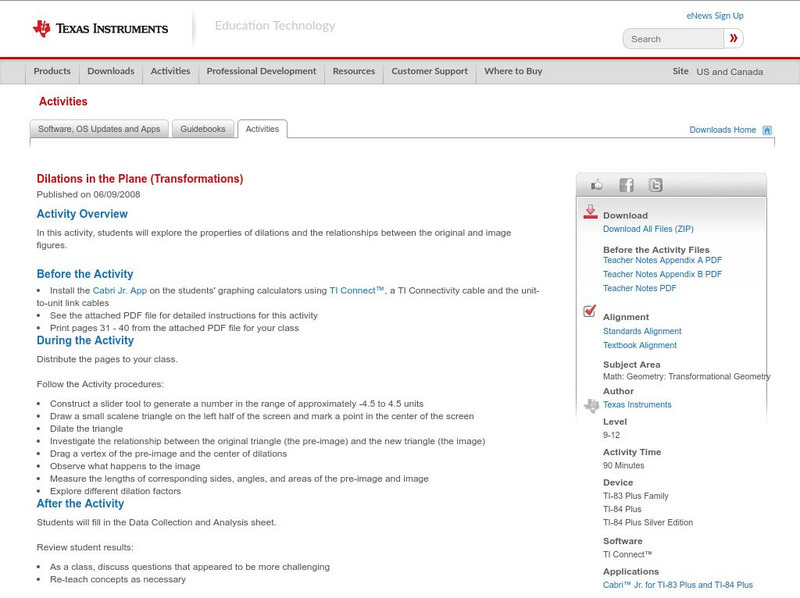
Texas Instruments: Dilations in the Plane (Transformations)
In this activity, students will explore the properties of dilations and the relationships between the original and image figures.
Texas Instruments
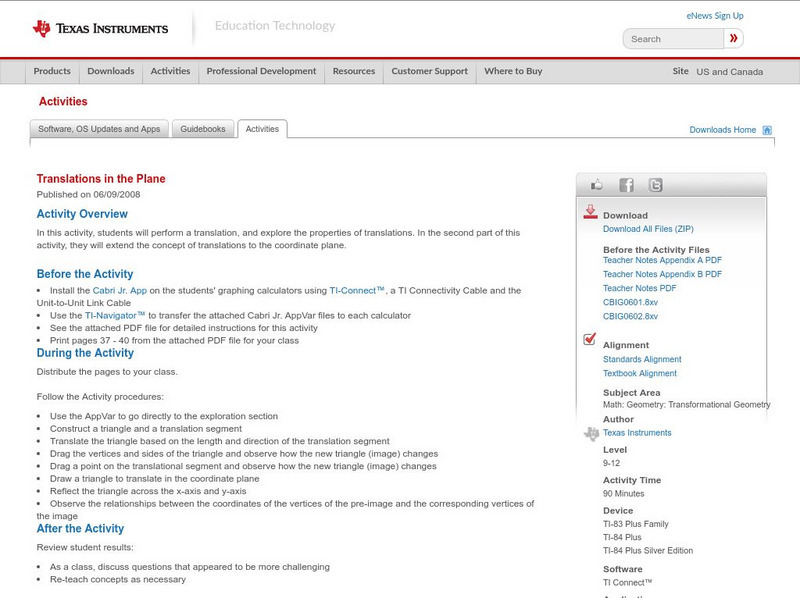
Texas Instruments: Translations in the Plane
In this activity, students will perform a translation, and explore the properties of translations. In the second part of this activity, they will extend the concept of translations to the coordinate plane.
Texas Instruments
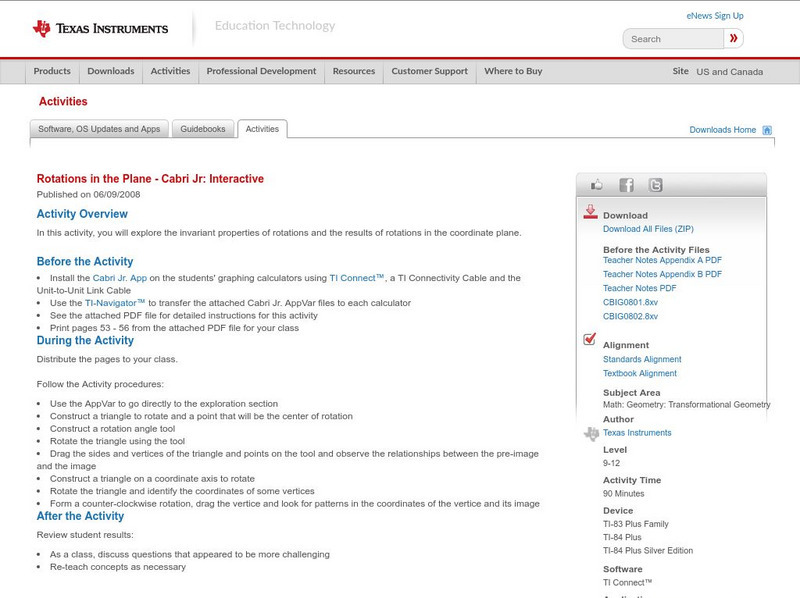
Texas Instruments: Rotations in the Plane Cabri Jr: Interactive
In this activity, you will explore the invariant properties of rotations and the results of rotations in the coordinate plane.

Texas Instruments
Texas Instruments: Exploring Taylor Series
In this Computer Algebra System (CAS) activity, students explore the Taylor's series. They investigate the approximation of numbers in sequences and series and find their interval of convergence using various methods.

Texas Instruments
Texas Instruments: Exploring the Vertex Form of the Quadratic Function
Students explore the vertex form of the parabola and discover how the vertex, direction, and width of the parabola can be determined by studying the parameters. They predict the location of the vertex of a parabola expressed in vertex form.

Texas Instruments
Texas Instruments: Exploring Transformations
The students will explore reflections of an object over the x-axis, y-axis, and origin.

Texas Instruments
Texas Instruments: Explore Transformations With Matrices
Students can use a graphing calculator to explore transformations with matrices. They will analyze how each element of the matrix affects the position of the image.
Texas Instruments
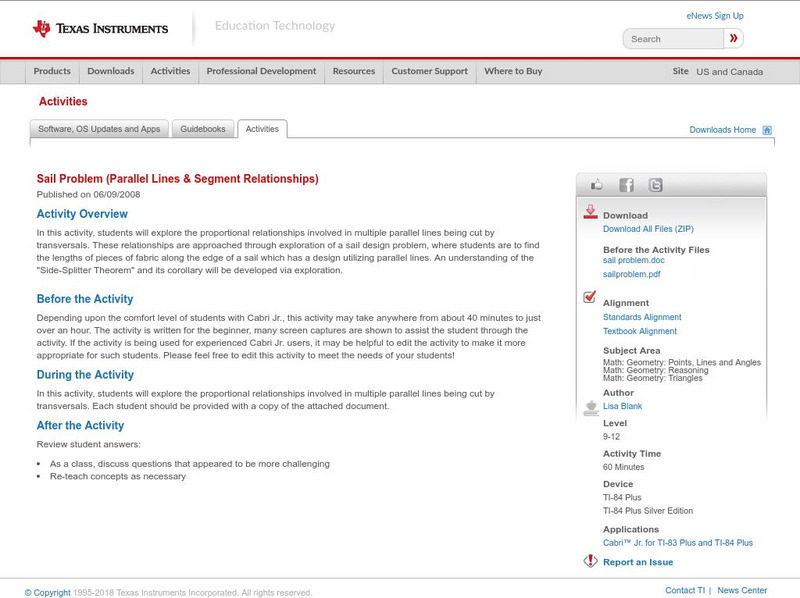
Texas Instruments: Sail Problem (Parallel Lines & Segment Relationships)
In this activity, students will explore the proportional relationships involved in multiple parallel lines being cut by transversals. These relationships are approached through exploration of a sail design problem, where students are to...

Texas Instruments
Texas Instruments: Exploring Functions With Cas
In this activity students use the CAS tool to explore sin, cos, and tan functions. They expand the functions and find the domain. They also prove the conjectures.
Texas Instruments
Texas Instruments: Exploring Linear Equations With Activity Center
Use the attached word document to guide your class exploration on linear equations and their graphs.
Texas Instruments
Texas Instruments: Glencoe Geometry: Cabri Jr.: Exploring Tangents
Students can use Cabri Jr. to explore some of the characteristics of tangents.

Texas Instruments
Texas Instruments: Getting Started With Ti Navigator: Exploring Linear Model
This lesson introduces students' to Activity Center. In this activity, students will explore data on Women's Olympic 400 Meter Freestyle Swimming records. Concepts of domain and range will be investigated in the context of this problem...
Texas Instruments
Texas Instruments: Exploring Standard Form of a Quadratic Function
Students explore y=ax^2+bx+c using the transform graphing application. Teacher calculator is used with Navigator to send device settings, the equation format and initial coefficient values to all students. Worksheet includes all student...
Texas Instruments
Texas Instruments: Exploring Circles
Explore the relationship between the center and radius of a circle and the equation of the circle. Collect data and determine regression equations related to various combinations of data, and use the regression equations to make...
Texas Instruments
Texas Instruments: Arcs and Angles: Explore Inscribed & Central Angle Properties
This activitie uses the power of Cabri Jr. to explore the relationship between inscribed angles and central anlges in cirles.

Texas Instruments
Texas Instruments: Exploring the Width of a Parabola
Use TI-Navigator to explore the width of a parabola. All directions are provided on the teacher's guide.
Texas Instruments
Texas Instruments: Exploring Polar Equations
In this activity, students will explore polar equations. They learn that by changing values a, b, and n, different polar curves can be generated.
Texas Instruments
Texas Instruments: Exploring Linear Equations
This activity uses the Transformation Graphing Application to explore the linear equation after entering data into lists and doing a statistical plot of the data.
Texas Instruments
Texas Instruments: Exploring the Pythagorean Theorem and Its Applications
Students discover the Pythagorean Theorem by exploring right triangles using Cabri Jr. They apply the Pythagorean Theorem to real-world problems. Also, students create a scatter plot of the data and find an equation that fits the data.

Texas Instruments
Texas Instruments: Exploring Slope Intercept Form of a Line
Use TI-Navigator to explore the relationship between a linear function and its graphs. See how the value of the slope and y-intercept affect the graphs.
Texas Instruments
Texas Instruments: Explore Parallel and Perpendicular Lines
Students can use a graphing calculator to explore graphs of parallel and perpendicular lines. Students will find that parallel lines have the same slope and different y-intercepts and that the slopes of two perpendicular lines are...
Texas Instruments
Texas Instruments: Exploring the Fundamental Theorem of Calculus
In this Derive activity, students investigate the Fundamental Theorem of Calculus and explore examples of Riemann Sums for approximating the Definite Integral: the Midpoint Sum, the Left Hand Endpoint Sum, the Right Hand Endpoint Sum,...
Texas Instruments
Texas Instruments: Getting Started With Probability Simulations App
Explore probability theory with interactive animation that simulates the rolling of dice, tossing of coins and generating random numbers. Evaluation options include bar graphs, table of trials data, settings for specifying the number of...

Texas Instruments
Texas Instruments: The Standard Form of a Quadratic Equation
In this activity, students explore the standard form of a quadratic equation, y = ax 2 + bx + c. They explore how the x-intercepts (zeros), y-intercept, and vertex are related to the graph of the standard form of a quadratic function.