Hi, what do you want to do?






Curated Video
GCSE Chemistry - What is a Limiting Reactant? Limiting/Excess Reactants Explained #27
Limiting and Excess Reactants Explained. Often, in chemical reactions there will be less of one reactant that the other - we call this one the limiting reactant because how much reaction can take place. Whereas the more abundant reactant...
Curated Video
Limiting vs Excess Reactants - what's the difference?
Do you know the difference between a limiting and excess reactant and how to identify them in a chemical reaction? These are important skills to mastering chemistry! In this video, we will show you the difference between limiting and...
Curated Video
Solving Limiting Reactant Practice Problems!
In this video we walkthrough 3 limiting reactant practice problems step by step and show you how to solve them!
Curated Video
Preparing Soluble Salts Using Insoluble Reactants
In this video, the presenter explains how to prepare soluble salts using insoluble reactants. They use the example of zinc oxide as the insoluble base and demonstrate the steps involved in reacting it with an acid to produce zinc...
Professor Dave Explains
Practice Problem: Limiting Reagent and Percent Yield
Once we get the hang of stoichiometric calculations, we get a curve ball. Limiting reagents? Not all of the reactants will react? We might not get as much product as we expect? Let's practice identifying the limiting reagent, calculating...
Curated Video
GCSE Chemistry - How to Find the Volume of a Gas #28
This video covers:
- How to calculate the volume of a gas using the equal: volume = moles
x 24
- How to find the volume of a product when you're told the volume of
a reactant
Exam
board specific info:
AQA -...
- How to calculate the volume of a gas using the equal: volume = moles
x 24
- How to find the volume of a product when you're told the volume of
a reactant
Exam
board specific info:
AQA -...
Curated Video
Striking a Balance : Investigating Reaction Rate and Stoichiometry
Influence of Stoichiometry on Rate of Reaction.<b<br/>r/>
Rate of Reaction & Stoichiometry part 1
Rate of Reaction & Stoichiometry part 1
Curated Video
Energy Change of Reactions
Some reactions take in energy and some release energy. Why? And what are some common examples of each type of reaction? Chemistry - Reactions - Learning Points. An energy change occurs when reactions take place. Exothermic reactions...
Professor Dave Explains
Limiting Regents and Percent Yield
Chemistry doesn't always work perfectly, silly. Molecules are left over when one thing runs out! Also we never get all of the products that we thought we might by doing the math. You gotta know about the limiting reagents and the percent...

JFR Science
Limiting and Excess Reagents
Sometimes things are just left over. An informative video in the JFR Science series highlights limiting and excess reactants in a chemical reaction. It explains the process of solving stoichiometry problems with limiting reactants.

Khan Academy
Khan Academy: Chemistry: Limiting Reactant Example Problem 1
A video lecture explaining how to solve a limiting reactant problem. The problem is solved in an easy to follow step-by-step process where each step is explained. Also learn how to distinguish between the limiting and excess reactant....
Sophia Learning
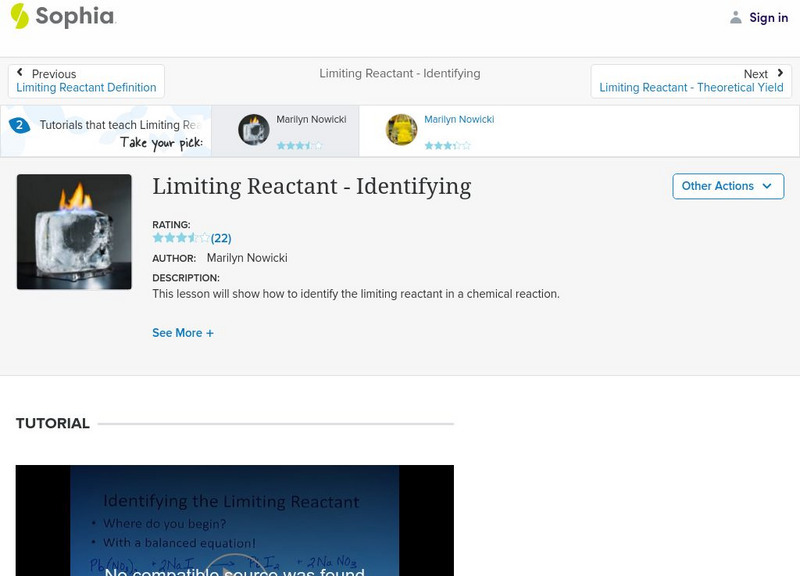
Sophia: Limiting Reactant Identifying: Lesson 2
This lesson will show how to identify the limiting reactant in a chemical reaction. It is 2 of 2 in the series titled "Limiting Reactant - Identifying."
Sophia Learning
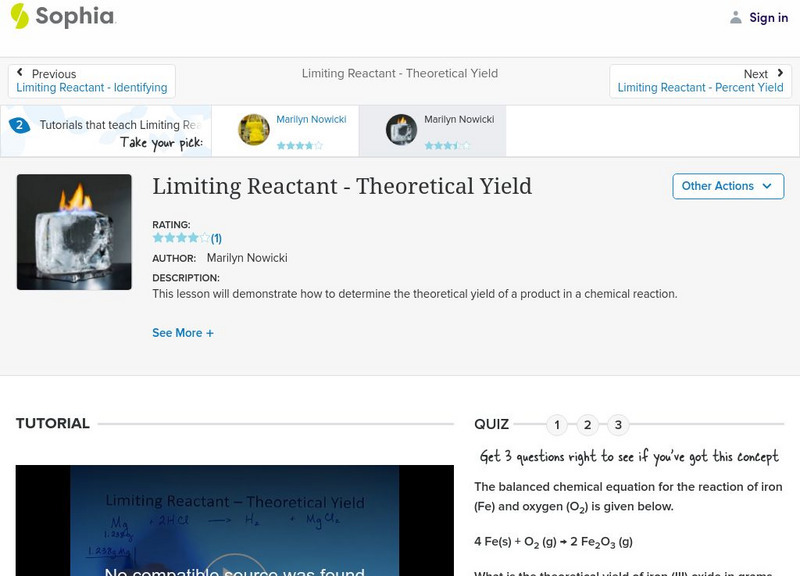
Sophia: Limiting Reactant Theoretical Yield: Lesson 2
This lesson will demonstrate how to determine the theoretical yield of a product in a chemical reaction. It is 2 of 2 in the series titled "Limiting Reactant - Theoretical Yield."