Hi, what do you want to do?






Curated OER
Small Group Acting: Enlivening Canadian History
Tenth graders role-play events in Canadian history. In small groups they develop a script, practice their skit, and perform a skit for the class depicting various events in Canadian history.

Curated OER
When is Humanitarian Intervention Justified?
Students analyze different foreign policies to derive their own idea of what constitutes appropriate intervention by a government. They complete a detailed proposal for their own Declaration of Human Rights.

Curated OER
Do We Have to Do This?
Young scholars conduct Internet research, and read articles about education to determine why particular educational practices are used, and why they are important in terms of No Child Left Behind. Students create PowerPoint presentations...

Curated OER
Changes in Pulse Rate
Eighth graders practice making observations and collecting data after determining a baseline pulse rate then collect data on the changes in that rate with exercise. Students must organize their data and analyze their observations.

Curated OER
Shrek
Students watch the movie Shrek and compose a text that displays an understanding of the film. Also, they create writing that reflects a critical analysis of content and a personal interpretation of the film's meaning.


Curated OER
How Are Boundaries Made, Kept, Broken?
Students write a first draft of an essay reflecting their opinions of Things Fall Apart. They complete their circle diagrams, have them approved by the teacher, and write their essays. They write in their dialectical journals as they...

Curated OER
Genetic Research: A Congressional Hearing
Students participate in a mock hearing of the U.S. Senate subcommittee on genetic research. They representing support groups for various genetic disorders present arguments for continued federal funding, while subcommittee members are...

Curated OER
Graphing With RXTE
Students use data from the Rossi X-ray Tiiming Explorer (RXTE) satellite to analyze and graph.

Curated OER
Observation
Students practice observation skills by discussing physical attributes of family artifacts. They determine what characteristics of an object are considered important details.

Curated OER
Interviewing A Parent
Students conduct an interview with a family member to research their family history. They prepare a list of questions, conduct the interview, and determine which house to visit for an artifact search.

Curated OER
Stewardship Letter
Students write a persuasive letter. In this stewardship lesson, students discover the basic format for a formal letter and some effective persuasive techniques. Students write a letter to bring about change in the way...

Curated OER
CURRENT AND CLIMATE
Students study currents and how they have been used to plot courses for travel. They examine the ocean currents in both the Atlantic and Pacific and discuss their effect on local weather.

Curated OER
Get Physical
Fourth graders research a physical exercise using primary source information. They analyze the information and write a report that validates, rejects, or qualifies the information.

Curated OER
Planning a Tourist Resort
Students work in teams of 2 to complete the presentation portion of the assignment. They may be required to work alone or may work with their partner to complete the "Board Member's Responses."

Curated OER
Neighborhood Rubrics
Students use a rubric to analyze their neighborhood and write a persuasive essay about changes that should be made. In this writing lesson, students use a rubric to grade their neighborhood and brainstorm improvements. Students write a...

Curated OER
Post-Nuclear War Survival
Learners use critical thinking and discussion to solve a problempresented in a hypothetical dilemma.

Curated OER
Designing "Green" to Save Our Green Planet
Students design an environmentally friendly home. In this middle school math/science lesson, students watch videos on creating green design. Students work in collaborative groups to determine what makes a house green and to...

Curated OER
Non-Violence Means "Doing Nothing"
Students reflect on violence and non-violence. In this World History lesson, students read an article by Gandhi then write an essay as to whether they agree or disagree with his thoughts. Students then share all their ideas...

Curated OER
How Are Boundaries Made, Kept, Broken?
Students complete essays reflecting themes in Things Fall Apart. They use Microsoft Word to revise, edit, and complete their essays. They complete their dialectical journals for Things Fall Apart.
Texas Education Agency
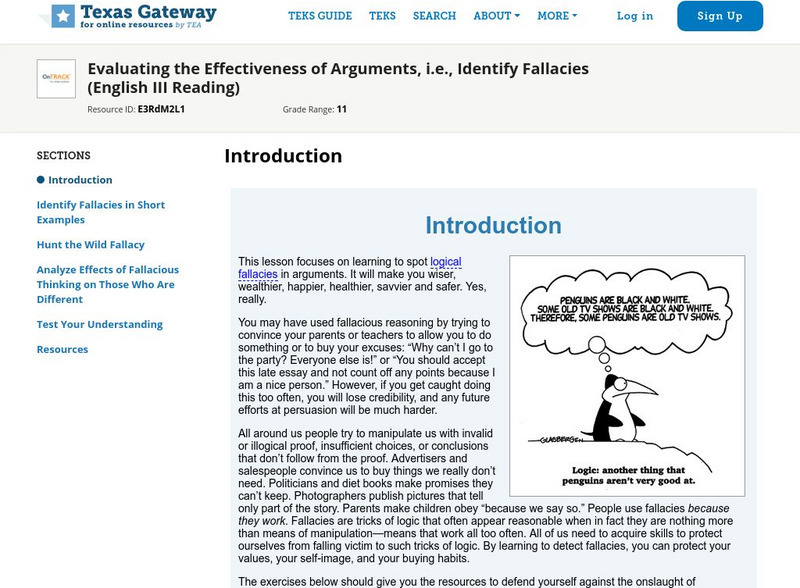
Texas Gateway: Evaluating the Effectiveness of Arguments: Identify Fallacies
This lesson focuses on learning to spot logical fallacies in arguments. All of us need to acquire skills to protect ourselves from falling victim to tricks of logic. By learning to detect fallacies, you can protect your values, your...
University of Sydney (Australia)
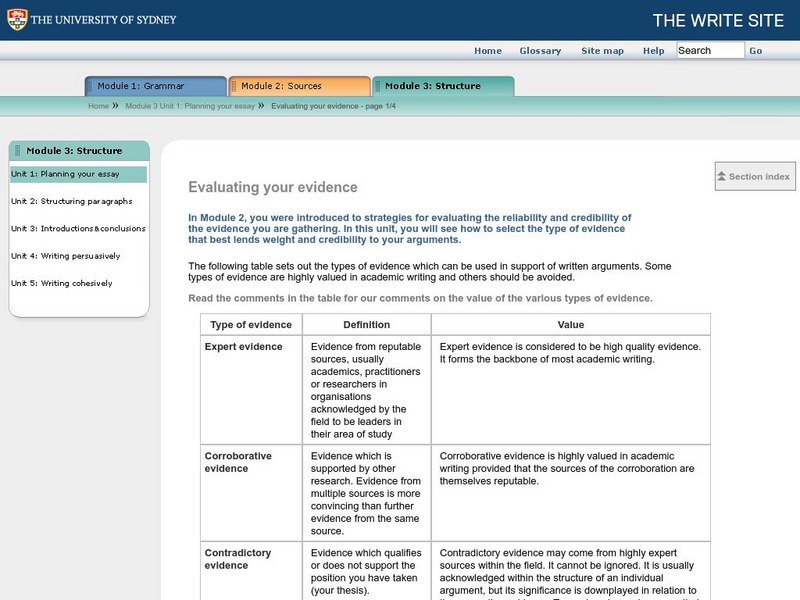
University of Sydney: The Write Site: Evaluating Your Evidence
This essay resource teaches students how to select the type of evidence that best lends weight and credibility to their topics and how to organize the evidence effectively. A chart is provided as a quick reference. Click on pages 2-4 at...
National Endowment for the Humanities
Neh: Edsit Ement: Introducing the Essay: Twain, Douglass and American Non Fiction
This lesson plan serves as an introduction to American literary non-fiction writing and focuses primarily on teaching some basic approaches to recognizing rhetorical strategies adopted for persuasive effect in essays and non-fiction. The...
Lumen Learning
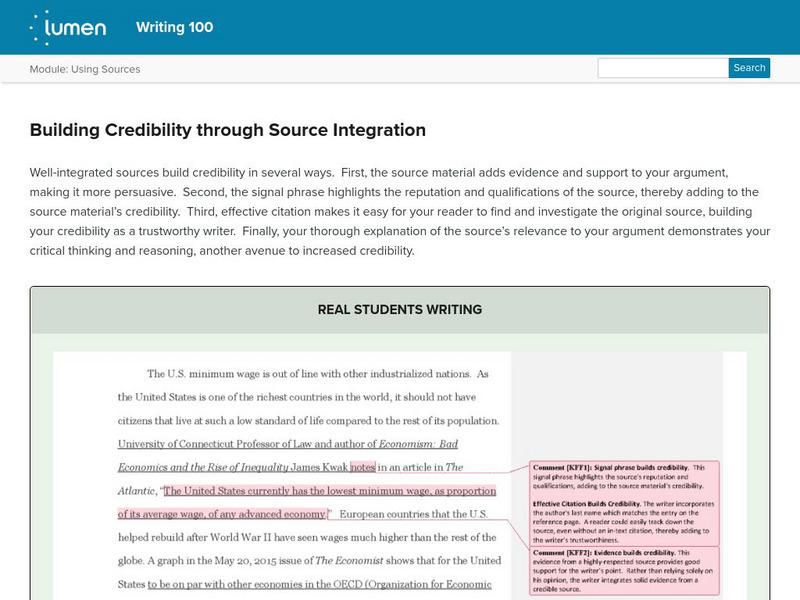
Lumen: Building Credibility Through Source Integration
Well-integrated sources build credibility in several ways: Source material adds evidence and support to your argument, the signal phrase highlights the reputation and qualifications of the source, and effective citation makes it easy for...