Hi, what do you want to do?






Curated OER
Exploring Scientists/Presentation
Students research a scientist of their choice. They write a research paper on him or her. They select ten important facts from their research paper and prepare a PowerPoint presentation using their facts.

Curated OER
Taking Apart Electrical Appliances
Students discover that electrical appliances are made up of individual components that work together. They, with partners, demonstrate to others how their piece of equipment or appliance works by taking it apart and examining the parts.

Curated OER
Wire Maze
Students investigate what causes electrical circuits to work. They construct a wire circuit and pass a paperclip through the maze, trying not to touch the wire, and answer discussion questions.

Curated OER
Growing Crystals
Young scholars explore the different types, visual appearance and creation of crystals. They grow an edible crystal - rock candy.

Curated OER
Interactions of Science and Technologies
Students explore how science and technology interact. They discuss important inventions, discoveries and technologies. They research a specific technological advance, or invention, and prepare a presentation that includes the...

Curated OER
Getting it Right!
Students investigate error. As shown in earlier activities from navigation lessons 1 through 3, without an understanding of how errors can affect position, one cannot navigate well. Students explore how computers can help in navigation....

Curated OER
Creating an Electronic Resume for a Job Search
Students develop an appropriate resume for posting on a website for a job search. They create a web page using filamentality, and explore the web to find established career sites.

Curated OER
Propellers, Forces and Energy
Students construct a model airplane, measure distance, and calculate velocity. In this creative lesson students work in groups to build a model and use it to calculate distances and velocity.

Curated OER
WebQuest on Chester Himes
Students perform a WebQuest to find out why Chester Hime's detective books were so popular. Small groups perform the research together then report to the class.

Curated OER
WebQuest on 1940/1950 Harlem
Students perform a WebQuest to fin out why Harlem was an attractive place for African Americans to live. Small groups perform the research together, and report to the class.

Curated OER
Space Program Spin-Offs
Students brainstorm types of accommodations needed for space travel. They create a table of categories for these accommodations and work in groups to research the categories. Each group puts together a five minute presentation to present...

Curated OER
Interpreting Political Cartoons
Students review political cartoons and discuss what political impact they can have. They choose a current political cartoon and write an essay exploring its intent and impact.

Curated OER
Famous Person Report - Computer Applications
High schoolers choose famous person to research online, use at least two different sources to find information, prepare rough drafts and document sources, meet in groups for peer feedback, review with teacher, and turn in final report.

Curated OER
Generators: Three Mile Island vs. Hoover Dam
Students are given a history of electricity and its development into the modern age lifeline upon which we so depend. The methods of power generation are introduced, and further discussion of each technology's pros and cons follows. ...

Curated OER
Sensor Challenge
Students develop a pseudo code flowchart for their robotic program. In this physics instructional activity, students construct a robot that can navigate through certain obstacles. They test their robot and present them to class.

Curated OER
Thrust to Weight Ratio
Students, after reading the Web page Thrust to Weight Ratio, use Range Games and the Air Page to complete the activity to answer questions about turbojet thrust to weight ratio.

TeachEngineering
Teach Engineering: Teaching the Engineering Design Process
Students follow the steps of the engineering design process (EDP) while learning about assistive devices and biomedical engineering. They first go through a design-build-test activity to learn the steps of the cyclical engineering design...
TeachEngineering
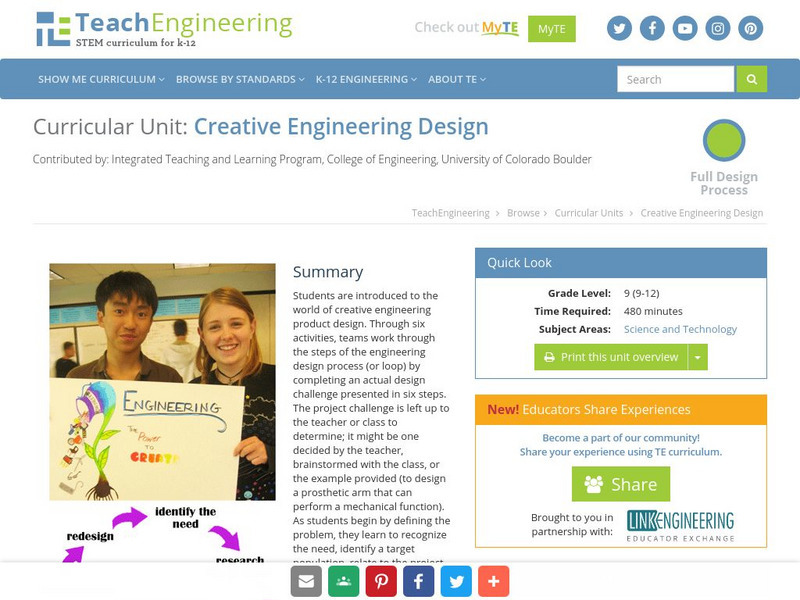
Teach Engineering: Creative Engineering Design
Students are introduced to the world of creative engineering product design. Through six activities, teams work through the steps of the engineering design process (or loop) by completing an actual design challenge presented in six...
TeachEngineering
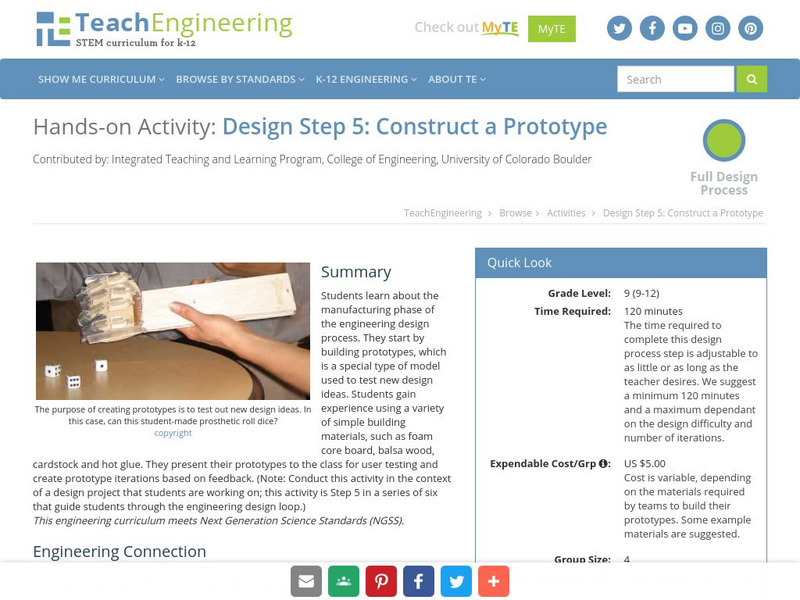
Teach Engineering: Design Steps 5 and 6: Create and Test a Prototype
Students learn about the importance of creating and testing prototypes during the engineering design process. They start by building prototypes, which is a special type of model used to test new design ideas. Students gain experience...
TeachEngineering
Teach Engineering: Problem Solve Your School
Students apply what they have learned about the engineering design process to a real-life problem that affects them and/or their school. They chose a problem as a group, and then follow the engineering design process to come up with and...
TeachEngineering
Teach Engineering: Hot Problem Solving
Student teams follow the steps of the engineering design process to meet the challenge of getting their entire class from one location on the playground to the sidewalk without touching the ground between. The class develops a well...

Utah State University
Utah State University: Optimization, an Important Stage of Engineering Design
Teaching middle and high school students how to weigh constraints and criteria against various design solutions in order to select the best possible solution is an important skill necessary for engineering, as well as for life. The...
TeachEngineering
Teach Engineering: Design Step 3: Brainstorm Possible Solutions
Brainstorming is a team creativity activity that helps generate a large number of potential solutions to a problem. In this activity, students participate in a group brainstorming activity to generate possible solutions to their...
TeachEngineering
Teach Engineering: Design Step 7: Improve and Redesign/manufacture a Product
As students learn more about the manufacturing process, they use what they learned from testing their designs in the previous activity to continue to improve and redesign. Students also have the opportunity to manufacture their final...