Hi, what do you want to do?





TeachEngineering
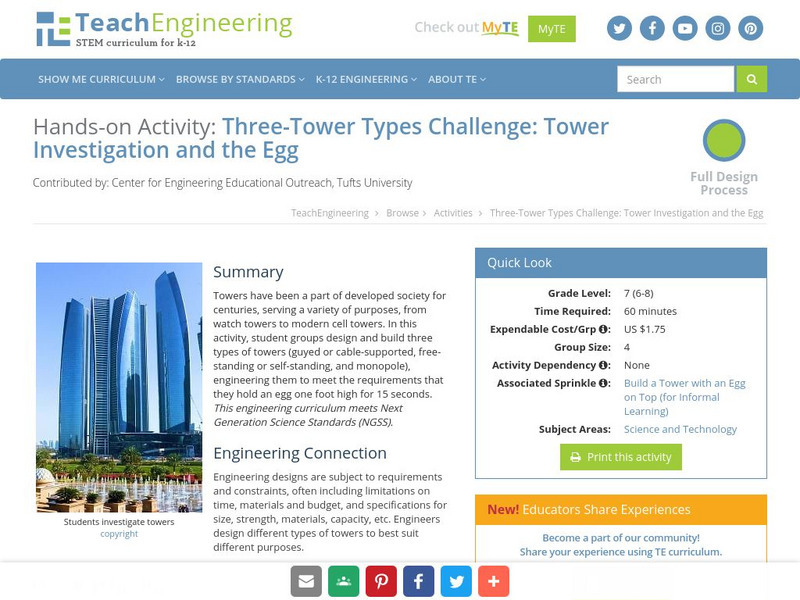
Teach Engineering: Tower Investigation and the Egg
Towers have been a part of developed society for centuries. Towers serve a variety of purposes, from lookouts to cellular towers. In this activity student groups will build three types of towers, engineering them to hold an egg one foot...

TryEngineering
Try Engineering: Chair Lift Challenge
Lesson investigates how engineers develop safe transportation systems to operate in a variety of climates and environments. Teams of students work together to construct a "chair lift" made from everyday materials as a test of this...
TeachEngineering
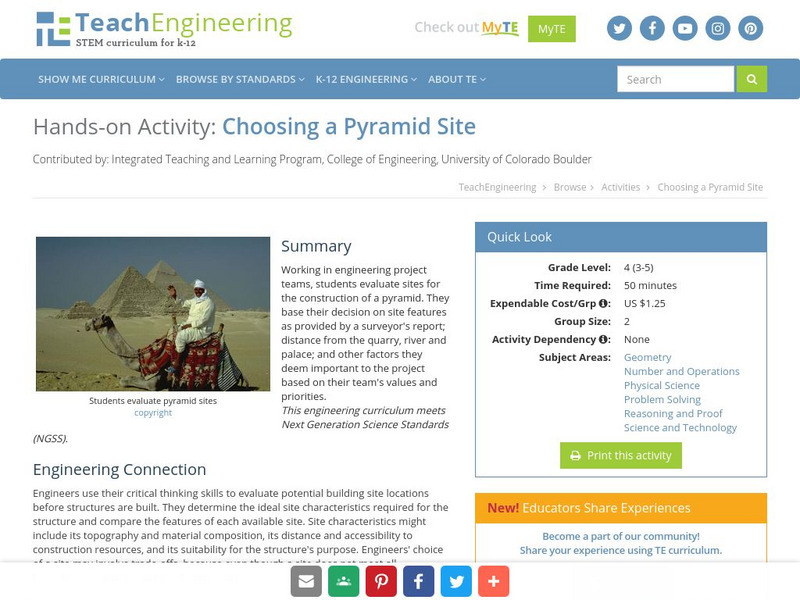
Teach Engineering: Choosing a Pyramid Site
Working in engineering project teams, students evaluate sites for the construction of a pyramid. They base their decision on site features as provided by a surveyor's report; distance from the quarry, river and palace; and other factors...
TeachEngineering
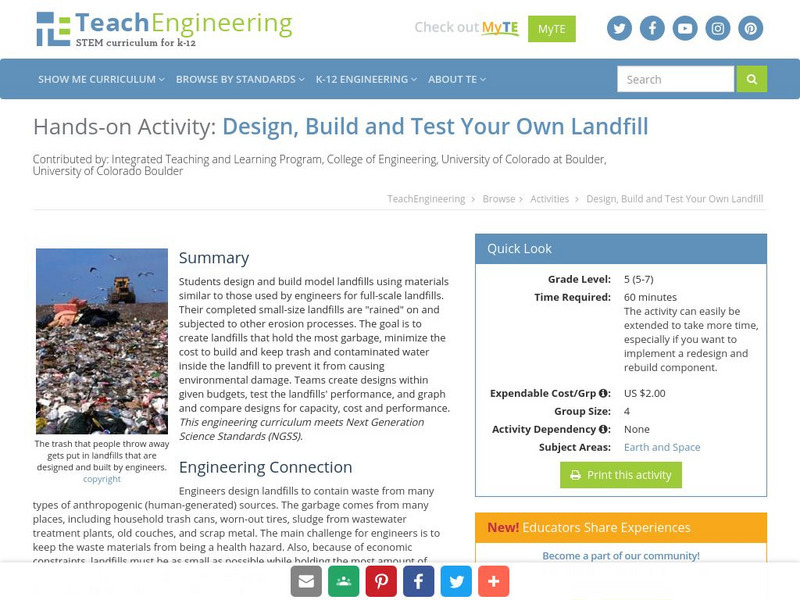
Teach Engineering: Design, Build and Test Your Own Landfill
Students design and build model landfills using materials similar to those used by engineers for full-scale landfills. Their completed small-size landfills are "rained" on and subjected to other erosion processes. The goal is to create...
Other
National Engineers Week Foundation: Flinker
Students investigate with common objects to see if they can make something that neither floats nor sinks, but rather "flinks" in the middle.
Other
Uss Constitution Museum: Design a Figurehead
This USS Constitution Museum resource is a lesson plan that calls for learners to work together in teams to create a new figurehead for the USS Constitution that was destroyed while on patrol.
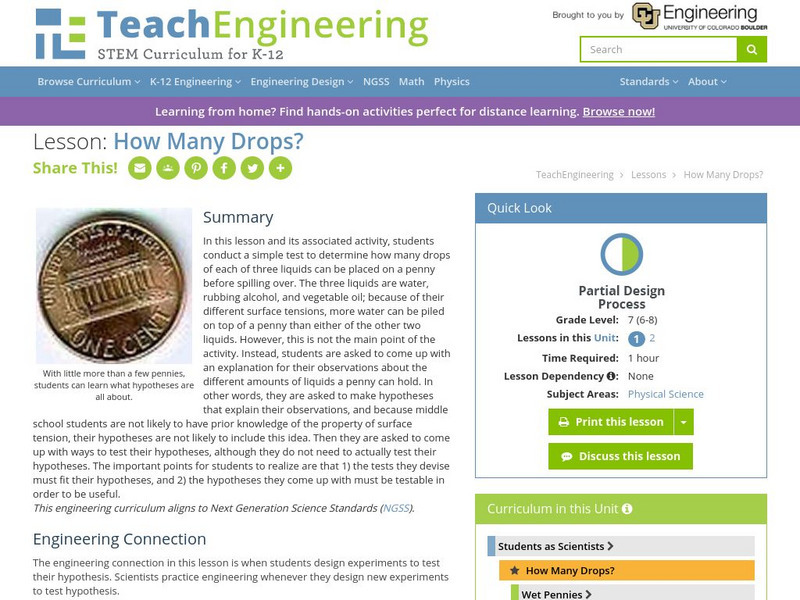
TeachEngineering
Teach Engineering: How Many Drops?
In this lesson and its associated activity, middle schoolers conduct a simple test to determine how many drops of each of three liquids can be placed on a penny before spilling over. The three liquids are water, rubbing alcohol, and...
TeachEngineering
Teach Engineering: What to Bring?
In this activity, students are provided with a list of supplies that survived their plane's crash in the Amazon jungle. They will organize the supplies to classify which items are useful for surviving in the Amazon. Students will use...
TeachEngineering
Teach Engineering: Built to Last?
In this activity, the students test the shelters they built in Lesson 3, Activity 1 for durability and water resistance.
TeachEngineering
Teach Engineering: Finding Food in the Amazon
In this activity, the students will investigate a variety of plants and animals common to the Amazon through research. They will determine the plant or animal characteristics that make them edible or useful for the trip and learn to...
TeachEngineering
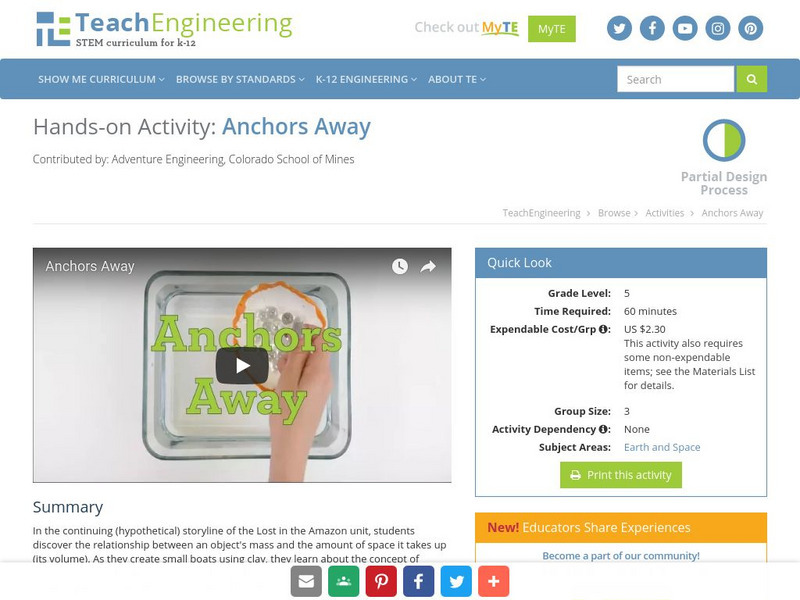
Teach Engineering: Anchors Away
In this activity, the students will discover the relationship between an object's mass and the amount of space it takes up (its volume). The students will learn about the concept of displacement and how an object can float if it...
TeachEngineering
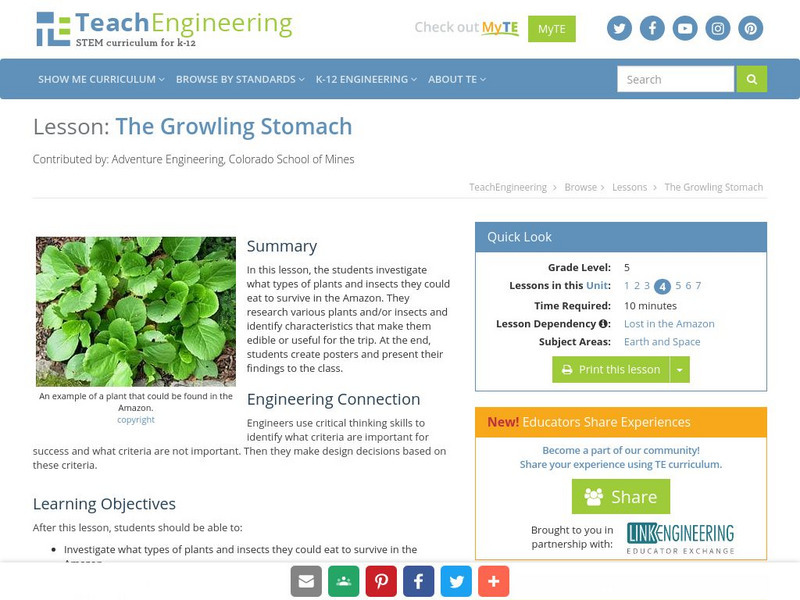
Teach Engineering: The Growling Stomach
In this lesson, the students will investigate what types of plants and insects they could eat to survive in the Amazon. They will research various plants and/or insects and identify characteristics that make them edible or useful for the...
Other
National Renewable Energy Laboratory: Junior Solar Car Competition
A design challenge through which students design and construct a solar-powered model car to compete in a road race. Students work in teams using the engineering design process to select the optimal gear ratio and components.

Exploratorium
Exploratorium: Science Snacks: Marshmallow Puff Tube
An engineering design process project where you will try different lengths of cardboard tubes to see how far you can blow a marshmallow. Project uses Newton's principles of unbalanced force to shoot the marshmallow far.
Center for Innovation in Engineering and Science Education, Stevens Institute of Technology
Ciese: Square of Life: Ant Day Care Center
For this instructional activity, learners use the engineering design process to create a home for ants where they can be observed for one day.

Exploratorium
Exploratorium: Science Snacks: Coffee Can Cuica
In this activity students will use the engineering design process to make a musical instrument called a cuica. This musical instrument uses "stick-and-slip" vibrations to make the sound.

Exploratorium
Exploratorium: Science Snacks: Falling Rhythm
An engineering design process project for students to create a regular rhythm of beats by spacing weights along a string and then dropping the string.
Center for Innovation in Engineering and Science Education, Stevens Institute of Technology
Ciese: Wonderful World of Weather: Whichever Way the Wind Blows
Young scholars use the Engineering Design Process to create a windosck that can determine which way the wind is blowing.
PBS
Pbs Learning Media: The Ruff Ruffman Show: Hamster Run
Use the engineering design process to build, test, and redesign structures to help the hamsters reach their food.
TryEngineering
Try Engineering: Pollution Patrol
Learners will work in teams to design and construct outdoor air pollution detectors from everyday items. They will then test the designs for presence of pollutants in the air and communicate their results to the class.
The Tech Interactive
The Tech Museum of Innovation: Escape the Lava [Pdf]
In this engineering challenge, students will design devices to help "Justin Case" escape lava by using items in their backpacks to get Justin from one tree to another. Students will use the knowledge they gain from this engineering...
Other
Ontario Council for Technology Education: Food Truck Project [Pdf]
By the end of this project, the student will demonstrate an understanding of the fundamental concepts and skills required in the planning and development of a product or service, such as a food truck, including the use of design process...
Science Buddies
Science Buddies: Balloon Car
Students will design, build, and race balloon-powered cars in this fun lesson that teaches about engineering design and kinetic and potential energy.
University Corporation for Atmospheric Research
Ucar: Planning a Disaster Relief Mission: Storyboarding
Students plan a disaster relief mission employing a UAV (drone) by filling in a comic book-like storyboard of engineering design steps.