Hi, what do you want to do?





TeachEngineering
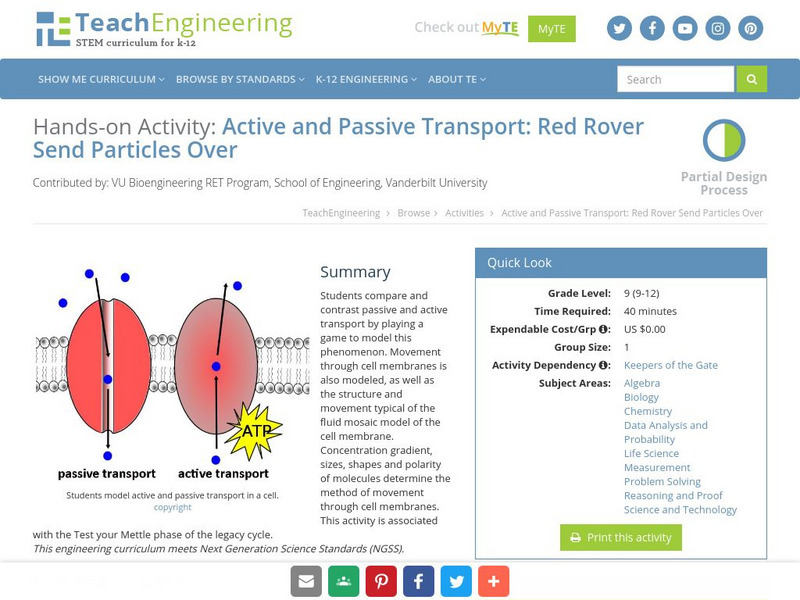
Teach Engineering: Active and Passive Transport: Red Rover Send Particles Over
Students compare and contrast passive and active transport by playing a game to model this phenomenon. Movement through cell membranes is also modeled, as well as the structure and movement typical of the fluid mosaic model of the cell...

PBS
Pbs Learning Media: Early Engineering With Ready Jet Go!: Pbs Kids Self Paced Learning
With real-life materials and exciting tools to touch and explore, engineering activities are a natural draw for many young children. In this professional development experience with Ready, Jet, Go!, we'll look at teacher practices for...
Other
Playdough to Plato: First Grade Stem Activities
This blog contains challenging STEM activities you can use to build confidence and take your teaching to the next level. Included are science, math, technology, and engineering activities.
TeachEngineering
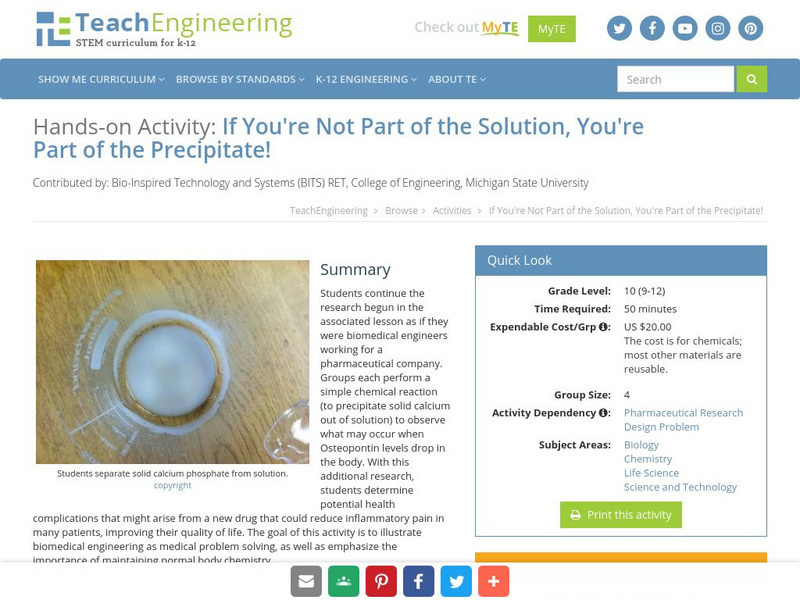
Teach Engineering: If You're Not Part of the Solution!
Students continue the research begun in the associated lesson as if they were biomedical engineers working for a pharmaceutical company. Groups each perform a simple chemical reaction (to precipitate solid calcium out of solution) to...
TeachEngineering
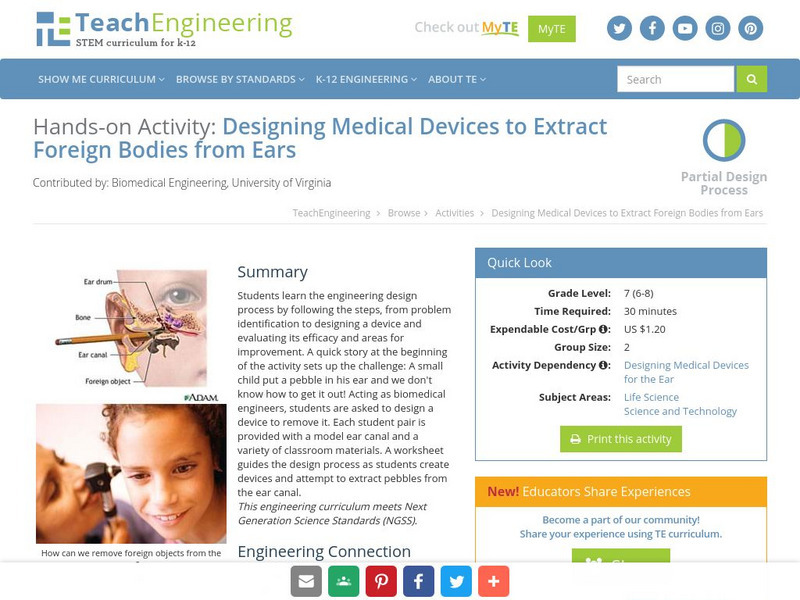
Teach Engineering: Designing a Medical Device
Students learn the engineering design process by following the steps, from problem identification to designing a device and evaluating its efficacy and areas for improvement. A quick story at the beginning of the activity sets up the...
Other
Lincoln Public Schools: Applied Technology & Engineering: Mousetrap Car It's a Snap! [Pdf]
This is an engineering activity that requires students to build a mousetrap car based on certain constraints. Constraints include students having a virtual budget that they use to buy approved parts for their car, the car having...
TeachEngineering
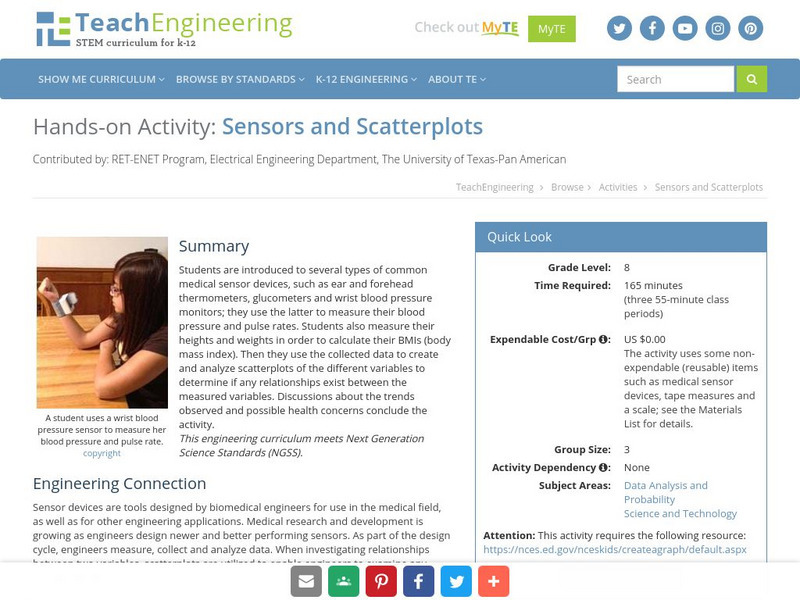
Teach Engineering: Sensors and Scatterplots
Students explore the use of several biomedical engineering sensor devices, and then use the collected data to create and analyze scatterplots of the different variables to determine if any relationships exist between the measured...
TeachEngineering
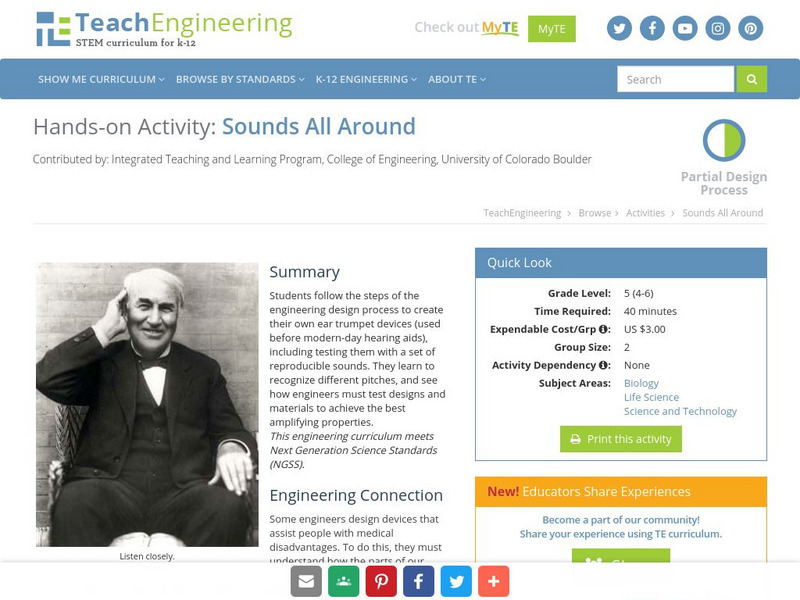
Teach Engineering: Sounds All Around
Students follow the steps of the engineering design process to create their own ear trumpet devices (used before modern-day hearing aids), including testing them with a set of reproducible sounds. They learn to recognize different...
TeachEngineering
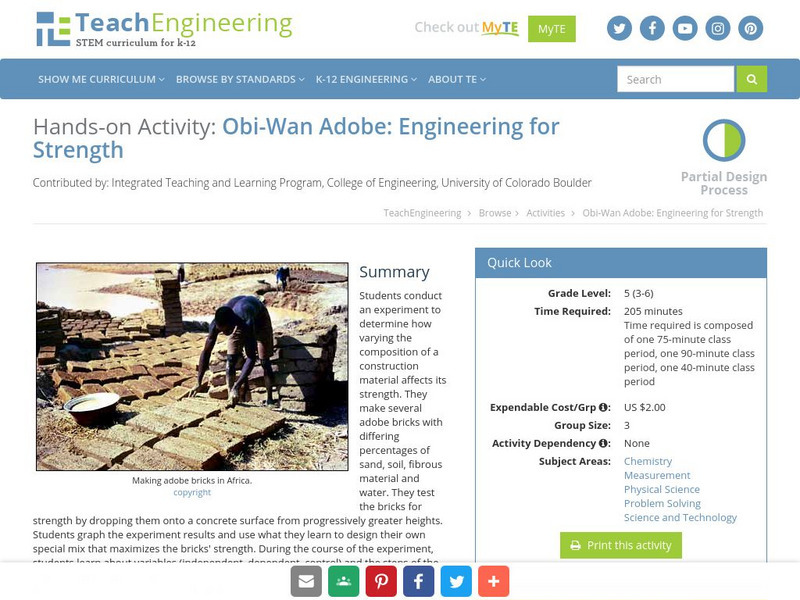
Teach Engineering: Obi Wan Adobe: Engineering for Strength
Students conduct an experiment to determine how varying the composition of a construction material affects its strength. They make several adobe bricks with differing percentages of sand, soil, fibrous material and water. They test the...
TeachEngineering
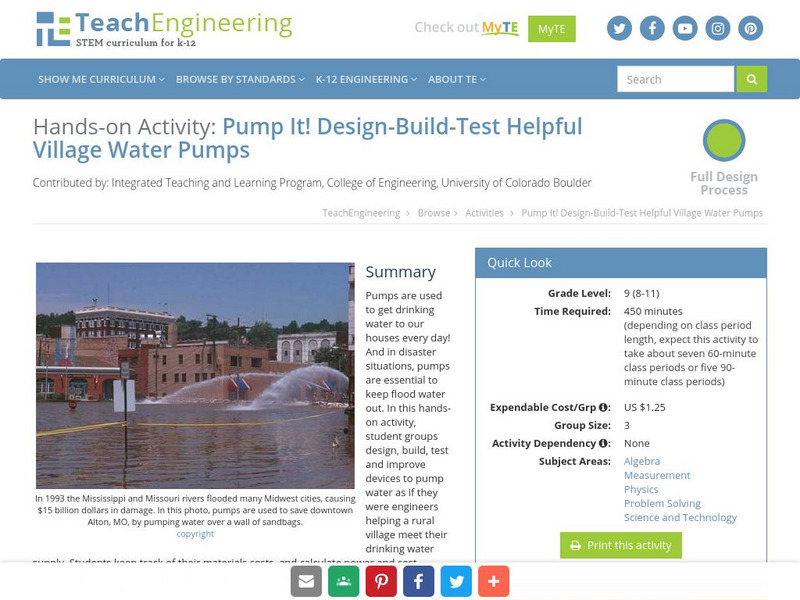
Teach Engineering: Pump It!
Pumps are used to get drinking water to our houses every day! And in disaster situations, pumps are essential to keep flood water out. In this hands-on activity, student groups design, build, test and improve devices to pump water as if...
TeachEngineering
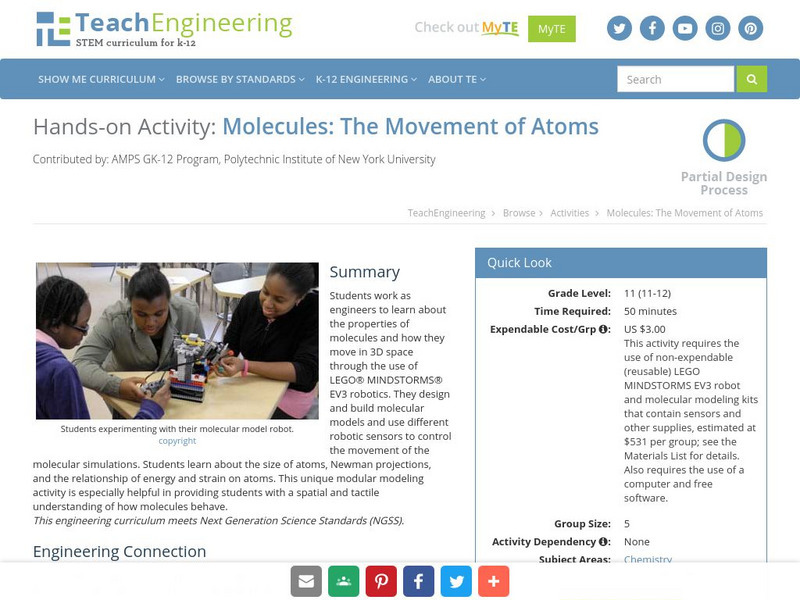
Teach Engineering: Molecules: The Movement of Atoms
Students work as engineers to learn about the properties of molecules and how they move in 3D space through the use of LEGO MINDSTORMS NXT robotics. They design and build molecular models and use different robotic sensors to control the...
TeachEngineering
Teach Engineering: Graphing Your Social Network
Students analyze their social networks using graph theory. They gather data on their own social relationships, either from Facebook interactions or the interactions they have throughout the course of a day, recording it in Microsoft...
TeachEngineering
Teach Engineering: Light Intensity Lab
Students complete this Beer's Law activity in class. Students examine the attenuation of various thicknesses of transparencies. From this activity, students will understand that different substances absorb light differently. This can...
TeachEngineering
Teach Engineering: Off Road Wheelchair Challenge
Students further their understanding of the engineering design process (EDP) while being introduced to assistive technology devices and biomedical engineering. They are given a fictional client statement and are tasked to follow the...
TeachEngineering
Teach Engineering: Built to Last?
In this activity, the students test the shelters they built in Lesson 3, Activity 1 for durability and water resistance.
TeachEngineering
Teach Engineering: Taking the Boat to Manaus
In this activity, the students will apply the concepts they learned regarding mass, volume and density in the previous activities to design a boat.
TeachEngineering
Teach Engineering: Sticks and Stones Will Break That Bone!
Students learn about the strength of bones and methods of helping to mend fractured bones. During a class demonstration, a chicken bone is broken by applying a load until it reaches a point of failure (fracture). Then, working as...
TeachEngineering
Teach Engineering: In and Out Reactor
Students learn about material balances, a fundamental concept of chemical engineering. They use stoichiometry to predict the mass of carbon dioxide that escapes after reacting measured quantities of sodium bicarbonate with dilute acetic...
TeachEngineering
Teach Engineering: Keep It Moving! From Electrons to Electric Motors
Students act as engineers to apply what they know about how circuits work in electrical/motorized devices to design their own battery-operated model motor vehicles with specific paramaters. They calculate the work done by the vehicles...
TeachEngineering
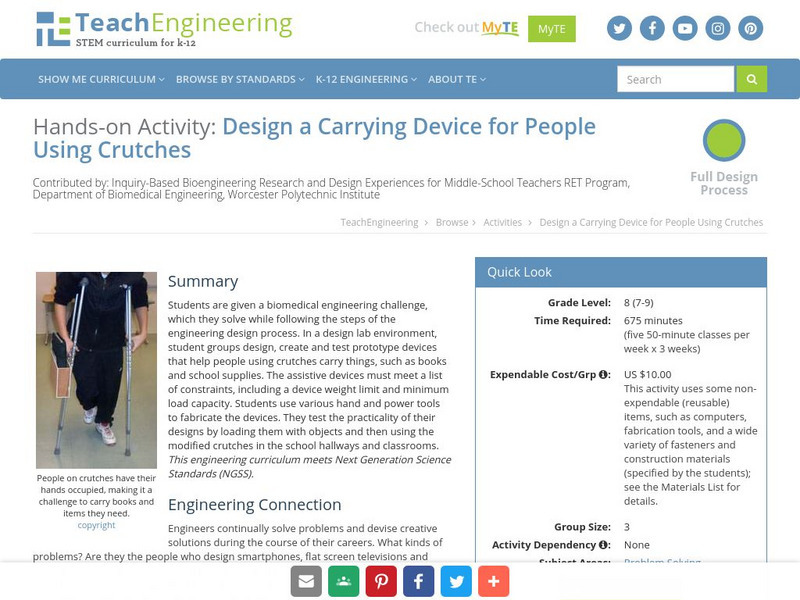
Teach Engineering: Design a Carrying Device for People Using Crutches
Students are given a biomedical engineering challenge, which they solve while following the steps of the engineering design process. In a design lab environment, student groups design, create, and test prototype devices that help people...
TeachEngineering
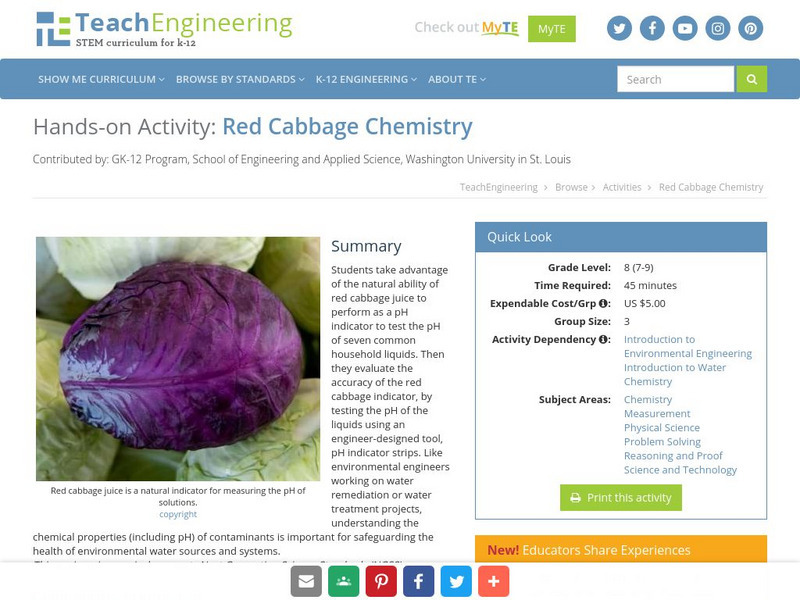
Teach Engineering: Red Cabbage Chemistry
Students take advantage of the natural ability of red cabbage juice to perform as a pH indicator to test the pH of seven common household liquids. Then they evaluate the accuracy of the red cabbage indicator, by testing the pH of the...
TeachEngineering
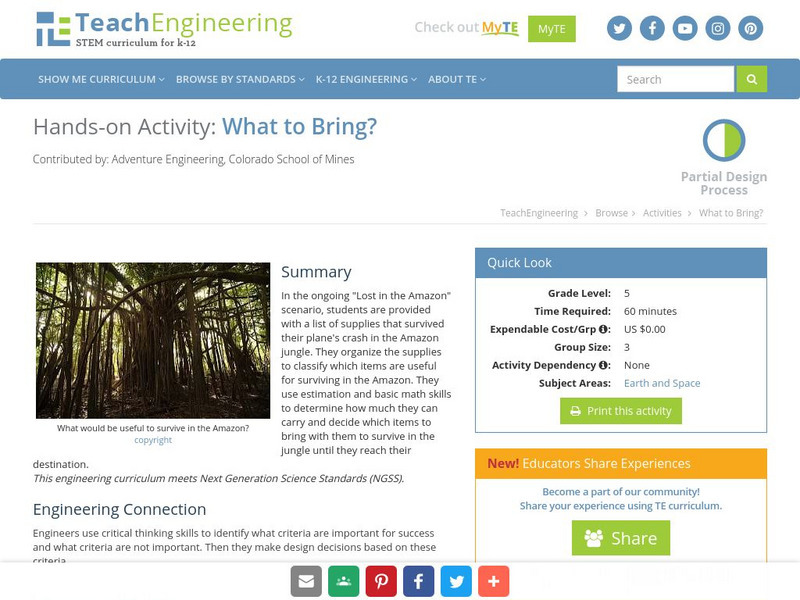
Teach Engineering: What to Bring?
In this activity, students are provided with a list of supplies that survived their plane's crash in the Amazon jungle. They will organize the supplies to classify which items are useful for surviving in the Amazon. Students will use...
TeachEngineering
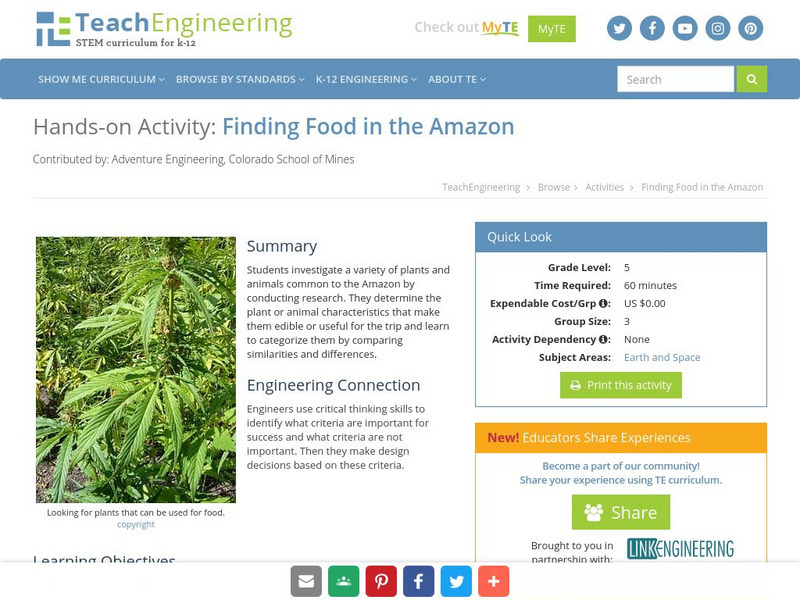
Teach Engineering: Finding Food in the Amazon
In this activity, the students will investigate a variety of plants and animals common to the Amazon through research. They will determine the plant or animal characteristics that make them edible or useful for the trip and learn to...
TeachEngineering
Teach Engineering: Anchors Away
In this activity, the students will discover the relationship between an object's mass and the amount of space it takes up (its volume). The students will learn about the concept of displacement and how an object can float if it...