Hi, what do you want to do?






TED-Ed
TED-Ed: The physics of surfing - Nick Pizzo
Wondering how you can catch the perfect wave? Dive into the fascinating and complex physics of surfing. -- Whether or not you realize it, surfers are masters of complicated physics. The science of surfing begins as soon as a board...
FuseSchool
Wave Motion
Wave Motion | Waves | Physics | FuseSchool All waves can transfer energy from one place to another without transferring any matter. This is done by a series of disturbances or vibrations that carry the energy. Just like the people in...
Bozeman Science
Wave Energy
In this video Paul Andersen explains how the energy of a wave if directly related to the amplitude of a wave. The wave energy of a sound wave is the volume of the wave.
MinuteEarth
How Do Some Waves Get SO Big?
All over the world, giant wave breaks appear because of underwater geology that supercharges their wave energy.

Curated Video
Transverse & Longitudinal Waves | Waves | Physics | FuseSchool
Transverse & Longitudinal Waves | Waves | Physics | FuseSchool Waves transfer energy from one place to another. You should already know how to describe them in terms of frequency, wavelength and amplitude. In this video we’re going to...
Curated Video
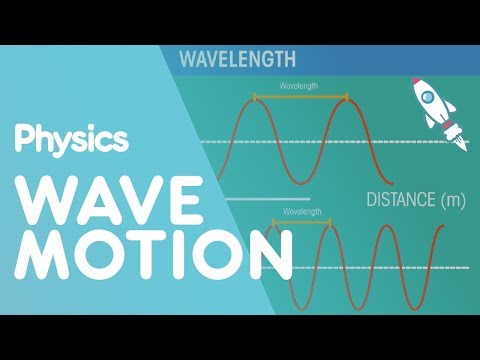
Wave Motion | Waves | Physics | FuseSchool
Wave Motion | Waves | Physics | FuseSchool All waves can transfer energy from one place to another without transferring any matter. This is done by a series of disturbances or vibrations that carry the energy. Just like the people in...
FuseSchool
Transverse & Longitudinal Waves
Waves transfer energy from one place to another. You should already know how to describe them in terms of frequency, wavelength and amplitude In this video we’re going to look at the two ways they can be classified. Waves are produced as...
Curated Video
How Everything Acts Like a Spring: A Physics Perspective
SUMMARY:
Why Everything in the universe is a spring (kind of). Why everything is a spring. Classical springs like you might have in your mattress have a harmonic oscillation. And this behavior has a quantum...
Why Everything in the universe is a spring (kind of). Why everything is a spring. Classical springs like you might have in your mattress have a harmonic oscillation. And this behavior has a quantum...
FuseSchool
Energy Sources
Energy Sources | Energy | Physics | FuseSchool There are many different sources of energy, how many can you name? Sources of energy include burning coal, oil, gas and biomass, solar, hydroelectric, tidal, wind, muscle power, geothermal,...
Crash Course
Traveling Waves: Crash Course Physics
Waves are cool. The more we learn about waves, the more we learn about a lot of things in physics. Everything from earthquakes to music! Ropes can tell us a lot about how traveling waves work so, in this episode of Crash Course Physics,...
Crash Course
Quantum Mechanics - Part 1: Crash Course Physics
What is light? That is something that has plagued scientists for centuries. It behaves light a wave... and a particle... what? Is it both? In this episode of Crash Course Physics, Shini introduces to the idea of Quantum Mechanics and how...
Crash Course
Maxwell's Equations: Crash Course Physics
In the early 1800s, Michael Faraday showed us how a changing magnetic field induces an electromotive force, or emf, resulting in an electric current. He also found that electric fields sometimes act like magnetic fields, and developed...
Bozeman Science
Wave-Particle Duality of Light
In this video Paul Andersen explains how light can be treated as both a particle and a wave. Physicists use scale to determine which model to use when studying light. When the wavelength of light is equivalent to the size of the object...
PBS
Sound Waves from the Beginning of Time
Invisible to the naked eye, our night sky is scattered with the 100s of billions of galaxies the fill the known universe. Like the stars, these galaxies form constellations – hidden patterns that echo the reverberations of matter and...
Bozeman Science
Transverse and Longitudinal Waves
In this video Paul Andersen compares and contrasts transverse and longitudinal waves. Waves carry energy through oscillations. In transverse waves the oscillations are perpendicular to the direction of the wave and in longitudinal they...
TED Talks
TED: What the discovery of gravitational waves means | Allan Adams
More than a billion years ago, two black holes in a distant galaxy locked into a spiral, falling inexorably toward each other, and collided. "All that energy was pumped into the fabric of time and space itself," says theoretical...
Bozeman Science
Mechanical and Electromagnetic Waves
In this video Paul Andersen compares and contrasts mechanical and electromagnetic waves. Both types of waves transfer energy through oscillations but mechanical waves requires a medium. Several examples of each type of wave are included.
Bozeman Science
Wave Amplitude
In this video Paul Andersen explains how the amplitude of a wave is a measure of the energy of the wave. He gives several examples of wave amplitude and shows you how to calculate the wave of a transverse and longitudinal wave.
Bozeman Science
Wave-Particle Duality - Part 1
In this video Paul Andersen explains the wave-particle duality discovered by scientists. In certain situations particles (like electrons and photons) display wave like properties. This phenomenon can best be explored using the double...
Bozeman Science
Wave Model of an Electron
The wave model of the electron can be used to explain the Bohr model. Electrons are found in certain orbits because they interfere with themselves and create standing waves. When the wavelengths don't match up with a whole integer they...
PBS
Gravitational Wave Background Discovered?
It was pretty impressive when LIGO detected gravitational waves from colliding black holes. Well we’ve just taken that to the next level with a galaxy-spanning gravitational wave detector that may have detected a foundational element of...
Bozeman Science
Electromagnetic Waves
In this video Paul Andersen details the characteristics of electromagnetic waves. Electromagnetic waves are transverse waves that can move through both mediums and vacuums. The electric and magnetic fields oscillate perpendicular to...
Bozeman Science
Wave-Particle Duality - Part 2
In this video Paul Andersen explains how classical waves (like light) can have particle properties. Albert Einsetein used the photoelectric effect to show how photons have particle properties.
PBS
Was the Gravitational Wave Background Finally Discovered?
A few weeks ago a large team of gravitational wave astronomers announced something pretty wild. The moderately confident detection of pervasive ripples in the fabric of space time that presumably fills the cosmos, detected by watching...