Hi, what do you want to do?






TeachEngineering
Teach Engineering: Conductivity
Students make a simple conductivity tester using a battery and light bulb. They learn the difference between conductors and insulators of electrical energy as they test a variety of materials for their ability to conduct electricity.
TeachEngineering
Teach Engineering: Introduction to Circuits and Ohm's Law
Students will explore the basics of dc circuits analyzing the light from light bulbs when connected in series and parallel circuits. Ohm's Law and the equation for power dissipated by a circuit will be the primary equations used. Using...
![Broward Education Foundation: Generating Fun With Alternative Energy [Pdf] Lesson Plan](https://statictemp.lp.lexp.cloud/images/attachment_defaults/resource/large/FPO-knovation.png "Broward Education Foundation: Generating Fun With Alternative Energy [Pdf] Lesson Plan")
Broward Education Foundation
Broward Education Foundation: Generating Fun With Alternative Energy [Pdf]
Young scholars took what they had learned and created a matching game (simple circuit board) for others to test their knowledge about energy. The matching game illuminates a light bulb, when the correct matching pairs are selected.
CK-12 Foundation
Ck 12: Physics Simulation: Flashing Neon Light
[Free Registration/Login Required] Learn about how capacitors are used in circuits to create transient events such as the flash of a light bulb using this interactive simulation. A PDF worksheet and a video tutorial are also available....
Environduck
Enviroduck: Greener Home Saving Energy With Cfl Lighting and Bulbs
Conserve energy at home with Compact Fluorescent Lamps or CFL light bulbs.
TryEngineering
Try Engineering: Series and Parallel Circuits
The core of this lesson plan is simple circuits and the differences between parallel and series circuit design. Learners perform experiments to test the differences between the two circuit designs using low voltage light bulbs.
TeachEngineering
Teach Engineering: Potato Power
Students use potatoes to light an LED clock (or light bulb) as they learn how a battery works in a simple circuit and how chemical energy changes to electrical energy. As they learn more about electrical energy, they better understand...
TeachEngineering
Teach Engineering: Human Power
Students do work by lifting a known mass over a period of time. The mass and measured distance and time is used to calculate force, work, energy and power in metric units. The students' power is then compared to horse power and the power...
TeachEngineering
Teach Engineering: Put a Spark in It! Electricity
Uncountable times every day "with the merest flick of a finger"each one of us calls on electricity to do our bidding. What would your life be like without electricity? Students begin learning about electricity with an introduction to the...

Alabama Learning Exchange
Alex: Save a Buck Challenge
Our pipes leak, air drafts push through our windows and walls, light bulbs create more heat than light, and every appliance we have stays plugged in all day long. Of course its our parents who pay the bills, so it doesn't matter. This is...

Other
Think Green: Think Waste Management
Find out how waste can be recycled and what you can do to aid recycling efforts in your community. With complete overviews of the types of materials that can be recycled: e-waste, paper and cardboard, metals, glass, plastics,...
CK-12 Foundation
Ck 12: Plix: Atomic Emission Lamps: Atomic Emission Spectra
[Free Registration/Login Required] In this interactive you will drag each gas bulb into the red circle to excite them and see their emission spectrum. You will need a sign-in to access this media, but it will be worth your time!
National High Magnetic Field Laboratory
Magnet Academy: Fluorescent Lamp 1934
Compared to incandescent lamps, fluorescent lamps last longer, require less energy and produce less heat, advantages resulting from the different way in which they generate light.
Texas Instruments
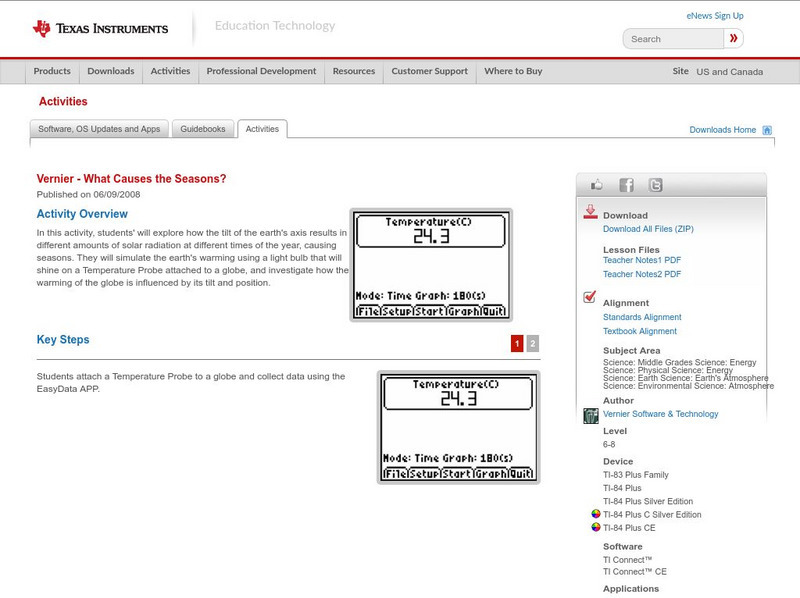
Texas Instruments: What Causes the Seasons?
In this activity, students' will explore how the tilt of the earth's axis results in different amounts of solar radiation at different times of the year, causing seasons. They will simulate the earth's warming using a light bulb that...