
National Institute of Open Schooling
Atomic Structure
Learners explain historical findings such as Rutherford and Bohr's contributions, explain wave particle duality, and formulate Heinsenberg's uncertainty principle. They also draw s, p, and d orbitals, explain more historical findings,...

Utah Education Network (UEN)
Microwave Magic
The microwave is a staple in many American households, but how exactly does it work? Approach this question from a scientific and practical standpoint, and discover cooking strategies, recipes, and methodologies for the standard...

National Institute of Open Schooling
Radioactive Pollution
Radioactive pollutants can enter the body through ingestion, inhalation, absorption, or injection. The last lesson in a series of 36 introduces pupils to radioactive pollution. They study its sources, both natural and man-made, its...

Science Struck
Science Struck: Electromagnetic Waves: Origin and Theory
Discusses the history of the discovery and study of electromagnetism, the scientists who worked on it, the basic principle, how wavelength and frequency are related, and types of electromagnetic waves.
Physics Classroom
The Physics Classroom: Propagation of Electromagnetic Waves
An explanation of and animation depicting the propagation of an electromagnetic wave through a material medium.
University of Colorado
University of Colorado: Physics 2000: Electromagnetic Waves
An excellent site with several pages describing what electromagnetic radiation is.
NASA
Nasa: Tour of the Electromagnetic Spectrum: Visible Light
Visible light waves are the only electromagnetic waves we can see. We see these waves as the colors of the rainbow. Each color has a different wavelength. Red has the longest wavelength and violet has the shortest wavelength. When all...
CK-12 Foundation
Ck 12: Earth Science: Electromagnetic Energy in the Atmosphere Study Guide
[Free Registration/Login may be required to access all resource tools.] Summarizes the key points about electromagnetic waves and how they are classified. Includes a few questions to check for understanding.
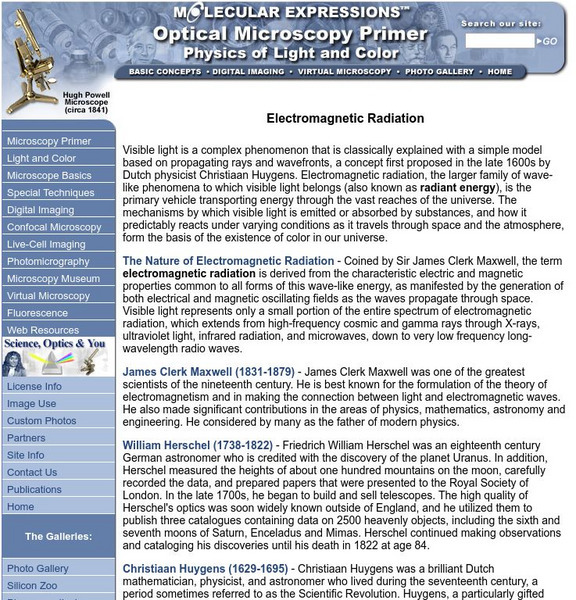
Florida State University
Florida State University: Molecular Expressions: Electromagnetic Radiation
This Florida State University page introduces light as an electromagnetic wave and discusses the frequency and wavelength range of the various regions of the electromagnetic spectrum. Includes links to some interactive Java applets.
Physics Classroom
The Physics Classroom: Light Waves and Color
The behavior of light waves is introduced and discussed. Also, polarization, color, diffraction, and interference are introduced and discussed thoroughly as supporting evidence of the wave nature of light.
CK-12 Foundation
Ck 12: Physics: Wave Optics Study Guide
A study guide for concepts related to wave optics.
Science Struck
Science Struck: Electromagnetic Energy and Why It Is Important
Explains what electromagnetic energy is, the history of its discovery, some terms used when talking about it, and gives some facts about it.

Georgia State University
Georgia State University: Hyper Physics: Wave Particle Duality
The dualistic nature of light is discussed. The photoelectric effect and the Davisson-Germer experiment are contrasted as empirical evidence supporting each of the two views - particle and wave - of the nature of light. The photoelectric...
NASA
Electromagnetic Spectrum: Ultraviolet Waves
Ultraviolet (UV) light has shorter wavelengths than visible light. Though these waves are invisible to the human eye, some insects can see them. The specific wavelength values are given. Uses and applications of these waves are explained.
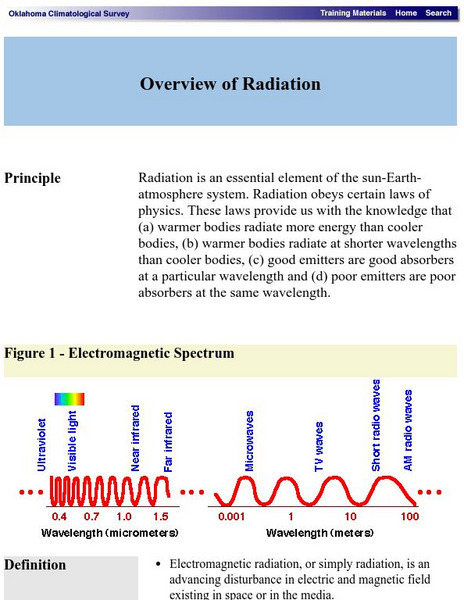
Oklahoma Mesonet
Oklahoma Climatological Survey: Overview of Radiation
This site details what radiation is, the physics of radiation, and radiative transfer as it occurs in nature. Content explores the electromagnetic spectrum, electromagnetic waves, properties of radiation, and solar radiation.
NASA
Nasa: Electromagnetic Spectrum: Radio Waves
Radio waves have the longest wavelengths in the electromagnetic spectrum. This NASA article discusses AM, FM, TV, cell phone, as well as radio astronomy, which all use this technology.
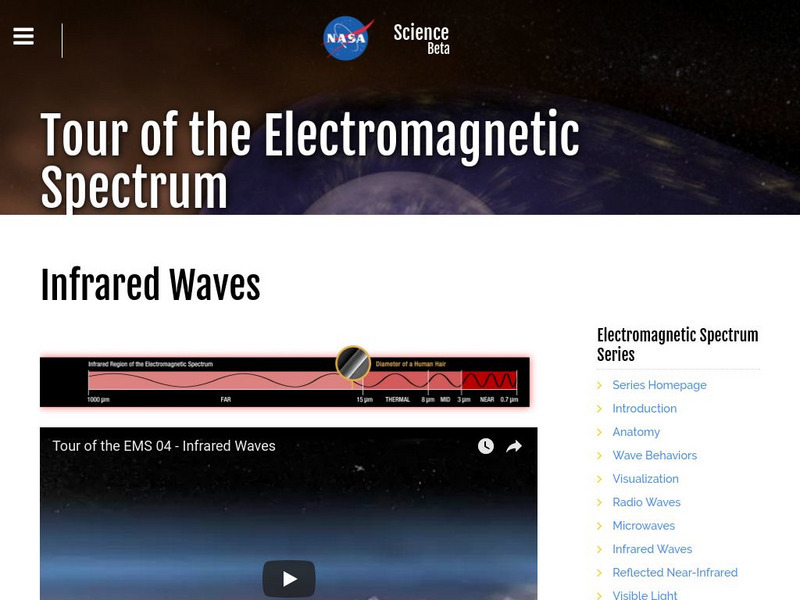
NASA
Nasa: Mission: Science: Electromagnetic Spectrum: Infrared Waves
Infrared light lies between the visible and microwave portions of the electromagnetic spectrum. Infrared light has a range of wavelengths, just like visible light has wavelengths that range from red light to violet.
Johns Hopkins University
The Electromagnetic Spectrum
NASA related site shows the entire Electromagnetic Spectrum. Provides a brief description of the expansive colored spectrum as well as a related link that provides more details.
Synopsys
Synopsys: Optics: A Gentle Intro to Optical Design: Wave Particle Duality
Discusses the manner in which light behaves as both wave and particle. This dualistic nature of light is one topic of many on the page.
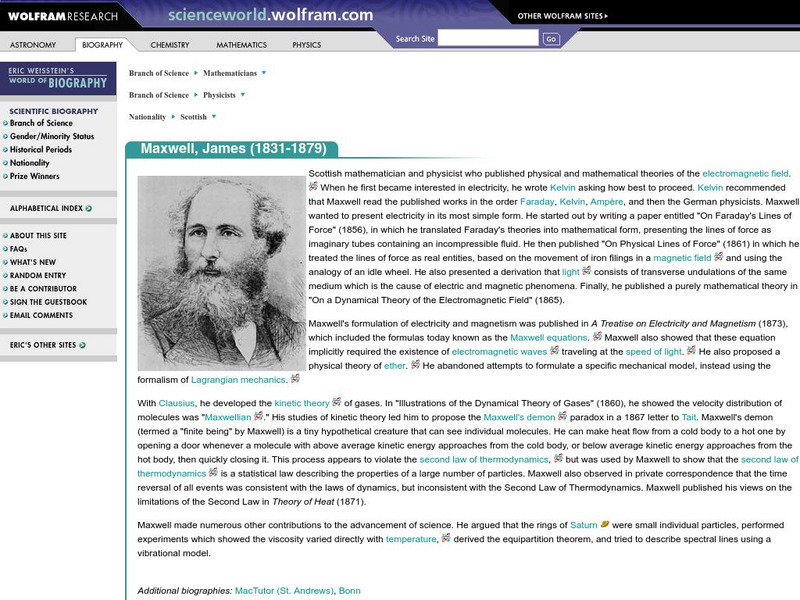
Wolfram Research
Wolfram Science World: Maxwell, James
This ScienceWorld site describes the Scottish mathematician and physicist James Maxwell (1831-1879) who published physical and mathematical theories of the electromagnetic field.
Physics Classroom
The Physics Classroom: Polarization
"How Do We Know Light Behaves as a Wave?" An answer is provided in this discussion of the polarization of light and the use of Polaroid filters in sunglasses. The four methods discussed on this page are: polarization by transmission,...
University of Oregon
University of Oregon: Electromagnetism
A solid summary from the University of Oregon of the work of James Maxwell Clerk, Michael Faraday, and others in the field of electric and magnetic phenomena. This is a fine essay.
Science Struck
Science Struck: How Does Light Travel Through Space and Other Media?
A detailed discussion of the nature of light, how it can travel through a vacuum, and how the speed of light is affected when light travels through a medium.
Cornell University
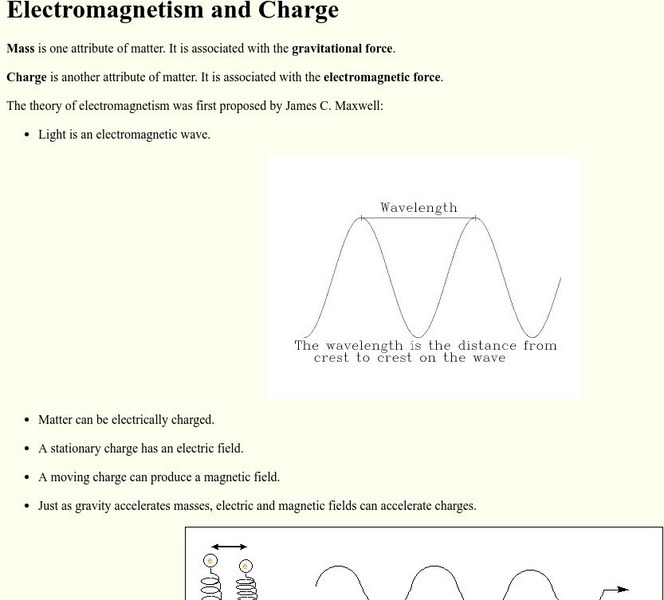
Cornell University: Astronomy: Electromagnetism and Charge
This site from Cornell University provides a very short, very telling comparison of matter and charge. This is a good site to check out on the subject, with a chart diagram to help with further information.