Hi, what do you want to do?






Physics Classroom
The Physics Classroom: Propagation of Electromagnetic Waves
An explanation of and animation depicting the propagation of an electromagnetic wave through a material medium.
NASA
Nasa: Tour of the Electromagnetic Spectrum: Visible Light
Visible light waves are the only electromagnetic waves we can see. We see these waves as the colors of the rainbow. Each color has a different wavelength. Red has the longest wavelength and violet has the shortest wavelength. When all...
CK-12 Foundation
Ck 12: Earth Science: Electromagnetic Energy in the Atmosphere Study Guide
[Free Registration/Login may be required to access all resource tools.] Summarizes the key points about electromagnetic waves and how they are classified. Includes a few questions to check for understanding.
Discovery Education
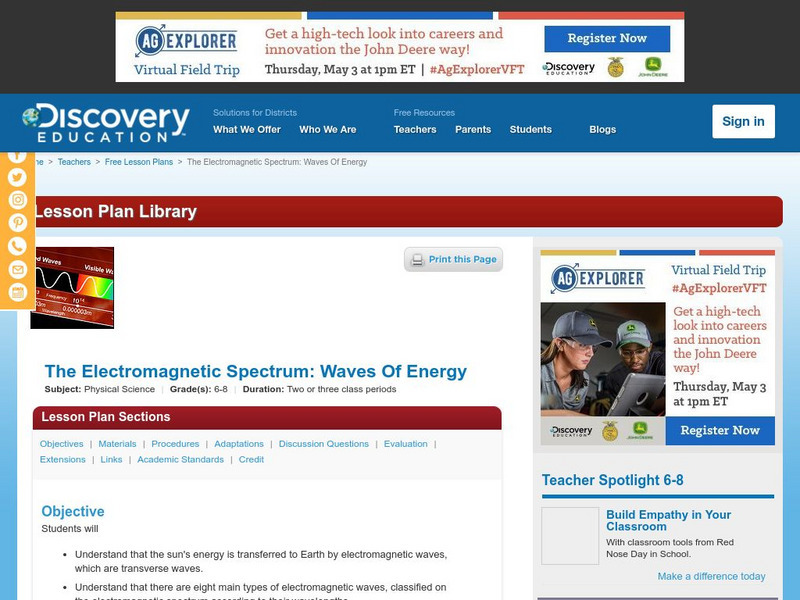
Discovery Education: The Em Spectrum: Waves of Energy
Students are introduced to the electromagnetic spectrum through this group research activity. Each group investigates a different wavelength range within the em spectrum and reports back to class. Discussion ideas also included.
TeachEngineering
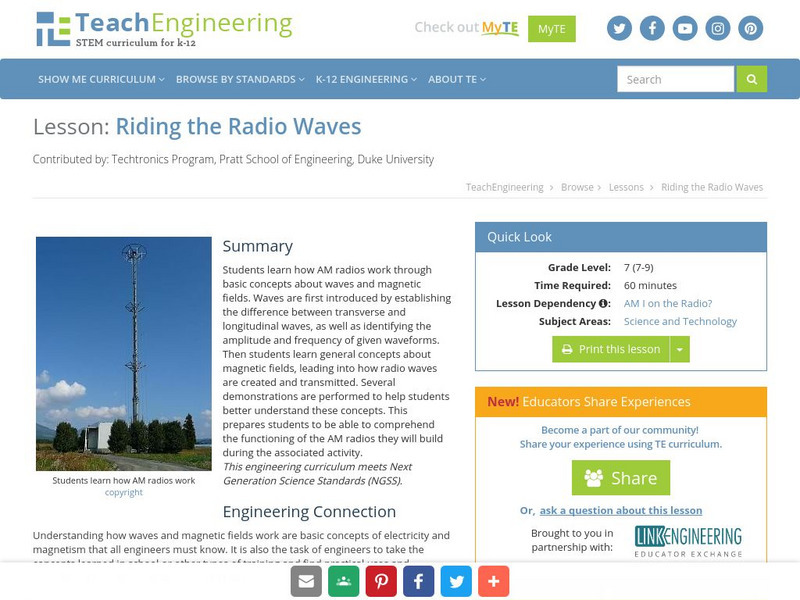
Teach Engineering: Riding the Radio Waves
In this lesson students learn how AM radios work through basic concepts about waves and magnetic fields. Waves are first introduced by establishing the difference between transverse and longitudinal waves, as well as identifying the...
PBS
Pbs Learning Media: How Is a Radio Wave Emitted?
This illustrated essay from A Science Odyssey Web site explains the science behind radio waves, including the role of electrons and electromagnetic fields.
CK-12 Foundation
Ck 12: Physics: Wave Optics Study Guide
A study guide for concepts related to wave optics.

Georgia State University
Georgia State University: Hyper Physics: Wave Particle Duality
The dualistic nature of light is discussed. The photoelectric effect and the Davisson-Germer experiment are contrasted as empirical evidence supporting each of the two views - particle and wave - of the nature of light. The photoelectric...
Physics Classroom
The Physics Classroom: The Electromagnetic and Visible Spectra
A tutorial on the electromagnetic and visible spectra. Discusses dispersion and how perceptions of white and black are related to the visible light spectrum.
Physics Classroom
The Physics Classroom: Light Waves/color: Electromagnetic and Visible Spectra
This illustrated physics tutorial explains the electromagnetic and visible spectra of light using illustrated examples and interactive practice problems.
University of Maryland
University of Maryland: Optics Highlights: Wave Optics
Part of an anecdotal history of optics and the study of light. Extremely thorough treatment of how scientists came to believe in the wave nature of light. Includes a short biographical sketch and discusses the work of Thomas Young...
Science Buddies
Science Buddies: How Does Color Affect Heating by Absorption of Light?
Light is an example of an electromagnetic wave. Electromagnetic waves can travel through the vacuum of interstellar space. They do not depend on an external medium-unlike a mechanical wave such as a sound wave which must travel through...
NASA
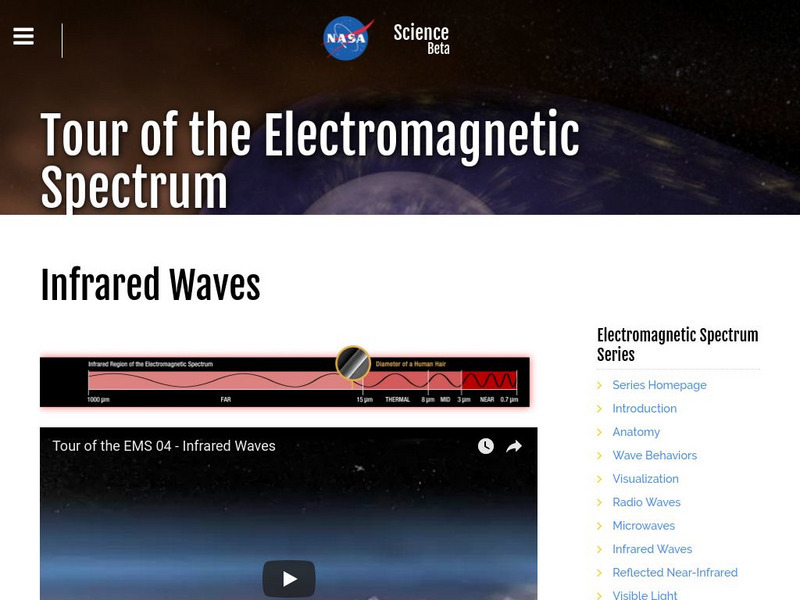
Nasa: Mission: Science: Electromagnetic Spectrum: Infrared Waves
Infrared light lies between the visible and microwave portions of the electromagnetic spectrum. Infrared light has a range of wavelengths, just like visible light has wavelengths that range from red light to violet.

Alabama Learning Exchange
Alex: Transverse Waves
Students will classify waves as mechanical or electromagnetic. Students will describe longitudinal and transverse waves. Students will show a transverse wave using a slinky.This lesson plan was created as a result of the Girls Engaged in...

TED Talks
Ted: Ted Ed: Light Waves, Visible and Invisible
Lucianne Walkowicz shows us the waves just beyond our perception: microwaves, radio waves, x-rays and more. [5:58]
Physics Classroom
The Physics Classroom: Polarization
"How Do We Know Light Behaves as a Wave?" An answer is provided in this discussion of the polarization of light and the use of Polaroid filters in sunglasses. The four methods discussed on this page are: polarization by transmission,...
Science Struck
Science Struck: How Does Light Travel Through Space and Other Media?
A detailed discussion of the nature of light, how it can travel through a vacuum, and how the speed of light is affected when light travels through a medium.
NASA
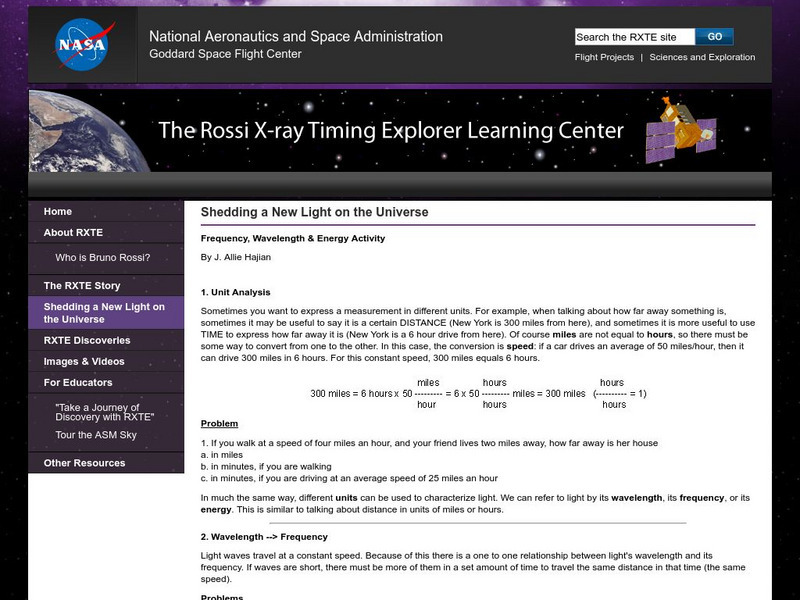
Rxte Learning Center: Frequency, Wave Length, and Energy Activity
Resource focuses on the relationship between the frequency, wavelength and speed of light. Has a link to an interactive activity relating frequency, wavelength, and energy.
Cosmo Learning
Cosmo Learning: Physics Ii: Electricity and Magnetism
A collection of video lectures from a fundamentals of physics course taught at Massachusetts Institute of Technology. The course is the second in the sequence and focuses on electricity and magnetism The videos feature topics on...
University of California
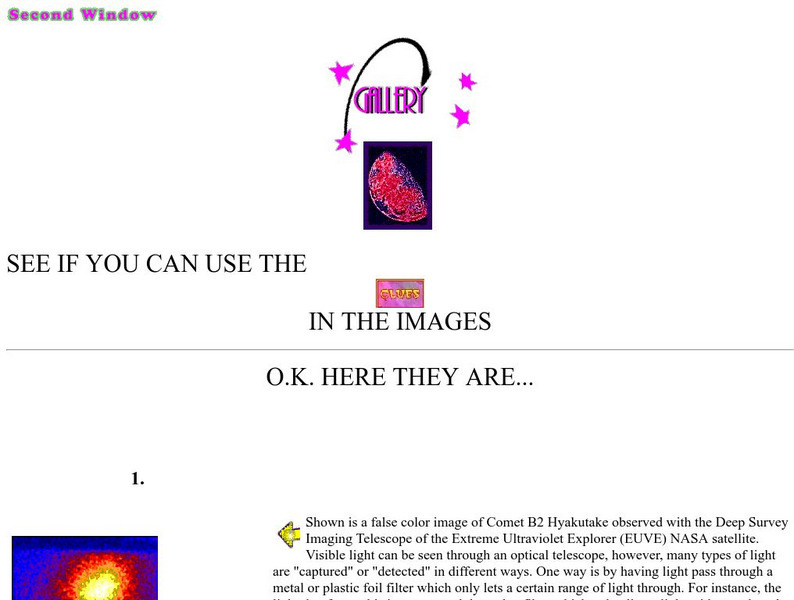
Center for Science Education: Gallery
A gallery of astronomy images which depict galaxies, comets, the moon, planets, nebulae, supernovae as seen in various regions of the electromagnetic spectrum. Each image in the gallery is described. Fascinating!

Space Telescope Science Institute
Amazing Space: Star Light Star Bright
Learn all about stars and the electromagnetic spectrum in this series of activities.
Nobel Media AB
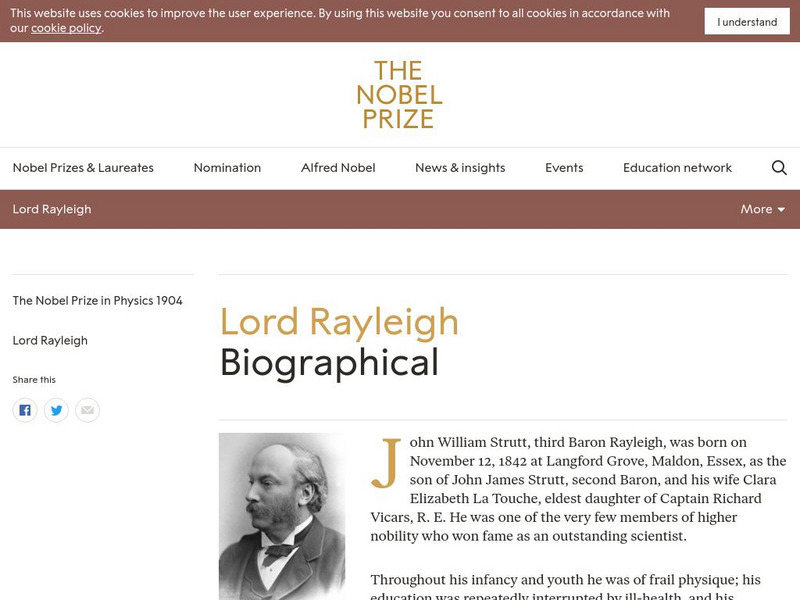
The Nobel Prize: Lord Rayleigh Biographical
At this site from the Nobel e-Museum, you can read about the scientific work of Lord Rayleigh (1842-1919 CE). This article includes information on his education and experiments with light and sound waves.
Georgia State University
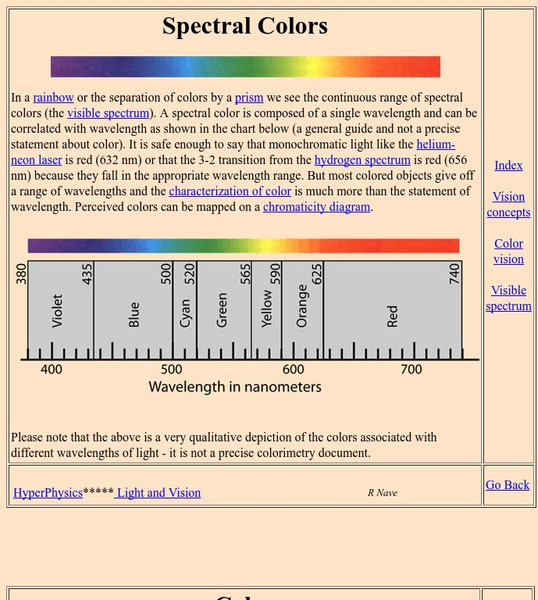
Georgia State University: Hyper Physics: Color
This site from Georgia State University discusses the location of visible light on the electromagnetic spectrum. Includes the wavelength values for various colors of light within the visible light spectrum.

University of St. Andrews (UK)
University of St. Andrews: James Clerk Maxwell
Research resources for James Maxwell (1831-1879), who did revolutionary work on electricity and magnetism and on the kinetic theory of gases.