Hi, what do you want to do?






American Chemical Society
Isolation of Phytochrome
Why do soybean plants that are planted weeks apart in the spring mature simultaneously in the fall? Four independent activities cover the history of phytochrome research, scientist collaboration, the electromagnetic spectrum, and...

Towson University
The Crucial Concentration
Which sports drink provides the best pick-me-up after the big game or grueling workout? It may not be the one you'd think! Food science is the focus in a surprising lab activity. Pupils use colorimetry to determine the amount of protein,...

National Institute of Open Schooling
Atomic Structure
Learners explain historical findings such as Rutherford and Bohr's contributions, explain wave particle duality, and formulate Heinsenberg's uncertainty principle. They also draw s, p, and d orbitals, explain more historical findings,...

NASA
Nasa: Tour of the Electromagnetic Spectrum: Visible Light
Visible light waves are the only electromagnetic waves we can see. We see these waves as the colors of the rainbow. Each color has a different wavelength. Red has the longest wavelength and violet has the shortest wavelength. When all...
NASA
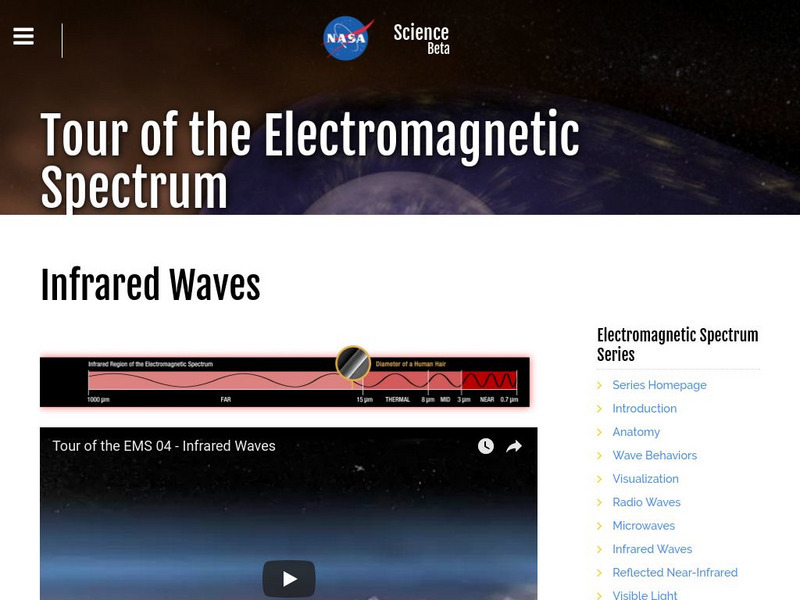
Nasa: Mission: Science: Electromagnetic Spectrum: Infrared Waves
Infrared light lies between the visible and microwave portions of the electromagnetic spectrum. Infrared light has a range of wavelengths, just like visible light has wavelengths that range from red light to violet.
NASA
Nasa: Electromagnetic Spectrum: Radio Waves
Radio waves have the longest wavelengths in the electromagnetic spectrum. This NASA article discusses AM, FM, TV, cell phone, as well as radio astronomy, which all use this technology.
NASA
Nasa: Space Place: The Electromagnetic Spectrum
Find out how energy, frequency, and wavelength are related in terms of the electromagnetic spectrum.
Johns Hopkins University
The Electromagnetic Spectrum
NASA related site shows the entire Electromagnetic Spectrum. Provides a brief description of the expansive colored spectrum as well as a related link that provides more details.
Science Struck
Science Struck: Electromagnetic Energy and Why It Is Important
Explains what electromagnetic energy is, the history of its discovery, some terms used when talking about it, and gives some facts about it.
Science Struck
Science Struck: A Simple Explanation of How Electromagnets Work
Gives a brief history of electromagnets and describes the parts of an electromagnet and how one works. Includes labeled illustrations and examples of their many applications.
Science Struck
Science Struck: Electromagnetic Waves: Origin and Theory
Discusses the history of the discovery and study of electromagnetism, the scientists who worked on it, the basic principle, how wavelength and frequency are related, and types of electromagnetic waves.
Florida State University
Florida State University: Molecular Expressions: Electromagnetic Radiation
This Florida State University page introduces light as an electromagnetic wave and discusses the frequency and wavelength range of the various regions of the electromagnetic spectrum. Includes links to some interactive Java applets.
NASA
Electromagnetic Spectrum: Ultraviolet Waves
Ultraviolet (UV) light has shorter wavelengths than visible light. Though these waves are invisible to the human eye, some insects can see them. The specific wavelength values are given. Uses and applications of these waves are explained.
Georgia State University
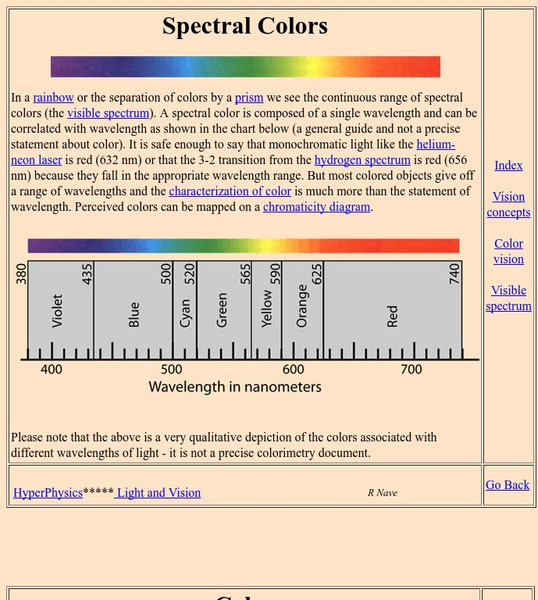
Georgia State University: Hyper Physics: Color
This site from Georgia State University discusses the location of visible light on the electromagnetic spectrum. Includes the wavelength values for various colors of light within the visible light spectrum.
Science Struck
Science Struck: Wavelength of Visible Light Spectrum
Explains where visible light fits into the electromagnetic spectrum and the wavelengths for the different colors we see.
NASA
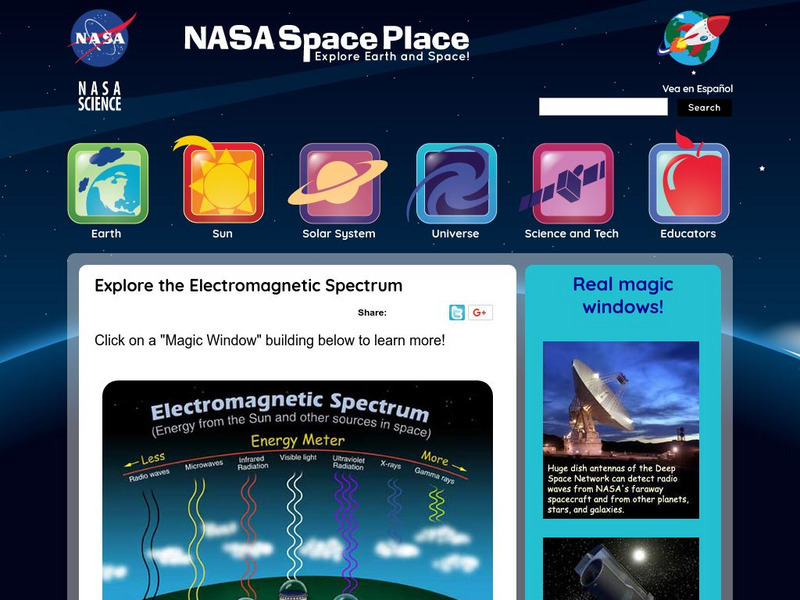
Nasa's the Space Place: A Trip to the Land of the Magic Windows
Explore the electromagnetic spectrum and learn about each type of energy on the spectrum.
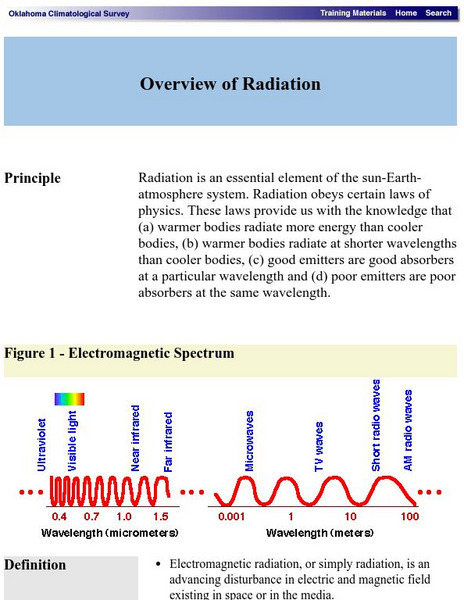
Oklahoma Mesonet
Oklahoma Climatological Survey: Overview of Radiation
This site details what radiation is, the physics of radiation, and radiative transfer as it occurs in nature. Content explores the electromagnetic spectrum, electromagnetic waves, properties of radiation, and solar radiation.
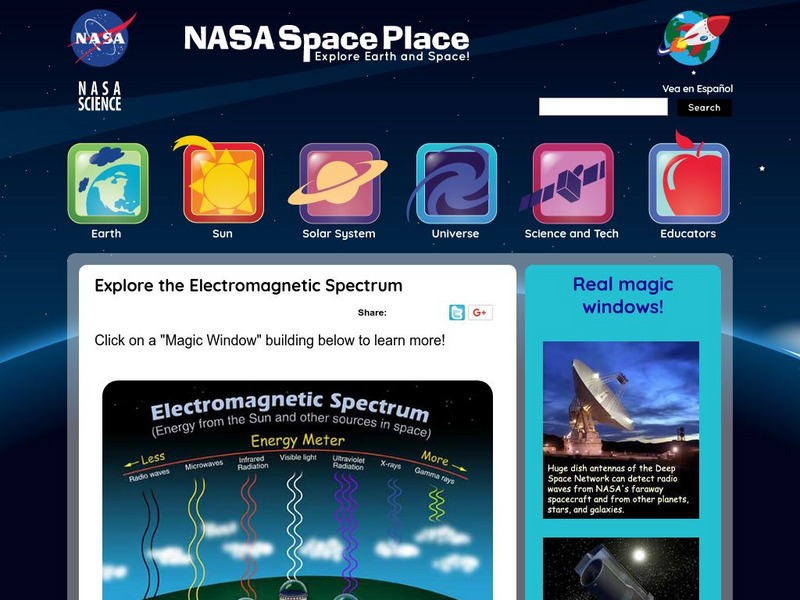
NASA
Nasa: The Space Place: The Land of the Magic Windows
This is a site from NASA that contains an interesting and fun way to learn about the electromagnetic spectrum. Kate receives a strange riddle from her grandfather. Find out what it says and go through the gateway to the Land of the Magic...
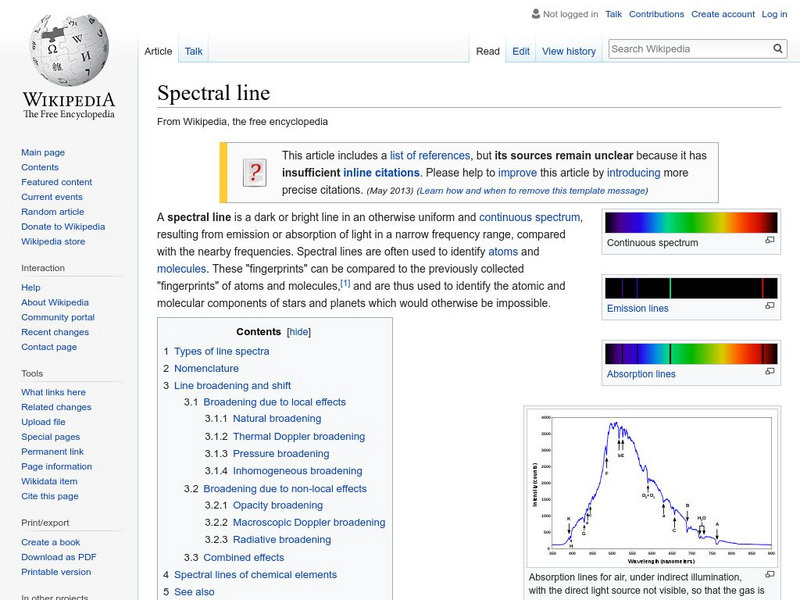
Wikimedia
Wikipedia: Spectral Line
Wikipedia offers information on spectral line, a dark or bright line in an otherwise uniform and continuous spectrum.
Other
Fluorescent Mineral Society: The Ultraviolet Spectrum
This resource presents a discussion of the nature and properties of ultraviolet light. The manner in which minerals emit UV light is described and explained.
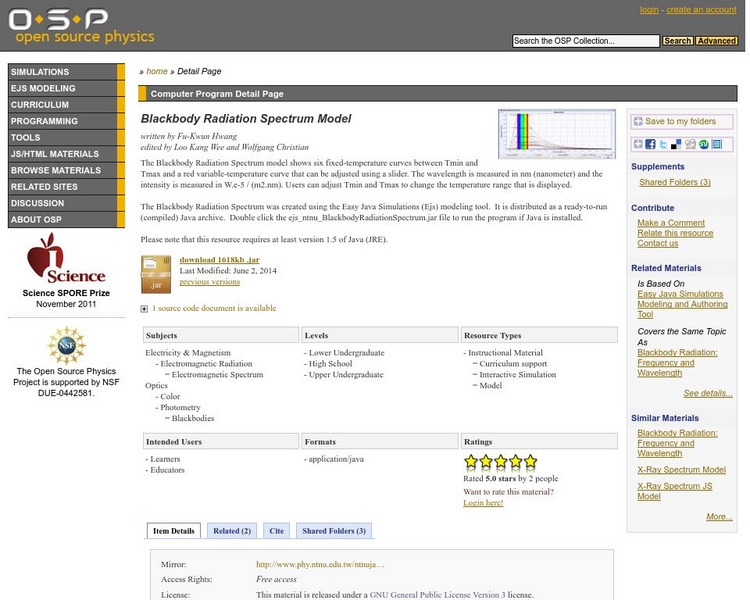
American Association of Physics Teachers
Com Padre Digital Library: Open Source Physics: Blackbody Radiation Spectrum
In this simulation change the temperature range displayed to measure blackbody radiation intensity.
Friesian School
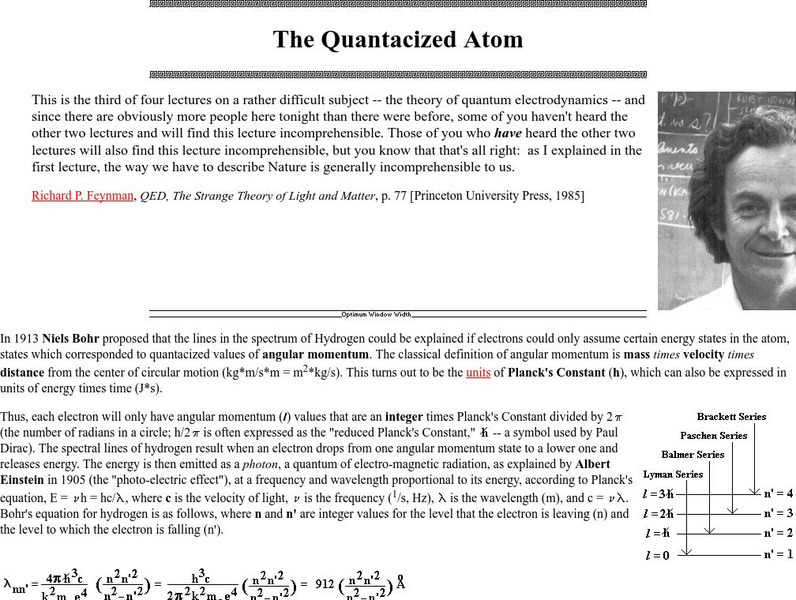
Proceedings of the Friesian School/the Quantacized Atom
A very lengthy page from friesian.com discussing Bohr's theory of electronic energy levels and the explanation of commonly observed atomic emission line spectra. The concept of a photon and Einstein's observation of the photoelectric...
Georgia State University
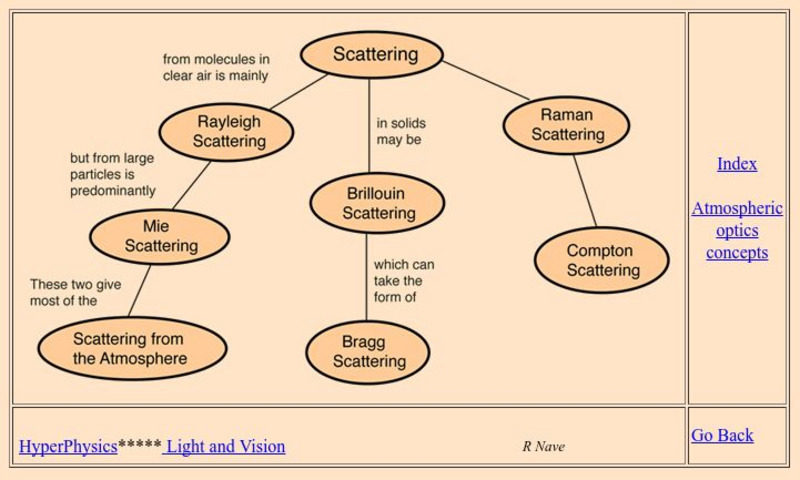
Georgia State University: Hyper Physics: Scattering Concepts
A collection of several pages explaining the principles which underlie Rayleigh scattering of light.
American Museum of Natural History
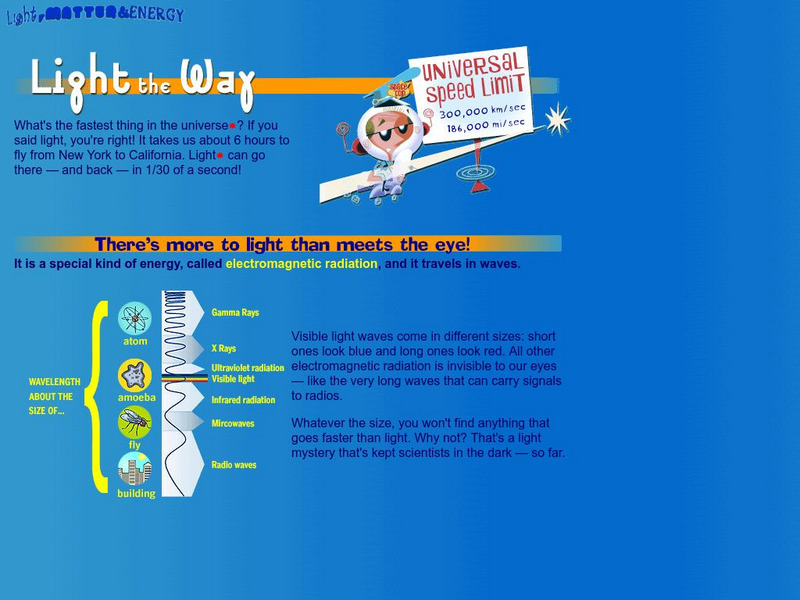
American Museum of Natural History: O Logy: Light, Matter, Energy: Light the Way
What is electromagnetic radiation and how does it work? Review a captioned graphic that explains electromagnetic radiation and the visible and invisible types of radiation on the electromagnetic spectrum.