Hi, what do you want to do?





Other
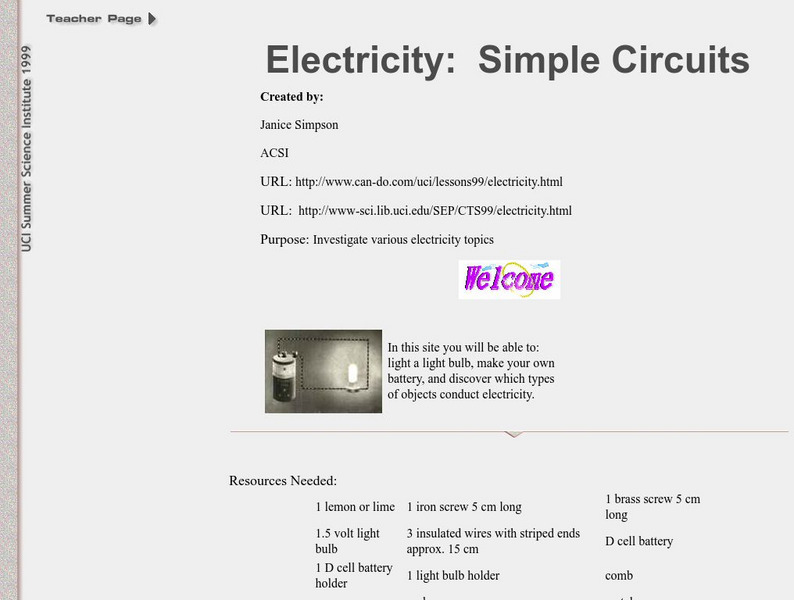
Electricity: Simple Circuits
Create your own simple electric circuit. Using simple supplies build your own battery and investigate conductivity. You can also construct a crossword puzzle with electrical vocabulary words.
Discovery Education
Discovery Education: Earth's Energy
A hands-on instructional activity for helping students understand simple circuits, series circuits, and parallel circuits, and the differences between the three.
TeachEngineering
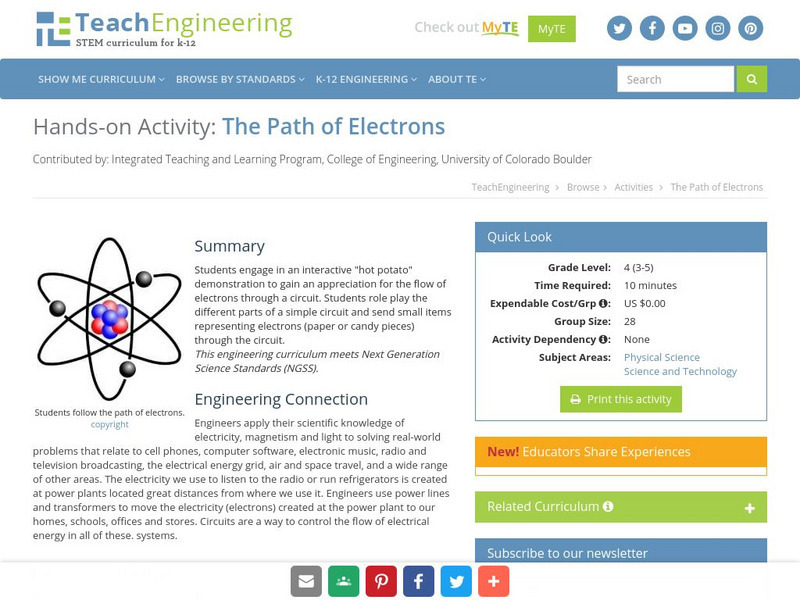
Teach Engineering: The Path of Electrons
Students engage in an interactive "hot potato" demonstration to gain an appreciation for the flow of electrons through a circuit. Students role play the different parts of a simple circuit and send small items representing electrons...

Science Buddies
Science Buddies: Project Ideas: Which Materials Are the Best Conductors?
A simple science fair project to test whether electricity can flow between two things. The Science Buddies project ideas are set up consistently beginning with an abstract, objective, and introduction, followed by a section on terms,...
TeachEngineering
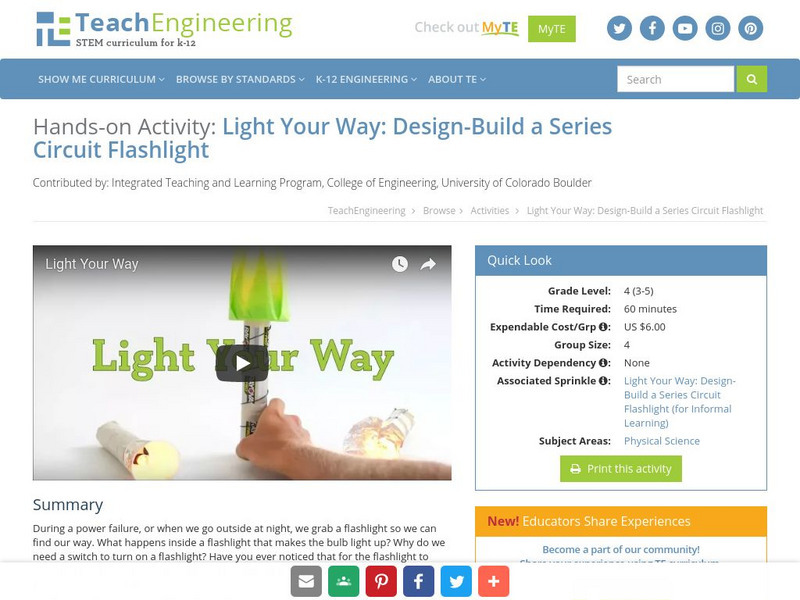
Teach Engineering: Light Your Way
When there is a power failure, or when we go outside at night, we grab a flashlight so we can find our way. What happens inside a flashlight that makes the bulb light up? Why do we need a switch to turn on a flashlight? Have you ever...

TeachEngineering
Teach Engineering: Conductivity
Students make a simple conductivity tester using a battery and light bulb. They learn the difference between conductors and insulators of electrical energy as they test a variety of materials for their ability to conduct electricity.
TeachEngineering
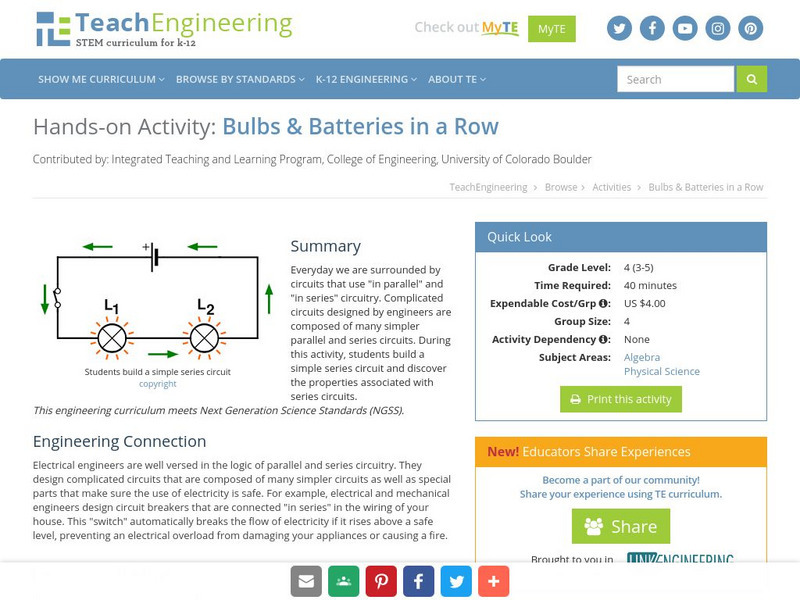
Teach Engineering: Bulbs & Batteries in a Row
Everyday we are surrounded by circuits that use "in parallel" and "in series" circuitry. Complicated circuits designed by engineers are composed of many simpler parallel and series circuits. During this activity, students build a simple...

Science4Fun
Science4 Fun: Resistors, Capacitors, and Inductors
Electric circuits are used to provide a path to electric current. They commonly use three basic electrical components, which are resistors, capacitors, and insulators. They affect the electric current and changes the behavior of the...
Concord Consortium
Mobile Inquiry Technology: Moving Magnets
This investigation has students examining how electric and magnetic charges are related. They will look at how an electric current is affected by the proximity of a magnet.