Hi, what do you want to do?





Science Buddies
Science Buddies: Measuring Light Intensity Using the Inverse Square Law
You've probably heard that compact fluorescent light bulbs are more efficient than incandescent bulbs. More of the electricity they use goes into producing light, and less into producing heat than with incandescent bulbs. How much more...

National High Magnetic Field Laboratory
Magnet Academy: Timeline of Electricity and Magnetism: 1870 1879
The telephone and first practical incandescent light bulb are invented while the word "electron" enters the scientific lexicon.
TeachEngineering
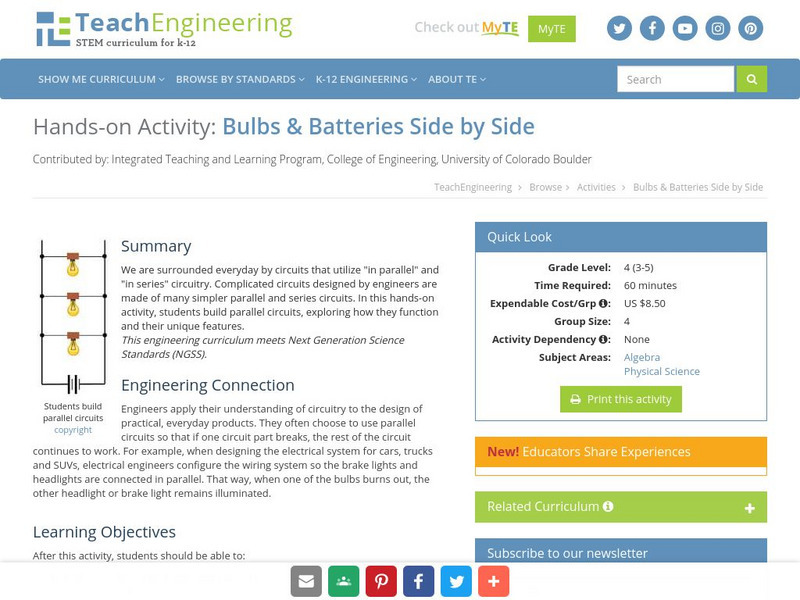
Teach Engineering: Bulbs & Batteries Side by Side
We are surrounded everyday by circuits that utilize "in parallel" and "in series" circuitry. Complicated circuits designed by engineers are made of many simpler parallel and series circuits. In this hands-on activity, students build...

US National Archives
Nara: Teaching With Documents: Telephone and Light Patent Drawings
A lesson plan about Alexander Graham Bell's patent for the telephone and Thomas Edison's patent for the electric lamp. Contains good background information and historically pertinent documents. It also discusses the role corporations...
TeachEngineering
Teach Engineering: Potato Power
Students use potatoes to light an LED clock (or light bulb) as they learn how a battery works in a simple circuit and how chemical energy changes to electrical energy. As they learn more about electrical energy, they better understand...
TeachEngineering
Teach Engineering: Switcheroo
In this hands-on activity, students construct a simple switch and determine what objects and what types of materials can be used to close a switch in a circuit and light a light bulb.
PBS
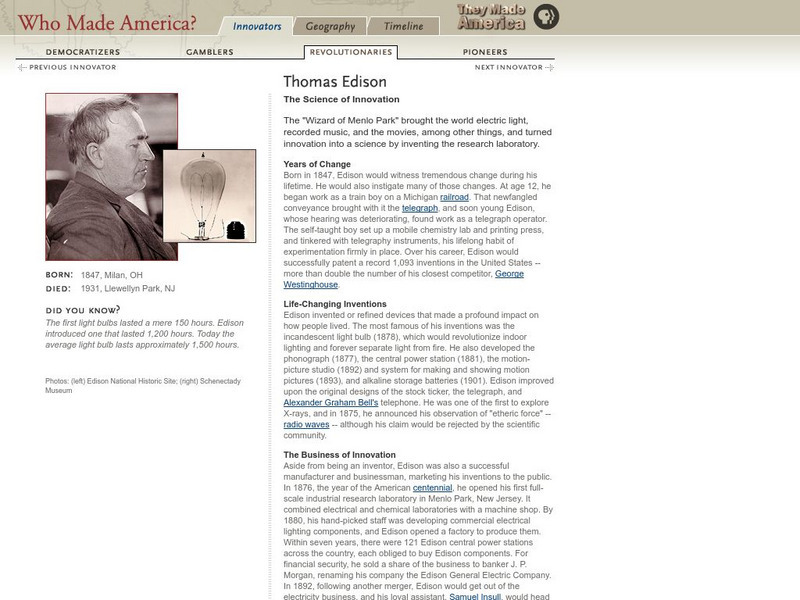
Pbs: Who Made America?: Innovators: Thomas Edison
The "Wizard of Menlo Park" brought the world electric light, recorded music, and the movies, among other things, and turned innovation into a science by inventing the research laboratory.
TeachEngineering
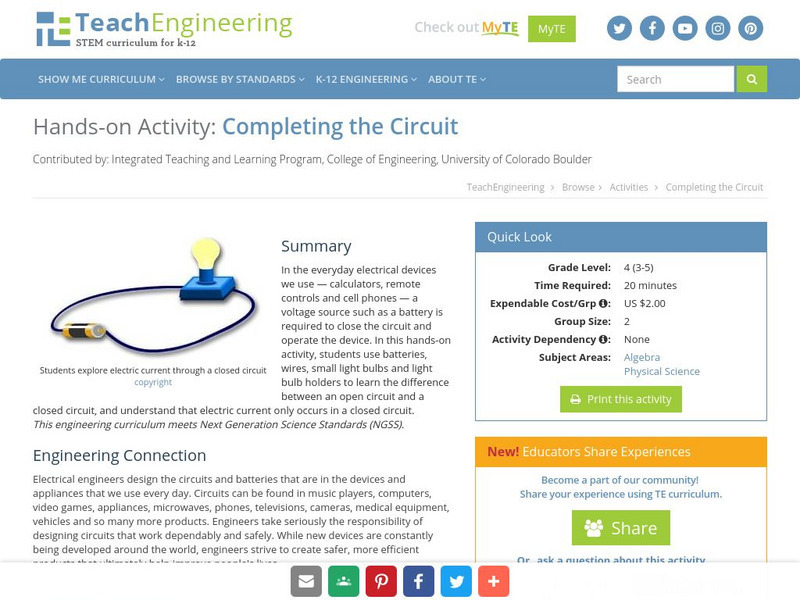
Teach Engineering: Completing the Circuit
In the everyday electrical devices we use - calculators, remote controls and cell phones - a voltage source such as a battery is required to close the circuit and operate the device. In this hands-on activity, students use a battery,...

TeachEngineering
Teach Engineering: Conductivity
Students make a simple conductivity tester using a battery and light bulb. They learn the difference between conductors and insulators of electrical energy as they test a variety of materials for their ability to conduct electricity.
TryEngineering
Try Engineering: Series and Parallel Circuits
The core of this lesson is simple circuits and the differences between parallel and series circuit design. Young scholars perform experiments to test the differences between the two circuit designs using low voltage light bulbs.
Smithsonian Institution
Lemelson Center: Invention Features: Lewis Latimer
Smithsonian site features the life and many accomplishments of Lewis Latimer, the famous African-American inventor.
Massachusetts Institute of Technology
Mit: Invention of the Week: Thomas Alva Edison
As the inventor of the lightbulb, phonograph, and the printing telegraph, Thomas Alva Edison (1847-1931), improved the daily lives of everyday people.
Science Buddies
Science Buddies: Shaking Up Some Energy
Shake N' Light flashlights have been advertised on televisions across the nation in the recent year. But many do not understand just how they get energy to light up the bulb without using batteries. Do this experiment to make your own...
Digital History
Digital History: The Wizard of Menlo Park
This resource provides information about the famous American inventor, Thomas Edison. Find out about his childhood, some of his famous inventions, and even some of his mistakes.

Enchanted Learning
Enchanted Learning: Inventors & Inventions 1801 1850
This site from Enchanted Learning presents several brief overviews of major early nineteenth century inventors and their inventions. The information is accessible by clicking on the corresponding link.