Hi, what do you want to do?





The College Board
Ap Central: Ap Physics C: Electricity and Magnetism: The Course
CollegeBoard offers a page of resources for students and teachers of AP Physics C: Electricity and Magnetism. Find course and exam information, teaching resources, articles, and recommended links.
The Wonder of Science
The Wonder of Science: Ms Ps2 3: Electric and Magnetic Forces
Work samples, phenomena, assessment templates, and videos that directly address standard MS-PS2-3: electric and magnetic forces.

Exploratorium
Exploratorium: Science Snacks: Physics/electricity & Magnetism
Exploratorium Science Snacks are miniature science exhibits and experiments that can be made with common, inexpensive, easily available materials. These electricity snacks represent a set of devices that you can build and experiment with...

Canada Science and Technology Museum
Canada Science and Technology Museum: Background Information for Electricity
The Canada Science and Technology Museum answers some of the most common questions about electricity. For example, get the definition of electricity, the difference between alternating and direct currents, and learn how a fuse works.
US Energy Information Administration
U.s. Eia Energy Kids: Energy Sources: Electricity
A basic description of electricity and the role it plays in everyday life.
Orpheus Books
Q Files: Electricity and Magnetism: Electric Charge
Learn how electric charges work and about Coulomb's Law, which is used to calculate the strength of an electric force.
Other
Magnet Lab: Physics Lessons by Science Joy Wagon
These physics lessons and tutorials are designed to be a resource for learning introductory level, algebra-based physics. Organization is by topic, but a search option is available for quickly finding specific information. Although most...
TeachEngineering
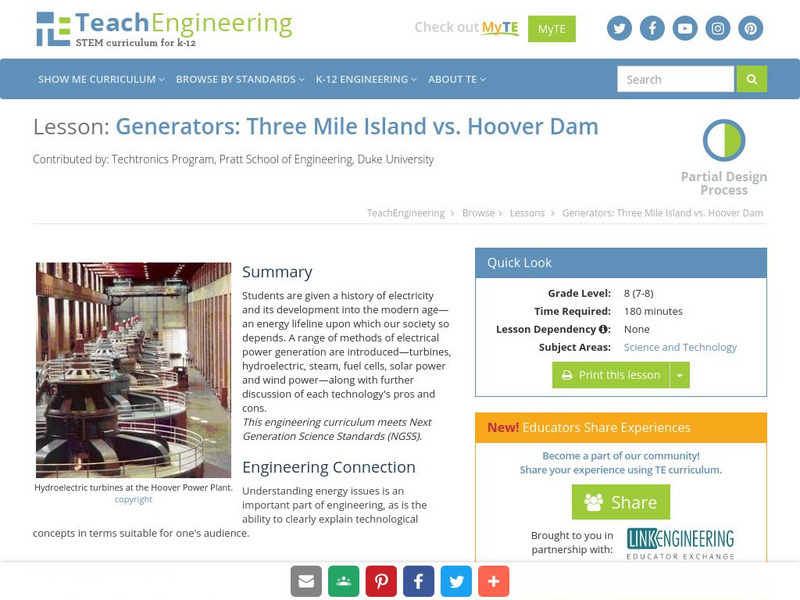
Teach Engineering: Generators: Three Mile Island vs. Hoover Dam
Young scholars are given a history of electricity and its development into the modern age lifeline upon which we so depend. The methods of power generation are introduced, and further discussion of each technology's pros and cons follows.
Thomas Jefferson National Accelerator Facility
Jefferson Lab: Reading Passages: Charges and Electricity
Read and fill in the blanks of this passage explaining charges and electricity. Each blank has a dropdown menu with choices. When you finish, click CHECK MY ANSWERS. If you pick a wrong answer, the right answer will be displayed along...
PBS
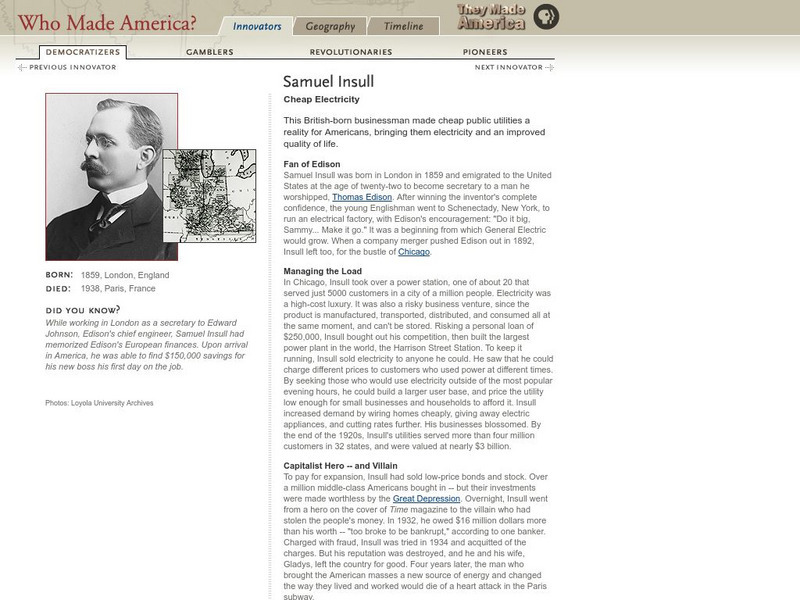
Pbs: Who Made America?: Innovators: Samuel Insull
This British-born businessman made cheap public utilities a reality for Americans, bringing them electricity and an improved quality of life.
Science Buddies
Science Buddies: Rock On! Recording Digital Data With Magnets
This is a straightforward project that shows you how data can be digitized and stored on magnetic recording media. You'll learn how alpha-numeric characters are digitized, and you'll use bar magnets to represent the individual data...
Science Buddies
Science Buddies: Walking Coins on a (Vertical!) 'High Wire'
Here is a project that is almost like a magic trick: with a strong magnet and a simple apparatus you can build yourself, you can make a coin "walk" up and down a wire coat hanger. This project is an interesting way to learn about the...
Science Buddies
Science Buddies: Solar Cell Power Output vs. Temperature
Solar cells provide a clean way of making electricity directly from sunlight. In this project you will build a simple circuit and experimental setup to investigate whether the power output of a solar cell changes with ambient temperature.
Other
Magnet Man: Cool Experiments With Magnets
Here is a lengthy listing of activities and resources pertaining to magnets and magnetism. Experiments which can be performed with many different types of magnets are described; detailed directions and photos are provided.
Florida State University
Florida State University: Magnet Lab: Discovery of Electromagnetism
Two scientists share the credit for discovering, and then interpreting, the phenomenon of electromagnetism.
The Wonder of Science
The Wonder of Science: Ms Ps2 5: Electric, Magnetic, and Gravitational Fields
Work samples, phenomena, assessment templates, and videos that directly address standard: MS-PS2-5: electric, magnetic, and gravitational fields.
Science Buddies
Science Buddies: The Strength of an Electromagnet
Has anyone ever told you that you have a magnetic personality? Have you ever heard that opposites attract? These common phrases are both based on the properties of magnets and magnetic electricity. In this science fair project, learn how...
Concord Consortium
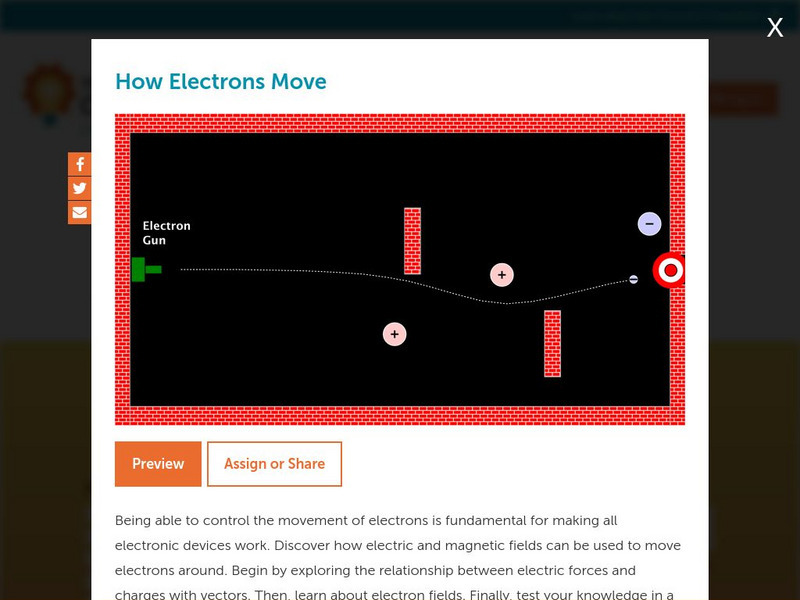
Concord Consortium: How Electrons Move
Being able to control the movement of electrons is fundamental for making all electronic devices work. Discover how electric and magnetic fields can be used to move electrons around. Begin by exploring the relationship between electric...
National High Magnetic Field Laboratory
Magnet Academy: The Tesla Coil
What's behind the cool purple sparks? Neat science about resonance and transformers. Slideshow: [6:00]
Science Buddies
Science Buddies: Make Your Own Electric Guitar Pickup
If you like playing electric guitar, this could be a cool project for you. In this project you'll wind one or more of your own electric guitar pickups and test them out in an inexpensive electric guitar to understand just how electric...
Science Buddies
Science Buddies: A Battery That Makes Cents
Batteries are expensive to purchase in a store, but you can make one your self for exactly 24 cents. In this experiment, you will make your own voltaic pile using pennies and nickels and determine how many coins in a pile will make the...
Science Buddies
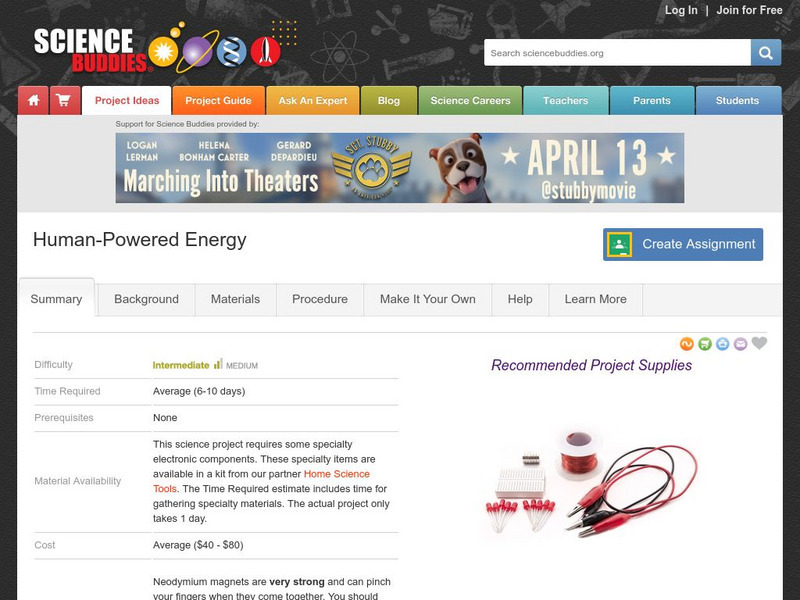
Science Buddies: Shaking Up Some Energy
Shake N' Light flashlights have been advertised on televisions across the nation in the recent year. But many do not understand just how they get energy to light up the bulb without using batteries. Do this experiment to make your own...
National High Magnetic Field Laboratory
Magnet Academy: Paul Lauterbur
Chemist Paul Lauterbur pioneered the use of nuclear magnetic resonance (NMR) for medical imaging. He developed a technique, now known as magnetic resonance imaging (MRI), in the early 1970s that involves the introduction of gradients in...
Science Struck
Science Struck: The Relationship Between Magnetism and Electricity
Provides a short explanation of the similarities between magnetism and electricity, the properties of their fields, and the effect they each have on a charged particle.