Hi, what do you want to do?





The Wonder of Science
The Wonder of Science: Ms Ps2 5: Electric, Magnetic, and Gravitational Fields
Work samples, phenomena, assessment templates, and videos that directly address standard: MS-PS2-5: electric, magnetic, and gravitational fields.

Exploratorium
Exploratorium: Science Snacks: Physics/electricity & Magnetism
Exploratorium Science Snacks are miniature science exhibits and experiments that can be made with common, inexpensive, easily available materials. These electricity snacks represent a set of devices that you can build and experiment with...
Science Buddies
Science Buddies: Rock On! Recording Digital Data With Magnets
This is a straightforward project that shows you how data can be digitized and stored on magnetic recording media. You'll learn how alpha-numeric characters are digitized, and you'll use bar magnets to represent the individual data...

Canada Science and Technology Museum
Canada Science and Technology Museum: Background Information for Electricity
The Canada Science and Technology Museum answers some of the most common questions about electricity. For example, get the definition of electricity, the difference between alternating and direct currents, and learn how a fuse works.
The Wonder of Science
The Wonder of Science: Ms Ps2 3: Electric and Magnetic Forces
Work samples, phenomena, assessment templates, and videos that directly address standard MS-PS2-3: electric and magnetic forces.
National High Magnetic Field Laboratory
Magnet Academy: Paul Lauterbur
Chemist Paul Lauterbur pioneered the use of nuclear magnetic resonance (NMR) for medical imaging. He developed a technique, now known as magnetic resonance imaging (MRI), in the early 1970s that involves the introduction of gradients in...
Science Buddies
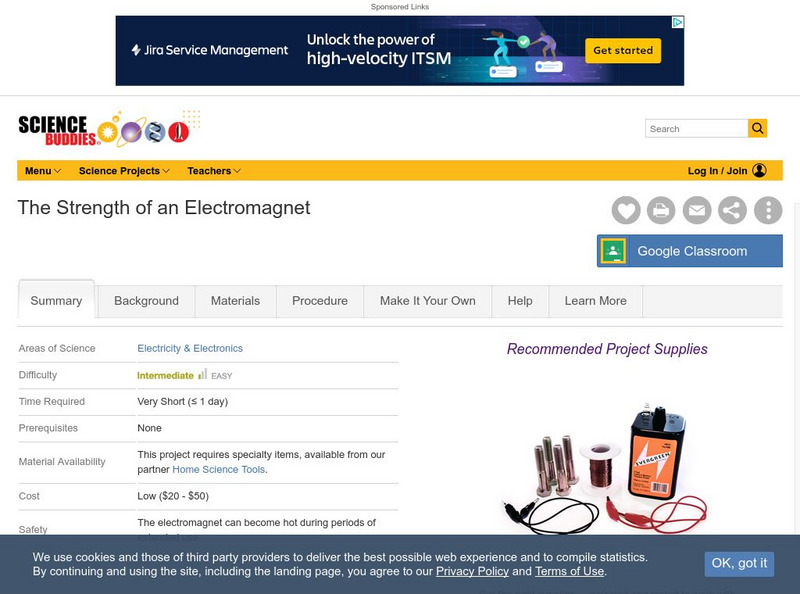
Science Buddies: The Strength of an Electromagnet
Has anyone ever told you that you have a magnetic personality? Have you ever heard that opposites attract? These common phrases are both based on the properties of magnets and magnetic electricity. In this science fair project, learn how...
The College Board
Ap Central: Ap Physics C: Electricity and Magnetism: The Course
CollegeBoard offers a page of resources for students and teachers of AP Physics C: Electricity and Magnetism. Find course and exam information, teaching resources, articles, and recommended links.
Science Buddies
Science Buddies: Make Your Own Electric Guitar Pickup
If you like playing electric guitar, this could be a cool project for you. In this project you'll wind one or more of your own electric guitar pickups and test them out in an inexpensive electric guitar to understand just how electric...
National High Magnetic Field Laboratory
Magnet Academy: Electricity Meter
When electricity became available to the masses, utilities needed meters to record customer usage. This early 20th century model resembles many in use today. (Java tutorial)
Florida State University
Florida State University: Magnet Lab: What Is a Bus Room?
The MagLab's bus tunnel has an aluminum track, but it doesn't carry passengers: it carries electricity, up to 56 megawatts of it.
National High Magnetic Field Laboratory
Magnet Academy: Capacitor
A capacitor is similar to a battery in that both store electrical energy. But a capacitor can't actually produce new electrons; it only stores them.
US Energy Information Administration
U.s. Eia Energy Kids: Energy Sources: Electricity
A basic description of electricity and the role it plays in everyday life.
Other
Magnet Man: Cool Experiments With Magnets
Here is a lengthy listing of activities and resources pertaining to magnets and magnetism. Experiments which can be performed with many different types of magnets are described; detailed directions and photos are provided.
Thomas Jefferson National Accelerator Facility
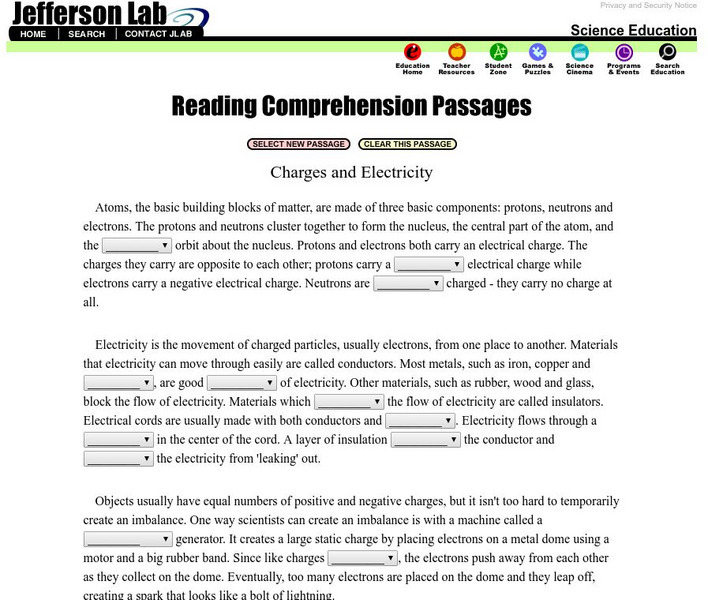
Jefferson Lab: Reading Passages: Charges and Electricity
Read and fill in the blanks of this passage explaining charges and electricity. Each blank has a dropdown menu with choices. When you finish, click CHECK MY ANSWERS. If you pick a wrong answer, the right answer will be displayed along...
Other
Magnet Lab: Physics Lessons by Science Joy Wagon
These physics lessons and tutorials are designed to be a resource for learning introductory level, algebra-based physics. Organization is by topic, but a search option is available for quickly finding specific information. Although most...
Society for Science and the Public
Science News for Students: Like Electricity, but Magnetic
Describes research using magnetic monopoles that could one day lead to devices powered by magnetism or magnetricity, the name scientists have given this type of energy.
National High Magnetic Field Laboratory
Magnet Academy: Gold Leaf Electroscope 1787
For centuries, the electroscope was one of the most popular instruments used by scientists to study electricity. Abraham Bennet first described this version in 1787.
National High Magnetic Field Laboratory
Magnet Academy: Oersted Satellite, 1999
Named in honor of Danish physicist Hans Christian Oersted, Denmark's first satellite has been observing and mapping the magnetic field of the Earth.
National High Magnetic Field Laboratory
Magnet Academy: Wheatstone Bridge 1843
Read about the device used for measuring resistance in a circuit which was discovered in 1843, but had been invented a decade earlier. The inventor's name was not Wheatstone.
National High Magnetic Field Laboratory
Magnet Academy: Electrostatic Generator
Though simple by today's standards, the early electrostatic generators were a great milestone in humankind's understanding of electricity, allowing scientists to produce electricity so they could study it. (Java tutorial)
Science and Mathematics Initiative for Learning Enhancement (SMILE)
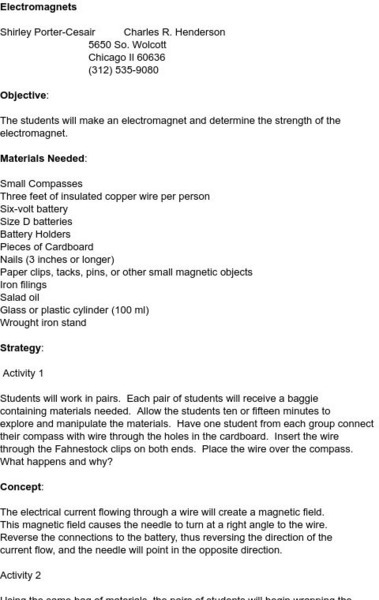
Smile: Electromagnets
This lesson plan contains several activities designed to help the student understand the magnetic effects of an electrical current.
American Association of Physics Teachers
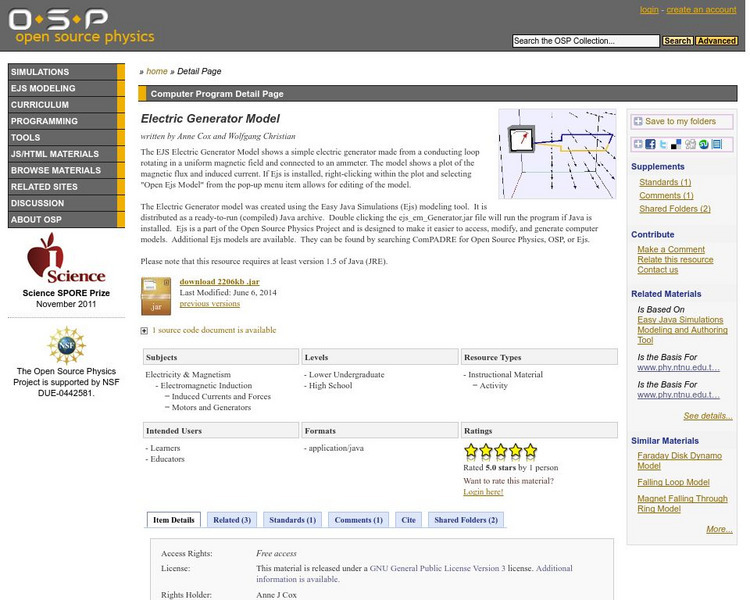
Com Padre Digital Library: Open Source Physics: Electric Generator Model
An electromagnetic induction model that simulates an electric generator made from a conducting loop rotating in a uniform magnetic field and connected to an ammeter.
Florida State University
Florida State University: Magnet Lab: Discovery of Electromagnetism
Two scientists share the credit for discovering, and then interpreting, the phenomenon of electromagnetism.