Hi, what do you want to do?





Texas Education Agency
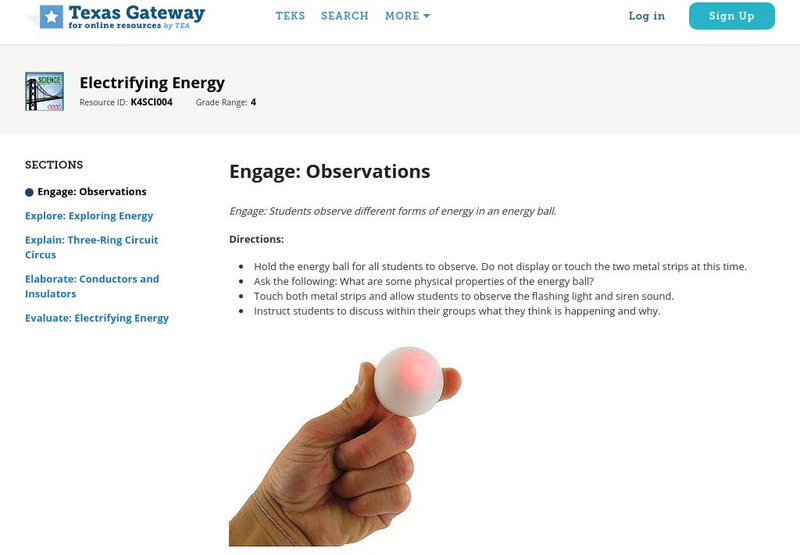
Texas Gateway: Electrifying Energy
This tutorial reviews over electrical energy.

Science Buddies
Science Buddies: Build Your Own Windmill Generator
Build your own windmill and see how the wind can be converted into energy to produce electricity. This science fair project should help you understand the use of wind as a source of alternative energy. The Science Buddies project ideas...
CK-12 Foundation
Ck 12: Forces on Charged Objects
[Free Registration/Login may be required to access all resource tools.] Students learn which subatomic particles contribute to static electricity, and determine the charge of an object based on what particles it has gained or lost.
Concord Consortium
The Concord Consortium: Molecular Workbench: The Hall Effect
Adjust the magnetic field in this simulation to see how the flow of electricity is affected.

ClassFlow
Class Flow: Changing Circuits
[Free Registration/Login Required] The teacher will use this lesson plan flipchart to review circuits. This unit consolidates Children's knowledge of materials which are electrical conductors, extends understanding of ways in which the...

Georgia Department of Education
Ga Virtual Learning: Electrostatics
Through informational text, interactive activities, practice problems, and virtual simulations, students learn about the basic properties of electricity in this unit.
PBS
Pbs Learning Media: The Structure of Metal
In this interactive activity from the NOVA Web site, animations explain different aspects of the properties of metal.
Georgia Department of Education
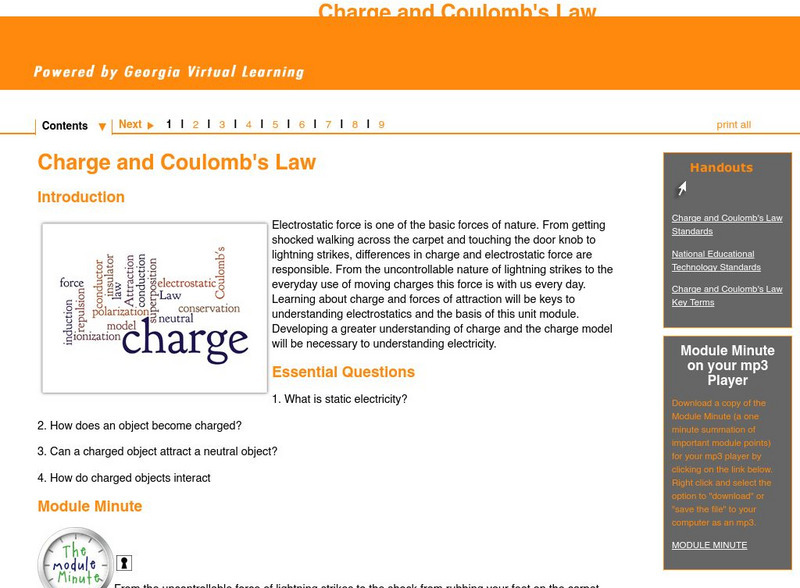
Ga Virtual Learning: Charge and Coulomb's Law
Learning about charge and forces of attraction will be keys to understanding electrostatics and the basis of this learning unit. Developing a greater understanding of charge and the charge model is necessary to understanding electricity.

ClassFlow
Class Flow: Turning on the Lights
[Free Registration/Login Required] In this lesson students learn the parts of a circuit, build series and parallel circuits, learn about insulators and conductors, and more in this interactive multimedia flipchart.
Intel Corporation
Intel Education: Circuits and Switches
By comparing household electricity to household plumbing, this tutorial makes the concepts of electricity easier to understand. Includes video clips and interactive activities; click on "Instructional Strategies" for teacher resources...

University of St. Andrews (UK)
University of St. Andrews: Charles Augustin De Coulomb
A large complete authoritative biography of Coulomb. Five large pictures, over a dozen links to contemporaries, references, a poster, other mathematicians. A fine source.
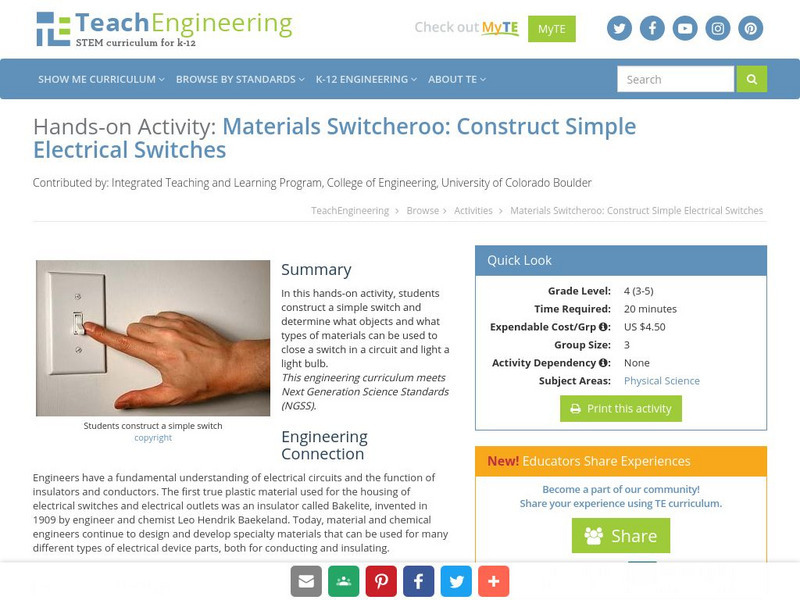
TeachEngineering
Teach Engineering: Switcheroo
In this hands-on activity, students construct a simple switch and determine what objects and what types of materials can be used to close a switch in a circuit and light a light bulb.
Maryland Science Center
Maryland Science Center: Build a Conductivity Tester [Pdf]
Instructions on how to build an instrument that can be used to test which materials are conductors and which are insulators, in order to bridge a gap in an electrical circuit.

Khan Academy
Khan Academy: Conservation of Charge Review
Review the conservation of charge and how charge is transferred in various scenarios.
Channel 4 Learning
4 L: Science Essentials: Get Physical
Find a review of many aspects of the physical world. Simple explanations of electricity, gravity, and the solar system. Included are materials for teachers to use for enrichment.
Science Education Resource Center at Carleton College
Serc: Elements Metals, Nonmetals and Metalloids
Students investigate several properties of the given elements and decide whether each element is a metal, non-metal, or a metalloid.
Other
University of Delaware Physics Department: Lithography
University of Delaware Physics Department provides this indexing page for a slide show presentation.
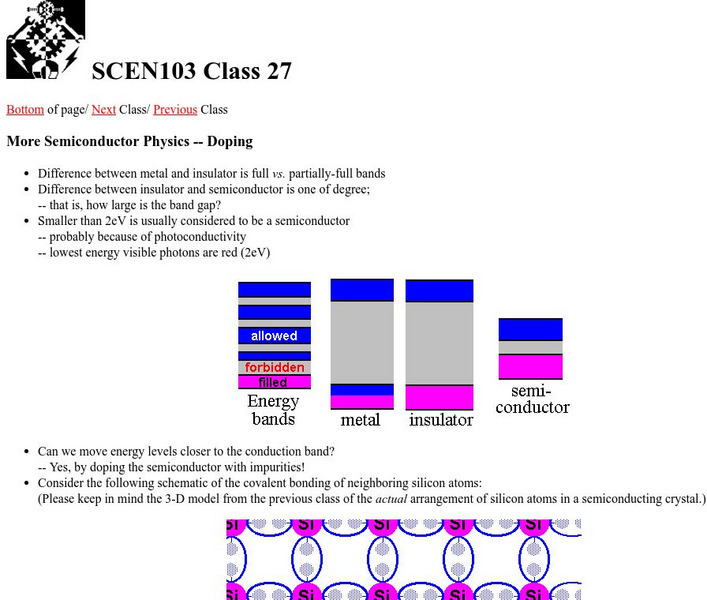
Other
Univ. Of Delaware Physics: More Semiconductor Physics
The University of Delaware Physics Department provides this site from a site titled "Silicon, Circuits, and the Digital Revolution," here is a series of four pages which explain the details behind how semiconductors work. An introduction...

National High Magnetic Field Laboratory
Magnet Academy: Heat Resistance
Heating a metal conductor makes it more difficult for electricity to flow through it. See why in this tutorial. (Java tutorial)
Science and Mathematics Initiative for Learning Enhancement (SMILE)
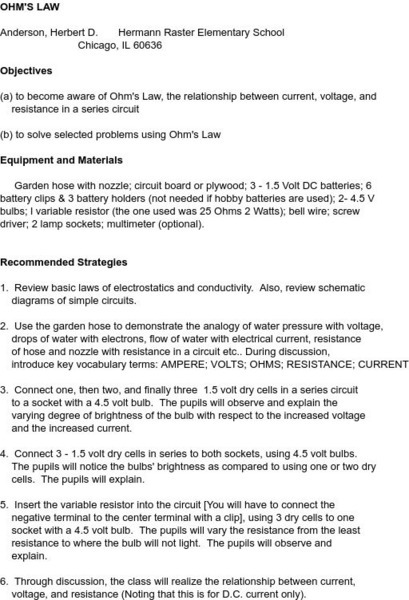
Smile: Ohm's Law
For the teacher planning a lesson plan or for the student preparing for a project or presentation. This page describes a series of simple activities related to the voltage-current-resistance relationship.
Other
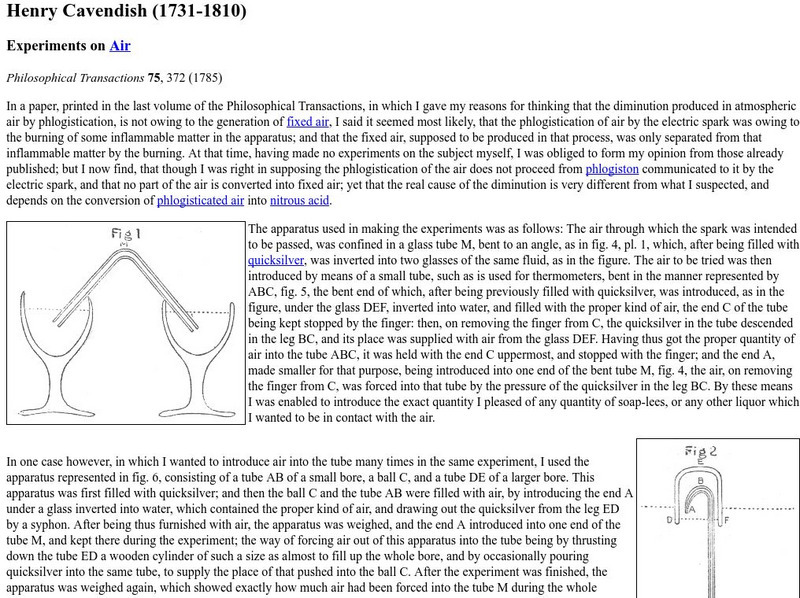
Experiments on Air by Henry Cavendish
Cavendish's 1785 original paper on phlogiston and air. Fascinating reading.
Science4Fun
Science4 Fun: Copper
Fun and interesting information about Copper, the second best conductor of electricity. Learn about its characteristics, uses, where it is found, and discovery.
Michigan State University
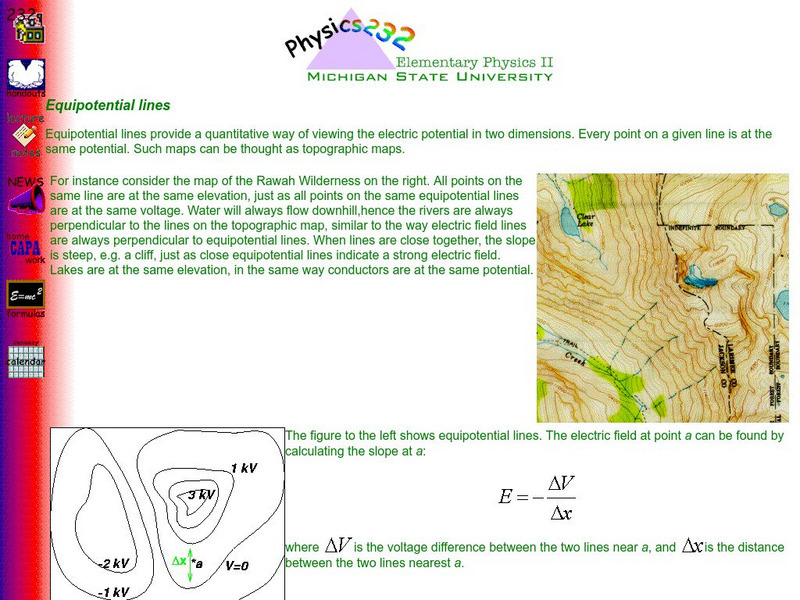
Michigan State University: Equipotential Lines
This site is from Michigan State University's Elementary Physics II class and details equipotential lines. The site displays maps and diagrams as well as formulas and rules for these types of lines.