Hi, what do you want to do?





Sophia Learning
Sophia: Electromagnetic Waves: Lesson 2
This lesson will show how a particle can travel in a wave form, by following perpendicular electric and magnetic fields. It is 2 of 4 in the series titled "Electromagnetic Waves."
Sophia Learning
Sophia: Electromagnetic Waves: Lesson 3
This lesson will show how a particle can travel in a wave form, by following perpendicular electric and magnetic fields. It is 3 of 4 in the series titled "Electromagnetic Waves."
Sophia Learning
Sophia: Electromagnetic Waves: Lesson 4
This lesson will show how a particle can travel in a wave form, by following perpendicular electric and magnetic fields. It is 4 of 4 in the series titled "Electromagnetic Waves."

Physics Aviary
Physics Aviary: Thomson's Cathode Ray Tube Lab
This lab is designed to have students look at the deflection of a cathode ray beam using magnetic fields and electric fields.

National High Magnetic Field Laboratory
Magnet Academy: Luigi Galvani
Luigi Galvani was a pioneer in the field of electrophysiology, the branch of science concerned with electrical phenomena in the body. His experiments with dissected frogs and electrical charges led him to suggest the existence of a...

National High Magnetic Field Laboratory
Magnet Academy: Humphry Davy
Humphry Davy was a pioneer in the field of electrochemistry who used electrolysis to isolate many elements from the compounds in which they occur naturally. Electrolysis is the process by which an electrolyte is altered or decomposed via...

National High Magnetic Field Laboratory
Magnet Academy: Julian Schwinger
Theoretical physicist Julian Schwinger used the mathematical process of renormalization to rid the quantum field theory developed by Paul Dirac of serious incongruities with experimental observations that had nearly prompted the...

National High Magnetic Field Laboratory
Magnet Academy: Magnetic Core Memory 1949
At the dawn of the computer age, magnetic core memory helped make data storage possible, and showed surprising staying power in a field where components are constantly being replaced by new and improved products.

National High Magnetic Field Laboratory
Magnet Academy: Gerd Binnig
Gerd Binnig co-developed the scanning tunneling microscope (STM) with Heinrich Rohrer. The STM allowed scientists entry into the atomic world in a new way and was a major advance in the field of nanotechnology. For their achievement,...

National High Magnetic Field Laboratory
Magnet Academy: Paul Dirac
Paul Adrien Maurice Dirac was an outstanding twentieth century theoretical physicist whose work was fundamental to the development of quantum mechanics and quantum electrodynamics. He was awarded the Nobel Prize for Physics jointly with...

National High Magnetic Field Laboratory
Magnet Academy: Eric Cornell
Born in Palo Alto, California, and raised in Cambridge, Massachusetts - homes to Stanford and the Massachusetts Institute of Technology, respectively - you could say Eric Cornell was destined to become a renowned scientist. And while he...
Florida State University
Florida State University: Lightning, a Natural Capacitor
Text and animated graphic show how lightning is an example of a natural capacitor.
Massachusetts Institute of Technology
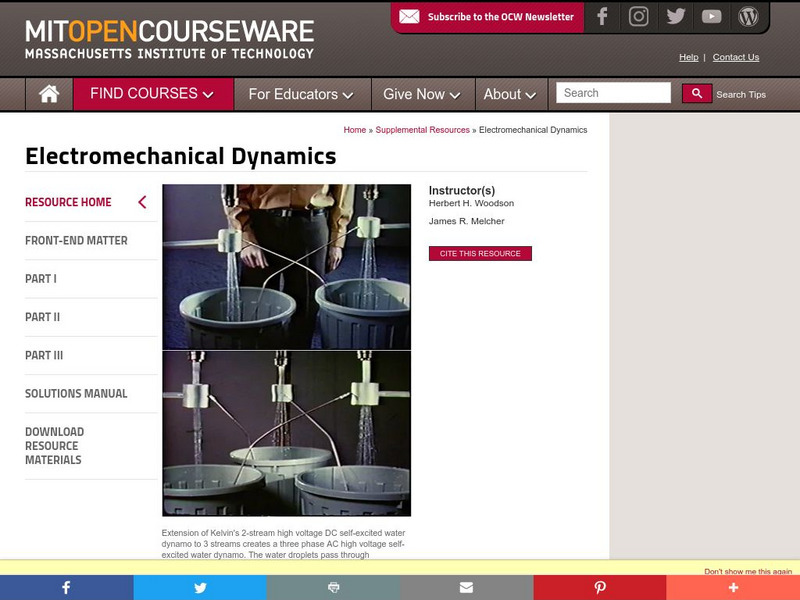
Mit: Open Course Ware: Supplemental Resources: Electromechanical Dynamics
College-level textbook highlighting the interaction of electromagnetic fields with media in motion. Types of electromechanical interactions discussed include rotating machinery, plasma dynamics, the electromechanics of biological...
Exploratorium
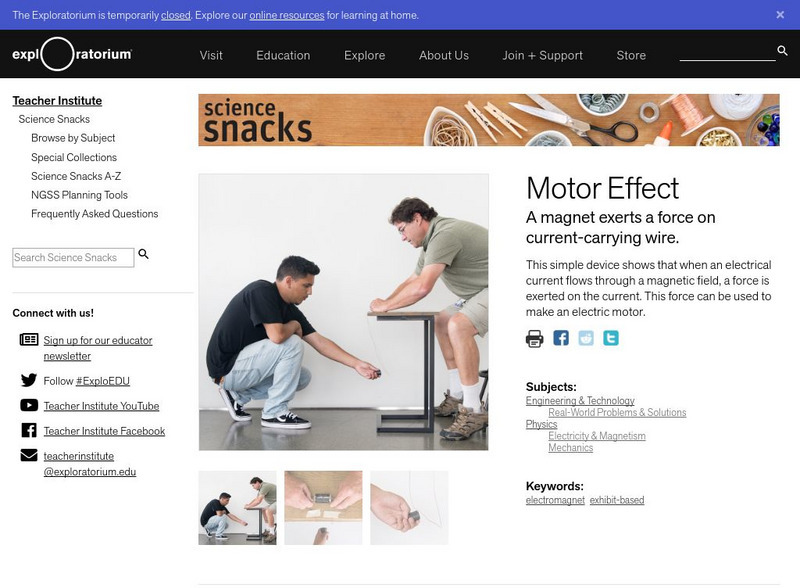
Exploratorium: Science Snacks: Motor Effect
"A magnet exerts a force on current-carrying wire." This simple device shows how magnets affect wires with current in them, the basis of the electric motor. If you see, feel and understand this, the electric motor becomes very clear.
CK-12 Foundation
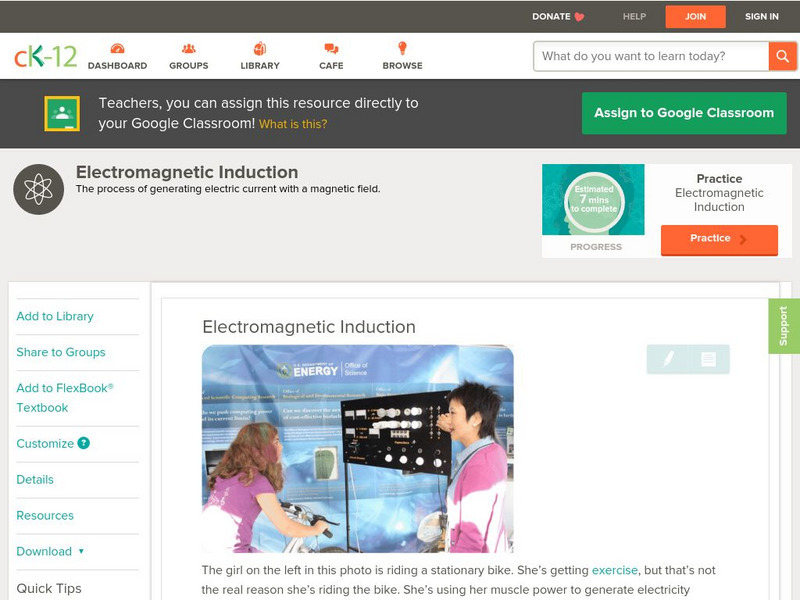
Ck 12: Physical Science: Electromagnetic Induction
[Free Registration/Login may be required to access all resource tools.] Covers what electromagnetic induction is, how it occurs, the current produced from it, and how it is used.
TeachEngineering
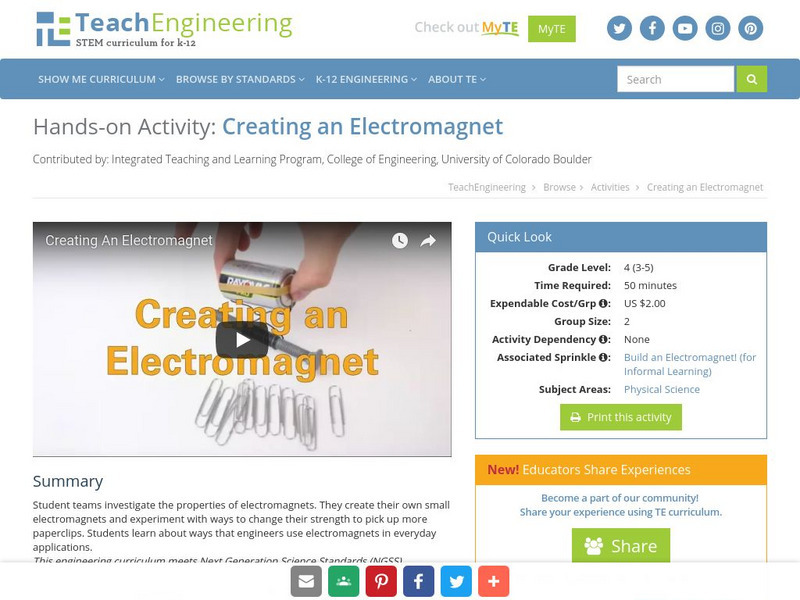
Teach Engineering: Building an Electromagnet
Student teams investigate the properties of electromagnets. They create their own small electromagnet and experiment with ways to change its strength to pick up more paper clips. Students learn about ways that engineers use...
Science and Mathematics Initiative for Learning Enhancement (SMILE)
Smile: Introduction to Magnets (Classroom Unit)
A teacher unit which includes several hands-on activities about types of magnets, magnetism, and electrostatics. An activity designed to suit all grade levels. Many parts of the activity would be easily adaptable as a student project.
Cornell University
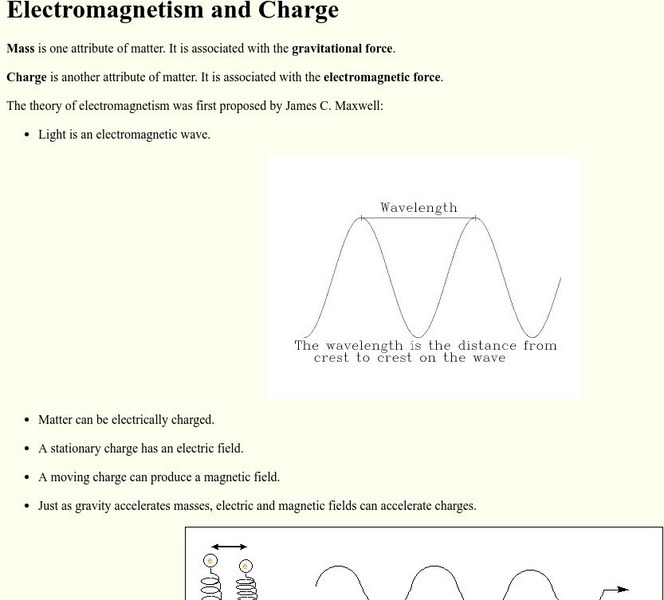
Cornell University: Astronomy: Electromagnetism and Charge
This site from Cornell University provides a very short, very telling comparison of matter and charge. This is a good site to check out on the subject, with a chart diagram to help with further information.
University of Colorado
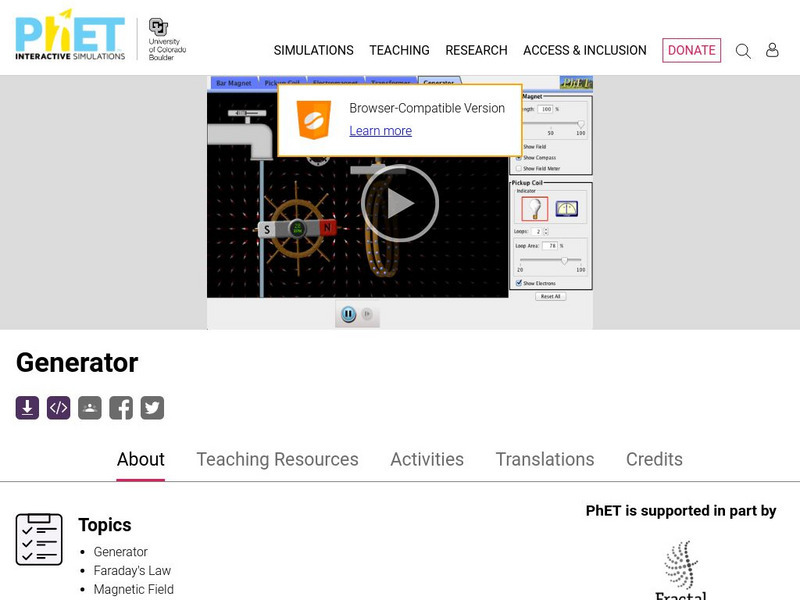
University of Colorado: Ph Et Interactive Simulations: Generator
Generate electricity with a bar magnet! Discover the physics behind the phenomena by exploring magnets and how you can use them to make a bulb light. Java required.
University of Colorado
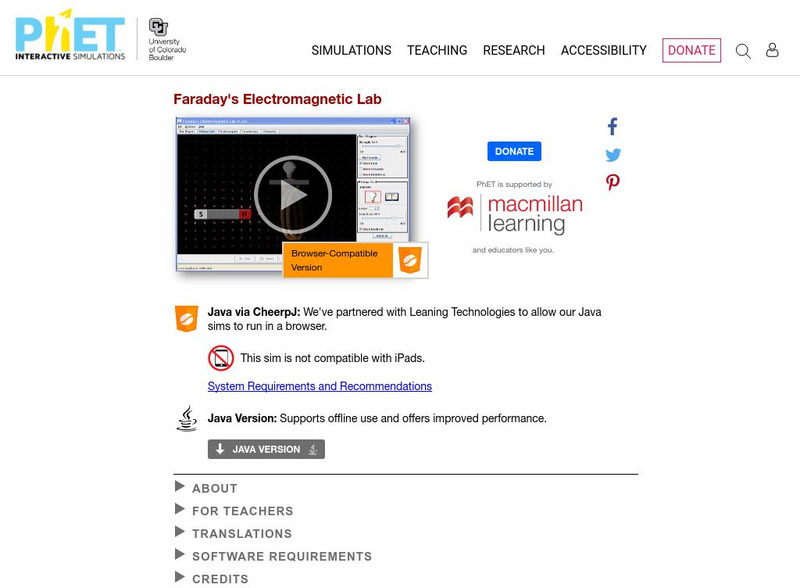
University of Colorado: Ph Et Interactive Simulations: Faraday's Electromagnetic Lab
Investigate with a bar magnet and coils to learn about Faraday's law. You can also play with electromagnets, generators, and transformers!
University of Colorado
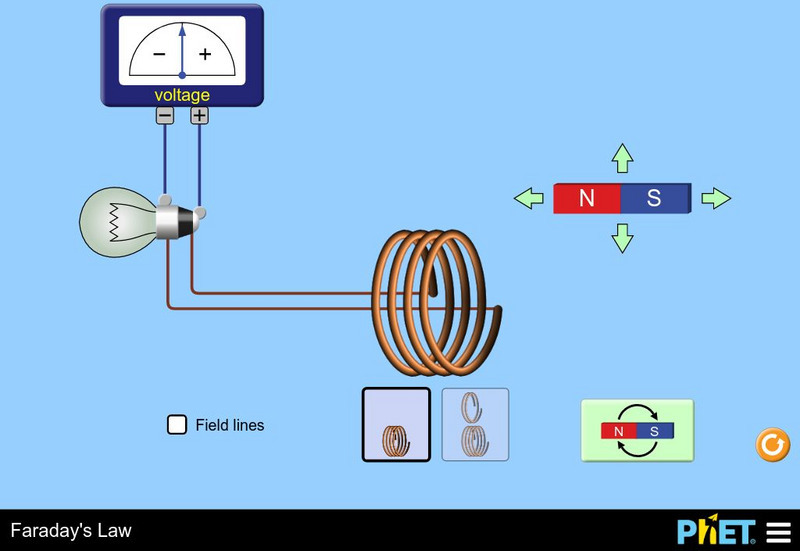
University of Colorado: Ph Et Interactive Simulations: Faraday's Law
Investigate Faraday's law and how a changing magnetic flux can produce a flow of electricity!
University of New South Wales (Australia)
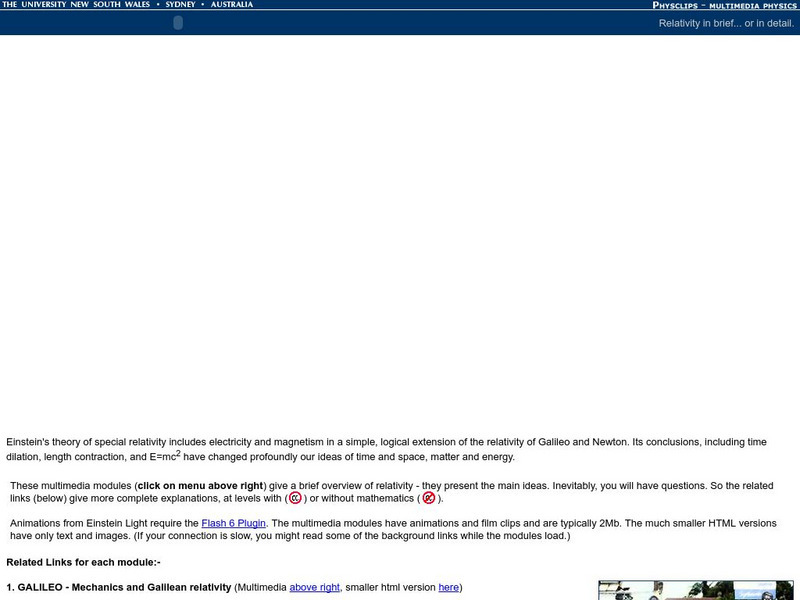
University of New South Wales: Einstein Light
Einstein Light highlights the Theory of Special Relativity and related topics. Learn how Galileo, Maxwell, and Einstein contributed to our knowledge of relativity, electricity, magnetism, and time by watching fun, interactive modules.
Georgia State University
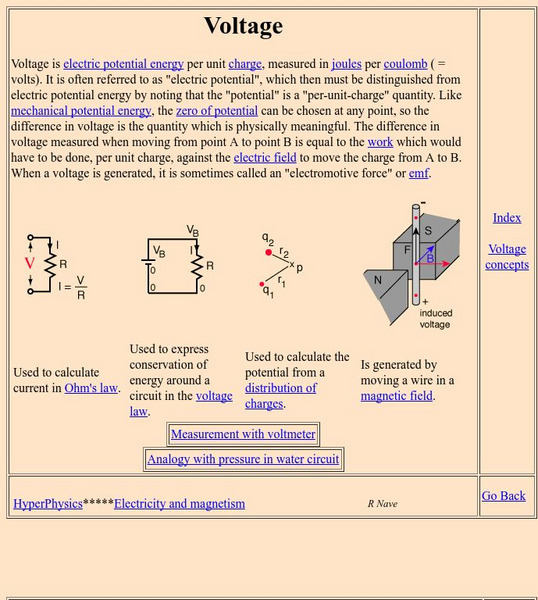
Georgia State University: Hyper Physics: Voltage
Electrical currents and voltage are defined and illustrated.
Concord Consortium
The Concord Consortium: Molecular Workbench: Lorentz Force 3 D
Adjust the magnetic field intensity and the particle speed in this simulation to observe the affect the movement of the particle.