Hi, what do you want to do?






Illustrative Mathematics
Voting for Three, Variation 3
Get your learners to think outside the box. Students require a good understanding of ratios and their relationship to fractions to complete the problem. The only quantities given in the problem are the ratio of the number of votes for...

Illustrative Mathematics
Voting for Three, Variation 2
Here is another opportunity for math students to apply reasoning to solve real-world problems with ratios. The ratio of the number of votes for two candidates is provided. Your class is asked to use this ratio and information given about...

Illustrative Mathematics
Election Poll, Variation 1
Your class will learn what it means to take a random sample of a population and to draw inferences from the information gained. In part a, of the exercise, you discuss with your class how students during a class election can be best...

Illustrative Mathematics
Voting for Three, Variation 1
This is an opportunity for young mathematicians to apply reasoning to solve real-world problems with ratios. Even though there are three candidates for class president, students will only consider two at a time, making the first problem...

Curated OER
Election Poll, Variation 2
When a random sample isn't enough, your math class can compare the data from a physical simulation to decide if the probability is still likely. The activity is part of a probability series that focuses on one question and different ways...

Curated OER
Election Poll, Variation 3
Build on probability and incorporate a random number generator to select outcomes for a school election. Your learners will record their results on a dot plot and answer questions regarding whether their candidate has a chance at the...

Illustrative Mathematics
Voting for Two, Variation 4
After elections, the total amount of votes is not specified but the ratio of votes is. Your learners' job is to determine the fraction of votes John received above half of all votes. The problem can be solved abstractly or by other...

Illustrative Mathematics
Voting for Two, Variation 2
John won the election, but by how much more? Your learners will calculate how many votes each candidate received in order to determine the difference. Use with other lessons provided in the series to practice different variations of this...

Illustrative Mathematics
Voting for Two, Variation 3
After calculating election votes, your learners must determine how many votes the winner, John, got above 50%. This multi-step problem encourages them to think in a deeper way about what the question is asking them to find. Use with...

Illustrative Mathematics
Voting for Two, Variation 1
The votes are in and your mathematicians are going to calculate how many votes each candidate received. Three different solution choices are given, depending on which method is taught. Have your learners set up a table, compute parts, or...

Illustrative Mathematics
Electoral College
A cross-curricular resource that takes the electoral votes and allows your learners to organize and analyze the data. Young voters can determine which states are more influential and interpret the dotplot provided for more data....
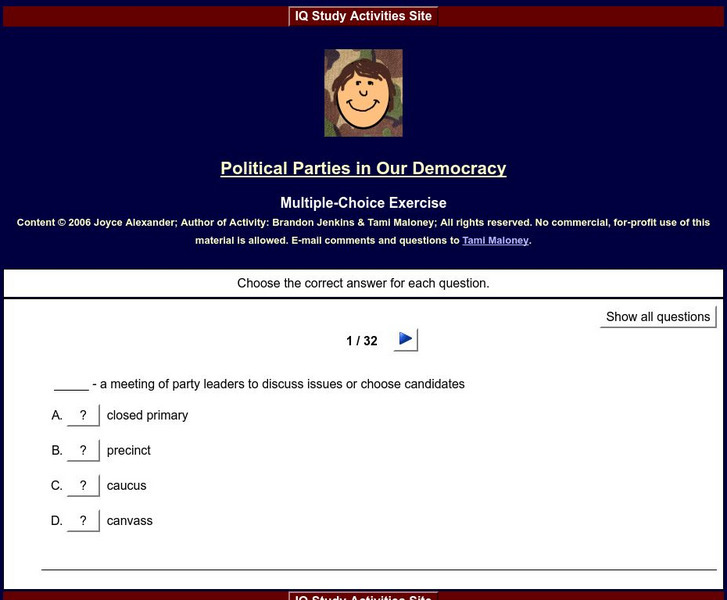
IQ Site
Iq Study Activities: Interactive Quizzes: Political Parties in Our Democracy
Thirty-two multiple-choice questions test your knowledge of political parties and the election process. Score is kept throughout the exercise and displayed at the end of the activity.