Hi, what do you want to do?






Council for Economic Education
Econ Ed Link: Bringing the Market to the Farm
This printable lesson discusses producers and consumers from an agricultural perspective. It focuses on choices that the consumer has with regard to purchasing agricultural goods (e.g. fruits and vegetables). As an example, it uses...
Digital History
Digital History: Foreign Competition
This site describes how by the 1970s, foreign manufacturers were embedded in the U.S. markets. For the U.S., this meant a loss of sales, a loss of jobs, and a loss of economic confidence.
Council for Economic Education
Econ Ed Link:i Don't Want Much, Just Want More: Allocation
This student version of an economics lesson plan focuses on allocation. For a lesson about how the rule of force motivates, check out this informative website.
Tutor2u
Tutor2u: Perfect Competition Introduction
This website describes the conditions of a "perfectly competitive" market structure, and the obstacles that the individual firm in this market will face.
Schools of California Online Resources for Education
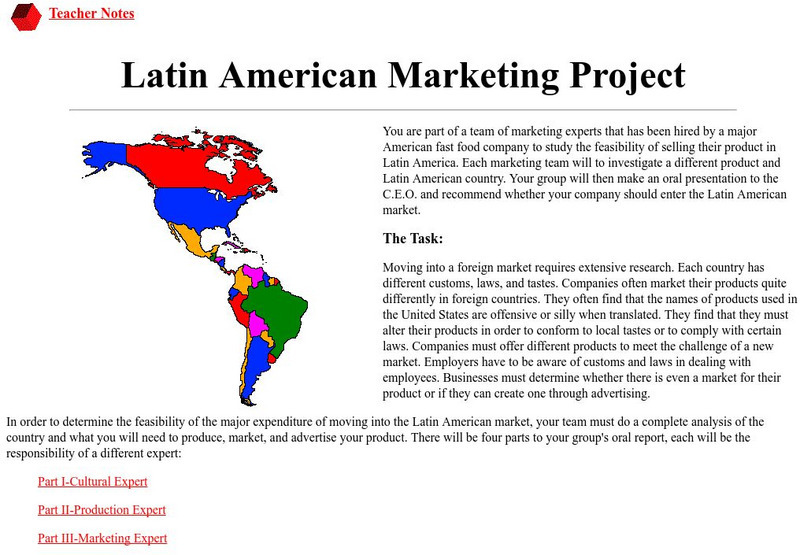
Score: Latin American Marketing Project
This site from Score provides information on the global marketplace. This is a unit where students are grouped to find out the best Latin American country to introduce a new fast food business. Site is very well outlined and includes...
Council for Economic Education
Econ Ed Link: Believe It or Not?
This lesson reveals to students how advertisers use words and images to make goods and services look their best. To protect consumers and make sure that competition among sellers is fair in the marketplace, the federal government...
Council for Economic Education
Econ Ed Link: Chevy Volt It's Electric!
The costs and benefits of owning an electric or hybrid car will be evaluated in this lesson plan. By reading and researching the history of the production of electric cars, the lesson plan allows students to understand how this market...
Council for Economic Education
Econ Ed Link: History of Monopolies in the United States
Monopolies in the United States have existed in many forms. When a business dominates a market, its market power makes it a monopoly. How these businesses use their market power will determine the legality of the monopoly.
Council for Economic Education
Econ Ed Link: What Happened to Railroads?
Between the Civil War and World War II, railroads were one of the nation's most important businesses and an integral part of people's lives. In this instructional activity, students assume the role of detectives investigating why the...
Council for Economic Education
Econ Ed Link: Be an Ad Detective
Every day, students are bombarded by advertising. They cannot escape it. But marketers realize that many ypung people are becoming very good at tuning ads out. Businesses thus are becoming more creative in their communication with...
Council for Economic Education
Econ Ed Link: Deregulation and the California Utilities
"The verdict is in: California's experiment with energy deregulation is not just a mess; it's a certifiable failure, according to everyone from the state governor to the very utilities that initially backed the scheme." This is how...
Tutor2u
Tutor2u: Oligopoly
This site lists the characteristics of an oligopoly, and discusses price competition, non-price competition, and price leadership.
Digital History
Digital History: Transforming American Law
Changes in American law promoted economic growth. See how private companies were protected from penalties and liabilities, and were given special privileges because they contributed to the public good.
Curated OER
Monopolistically Competitive Firm in Long Run Equilibrium
This site uses interactive graphs to show how changes in demand would change a firm's output, price, and profits or losses in a monopolistically competitive market structure.
Curated OER
Perfect Competition
This site shows costs curves for a firm in a perfectly competitive market, and has an interactive graph to show what their profit margin is at various levels of production.

Council for Economic Education
Econ Ed Link: Us and Eu Go Bananas Over Trade
Economists generally agree that free trade helps to improve the overall quality of life in countries that participate. However, disagreements do arise concerning trade agreements. This lesson looks at a disagreement between the US and EU...
Council for Economic Education
Econ Ed Link: Guess Who's Coming to Dinner
This lesson introduces regulation and information as two tools used by government to promote fair competition and complete information in a market economy. Using the 1906 Pure Food and Drugs Act as a case study, students explore the...
Council for Economic Education
Econ Ed Link: Business Ownership: The Franchise Option
Students explore an alternative to starting a business from scratch- investing in a franchise. They begin by considering the pros and cons of a franchise and whether this form of business is an option that would fit their personality and...
Yale University
Yale Department of Economics: Surplus Labor [Pdf]
An evaluation of the microeconomics of surplus labor, this 26-page requires Adobe Acrobat.
Council for Economic Education
Econ Ed Link: Did You Get the Message?
Advertising is the primary tool used by businesses to tell consumers about the goods and services they sell in the marketplace. Businesses also use advertising to try to convince consumers to buy what they are selling. Advertisements do...
Council for Economic Education
Econ Ed Link: Fad or Fortune
This lesson focuses on collectibles and how they retain, lose, or gain value. In each round of a trading simulation, students will learn more about the value of their collectibles and discuss why items gain or lose value. They will...