Hi, what do you want to do?






Curated OER
Property Rights: Soviet Farms
Young scholars examine the problems with the collectivized agriculture program in the Soviet Union. They listen to a teacher-led lecture, participate in a property rights scenario activity, create a plan for maximizing the value of...

Curated OER
Johnson's Great Society (5)
In this online interactive American history worksheet, students answer 15 matching questions regarding Lyndon B. Johnson and the Great Society. Students may submit their answers to be scored.

Curated OER
Absolutely, Positively a Force in China
Young scholars explore the concept of company expansion. In this company expansion lesson, students read an article about FedEx and how it was able to expand. Young scholars discuss how FedEx was able to expand. Students discuss reasons...

Curated OER
The Free Trade Conundrum: Balancing Worker Wages and Consumer Prices Comparing the 19th and 21st Centuries
Exploring the concepts of free trade and protectionism, students compare and contrast 19th and 21st century arguments for and against the tariff.

Curated OER
Islam or Christianity?
Students design a mosaic depicting the city of Constantinople during determined periods of history. They include historical evidence that shows whether the city was under Muslim or Christian rule.

Curated OER
Fueling the Fires of Industrialization
Students review photos and discuss the role wood played in the American Industrial Revolution. They brainstorm a list of items which come from trees and complete worksheets as part of assessment.

Curated OER
How Can Business Profit from Tariffs? p1
Students investigate the impact of tariffs on businesses and consumers during the 1880s by looking at a political cartoon, solving a short math problem and comparing protectionism in the 1980's to protectionism in the 1880's.

Curated OER
Trading Around the World
Students role play as international traders from different continents. They negotiate prices and resolve trade barriers to better their understanding of free trade.

Curated OER
The Price of European Commodities in 1803
Students peruse actual price lists of European commodities dealers Strobel and Martini of Bordeaux, France. Each student creates a sales receipt of items that they have purchased from the French Brokerage firm. Students explore how the...

Robert Schenk, PhD
Cyber Economics: Monopolistic Competition
E-learning site uses an example of "pushcarts on the beach" to demonstrate a monopolistically competitive market structure and how, as more firms enter the market, price, quantity, and deadweight loss are all affected.

Annenberg Foundation
Annenberg Learner: Economics U$a: 21st Century Edition
A micro and macroeconomics course for 21st century learners. 28 half-hour videos sessions with text and guides regarding markets, firms, supply and demand, perfect competition and inelastic demand, economic efficiency, monopolies,...

Other
Foundation for Teaching Economics: Homepage
The Foundation for Teaching Economics is committed to excellence in economic education. The Foundation offers free workshops for high school educators and students. This site includes workshop dates, locations, and registration...
Other
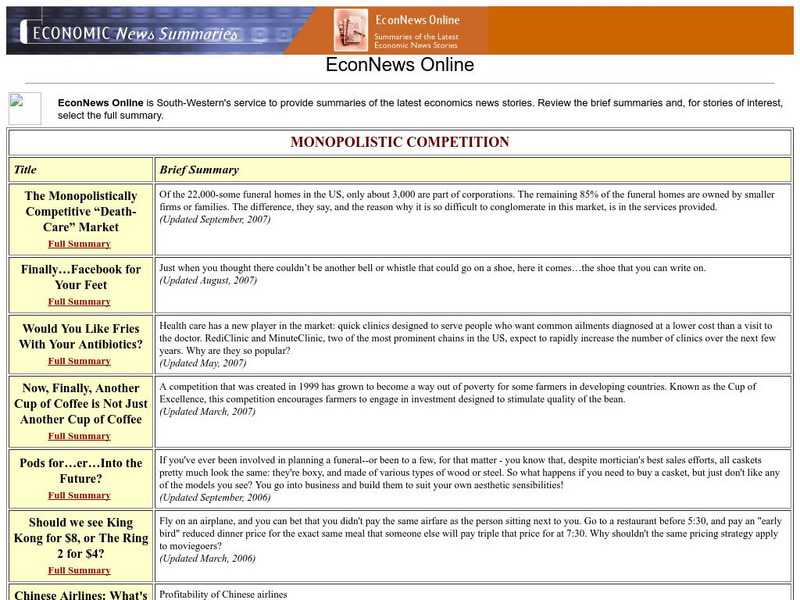
South Western Learning: Econ News: Monopolistic Competition
A wide variety of newspaper headlines are provided on the subject of economics and monopolistic competition. Each story comes with its own discussion questions.
Council for Economic Education
Econ Ed Link: The Economics of Professional Sports: Underpaid Millionaires?
Over the last century, professional baseball has grown to become one of the most popular forms of American entertainment. Indeed, the sport's nickname - "America's Pastime" - has become embedded in the nation's lexicon. More than 60...
Other
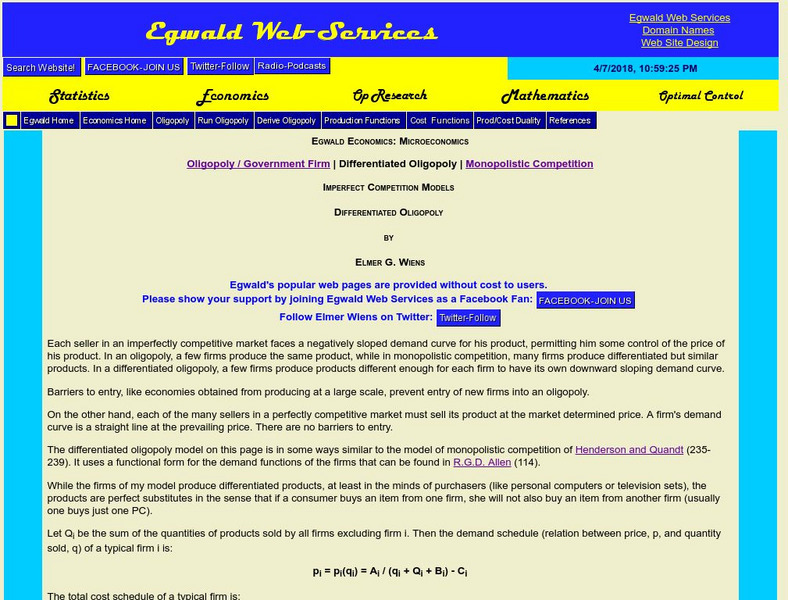
Egwald Web Services: Imperfect Competition Models: Differentiated Oligopoly
This site provides an in-depth study of a "differentiated oligopoly," and uses supporting graphs. For the advanced economics student.

Khan Academy
Khan Academy: Efficiency in Perfectly Competitive Markets
Why are perfectly competitive markets efficient?

Khan Academy
Khan Academy: Perfect Competition Foundational Concepts
Practice what you have learned about the foundational ideas behind perfectly competitive markets, including the characteristics of a perfectly competitive market, profit-maximization, and graphs of perfectly competitive firms.

Khan Academy
Khan Academy: Perfect Competition and Why It Matters
Read about the economic ideal of perfect competition.
Other
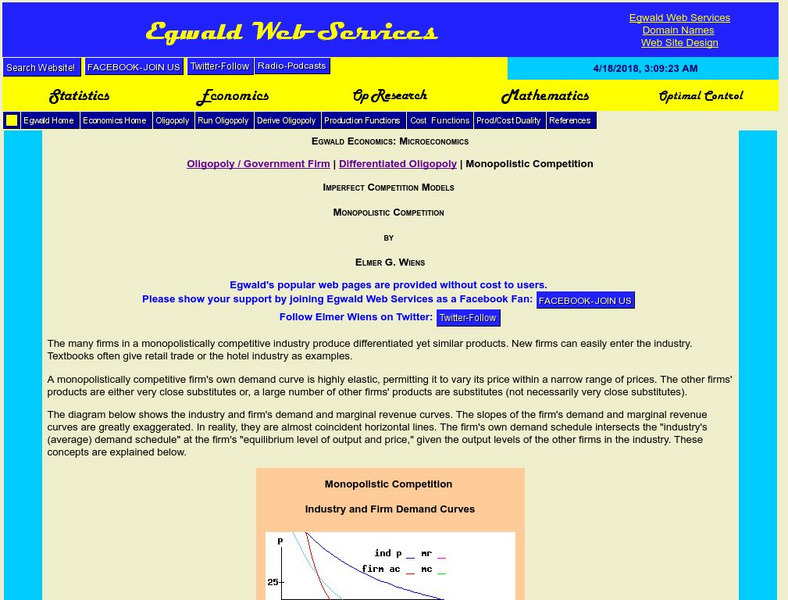
Egwald Web Services: Imperfect Competition Models: Monopolistic Competition
This site provides an in-depth examination of monopolistic competition, along with appropriate levels of output, price, and corresponding profits. This site is for the advanced student of economics.
Other
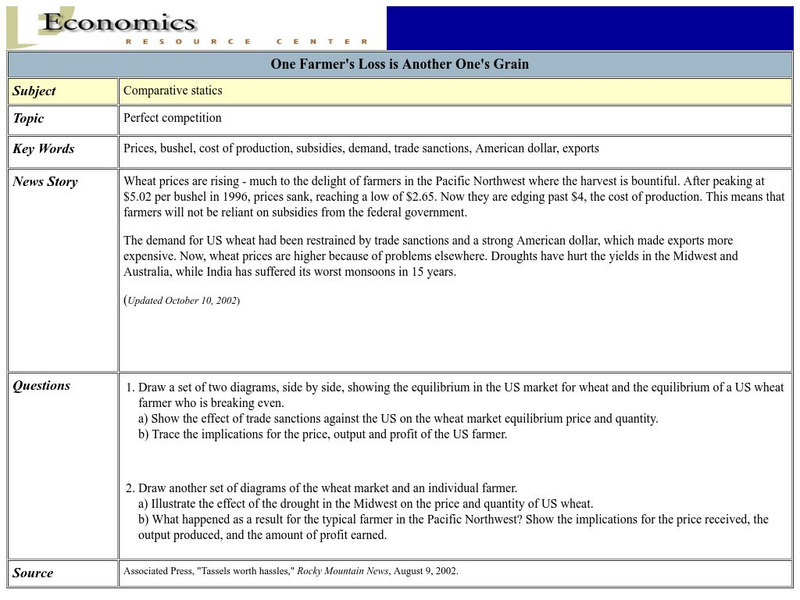
South Western Learning: Econ News: Comparative Statics: Perfect Competition
This site offers economics-based newspaper headlines and asks follow-up questions based on supply and demand in a perfectly competitive market.
Other
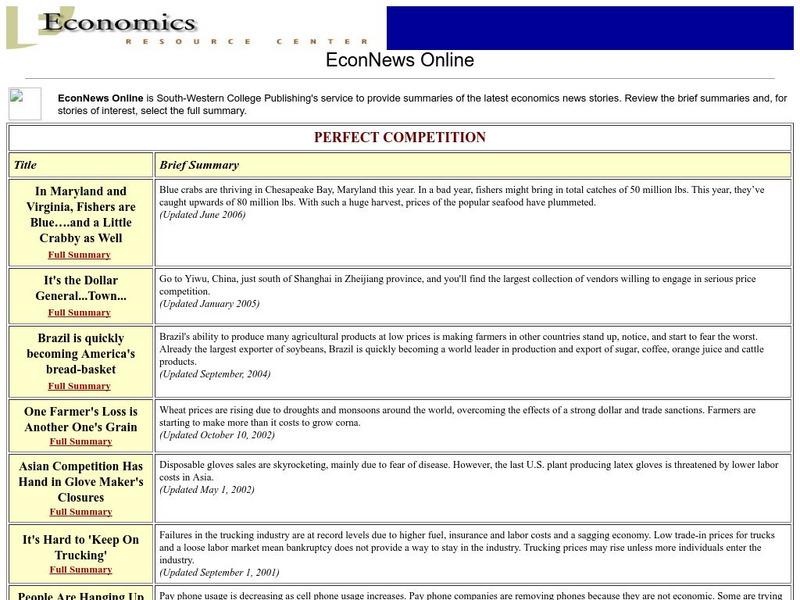
South Western Learning: Econ News: Perfect Competition
This site offers a variety of economics-related newspaper headlines in perfectly competitive markets, and each headline offers discussion questions related to that topic.

Other
Elemental Economics: Review of Basic Definitions: Competition
This site provides a good description of the four types of market structures: perfect competition, monopolistic competition, oligopoly, and monopoly, along with the major characteristics of each.
University of North Carolina
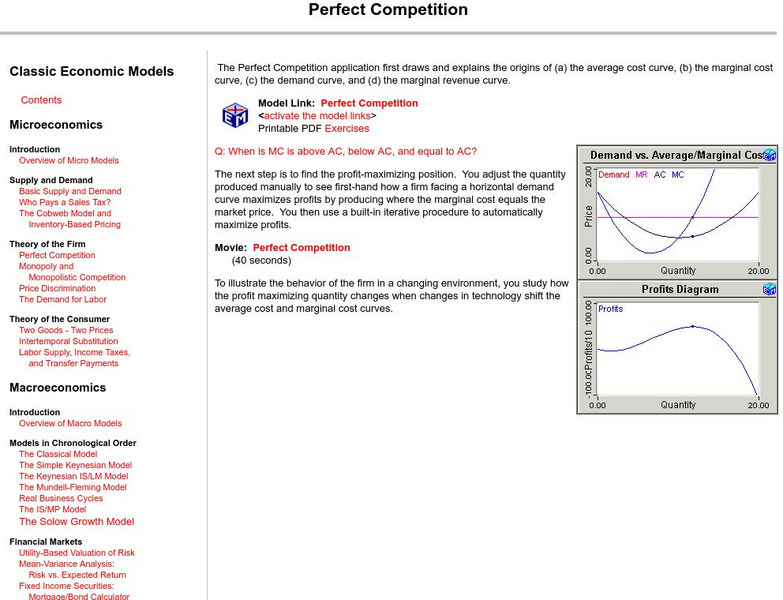
University of North Carolina: Perfect Competition
This site shows cost curves for a firm in a perfectly competitive market, and has an interactive graph to show what their profit margin is at various levels of production.
Other
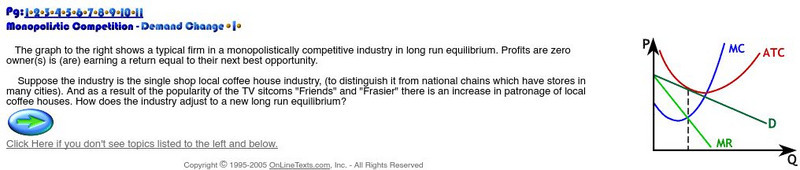
Online Texts: Monopolistic Competition: Demand Change
This site uses graphs to show how changes in demand would change a firm's output, price, and profits or losses in a monopolistically competitive market structure.