Hi, what do you want to do?






Other
Foundation for Teaching Economics: Homepage
The Foundation for Teaching Economics is committed to excellence in economic education. The Foundation offers free workshops for high school educators and students. This site includes workshop dates, locations, and registration...

Council for Economic Education
Econ Ed Link: The Economics of Professional Sports: Underpaid Millionaires?
Over the last century, professional baseball has grown to become one of the most popular forms of American entertainment. Indeed, the sport's nickname - "America's Pastime" - has become embedded in the nation's lexicon. More than 60...

Khan Academy
Khan Academy: Efficiency in Perfectly Competitive Markets
Why are perfectly competitive markets efficient?

Khan Academy
Khan Academy: Perfect Competition Foundational Concepts
Practice what you have learned about the foundational ideas behind perfectly competitive markets, including the characteristics of a perfectly competitive market, profit-maximization, and graphs of perfectly competitive firms.

Khan Academy
Khan Academy: Perfect Competition and Why It Matters
Read about the economic ideal of perfect competition.
Other
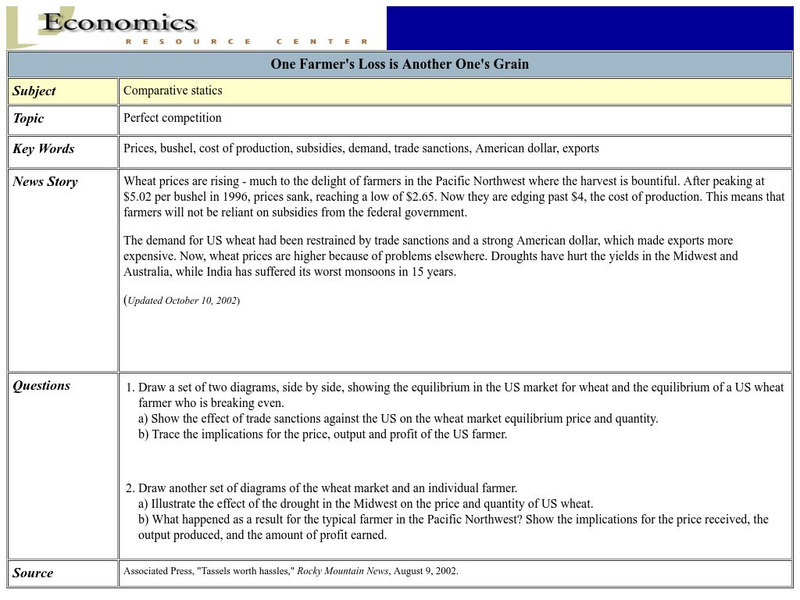
South Western Learning: Econ News: Comparative Statics: Perfect Competition
This site offers economics-based newspaper headlines and asks follow-up questions based on supply and demand in a perfectly competitive market.
Other
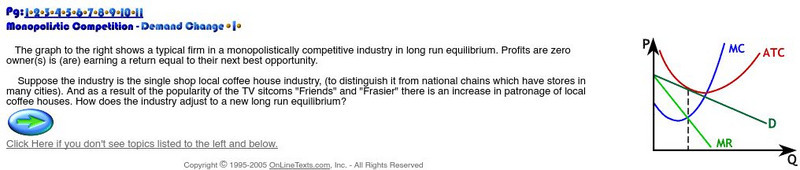
Online Texts: Monopolistic Competition: Demand Change
This site uses graphs to show how changes in demand would change a firm's output, price, and profits or losses in a monopolistically competitive market structure.
Council for Economic Education
Econ Ed Link:i Don't Want Much, Just Want More: Allocation
This student version of an economics lesson plan focuses on allocation. For a lesson about how the rule of force motivates, check out this informative website.
Tutor2u
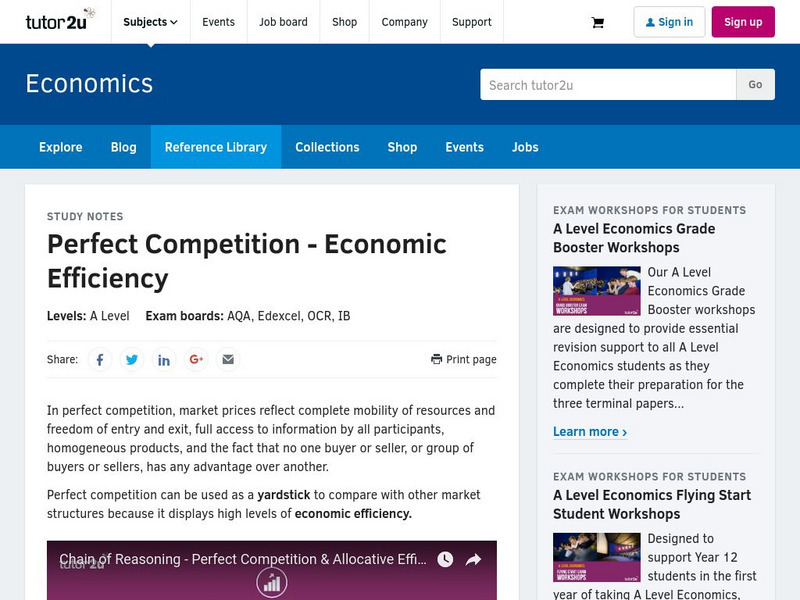
Tutor2u: Perfect Competition Introduction
This website describes the conditions of a "perfectly competitive" market structure, and the obstacles that the individual firm in this market will face.
Council for Economic Education
Econ Ed Link: History of Monopolies in the United States
Monopolies in the United States have existed in many forms. When a business dominates a market, its market power makes it a monopoly. How these businesses use their market power will determine the legality of the monopoly.
Tutor2u
Tutor2u: Oligopoly
This site lists the characteristics of an oligopoly, and discusses price competition, non-price competition, and price leadership.
Curated OER
Monopolistically Competitive Firm in Long Run Equilibrium
This site uses interactive graphs to show how changes in demand would change a firm's output, price, and profits or losses in a monopolistically competitive market structure.
Curated OER
Perfect Competition
This site shows costs curves for a firm in a perfectly competitive market, and has an interactive graph to show what their profit margin is at various levels of production.
Council for Economic Education
Econ Ed Link: Guess Who's Coming to Dinner
This lesson introduces regulation and information as two tools used by government to promote fair competition and complete information in a market economy. Using the 1906 Pure Food and Drugs Act as a case study, students explore the...
Yale University
Yale Department of Economics: Surplus Labor [Pdf]
An evaluation of the microeconomics of surplus labor, this 26-page requires Adobe Acrobat.
Council for Economic Education
Econ Ed Link: Fad or Fortune
This instructional activity focuses on collectibles and how they retain, lose, or gain value. In each round of a trading simulation, students will learn more about the value of their collectibles and discuss why items gain or lose value....