Hi, what do you want to do?






Curated OER
Fall Lesson Plans
Fall lesson plans can combine science, history, and writing into an enticing combination.

Curated OER
Taiga
In this taiga instructional activity, students read a short article describing what a taiga is and then answer 10 multiple choice, true or false or short answer questions relating to the article.

Curated OER
Look At Those Leaves!
Students observe, measure and sort leaves. In this leaf lesson students divide into groups and observe the different kinds of leaves.

Curated OER
Exploring the Night Sky: Fall/Winter
Learners explain how moon phases occur. They explain three ways that the night sky has been used through history. Students locate some of the constellations in the night sky. They discuss stories and myths surrounding stars.

Curated OER
Astronomy
Students complete a unit of lessons on our solar system, its stars, and astronomers. They record information in a space journal, design constellations, define key vocabulary, observe the phases of the moon, and create a group planet...

Curated OER
Ancient Sun Models of the World
Students explain that many different cultures across the world developed their own reasoning for the weather around them. They explore the different cultural beliefs of the sun's cycle and to create their own story of the sun's movement.

Curated OER
Precession
Students explain how Hipparchus, around 130 BC, used a shift in the predicted location of a lunar eclipse to detect a slight shift in the path of the Sun around the sky. They examine the elliptical orbit in which the Earth travels around...

Curated OER
Today's Weather on Mars
Students investigate the temperature and wind data locally, nationally, and internationally and compare these conditions to those on Mars. Conclusions are drawn about the differences of these conditions and the causes for the variance...

Curated OER
Is it Really Winter in Australia? It is June!
The purpose of this activity is to determine how the location of a place on the Earth (hemisphere) determines what season that place is experiencing relative to the Sun's rays. Day one the students will be introduced to the terms...

Curated OER
Climatic Changes
In this climate changes activity, students review the different events such as volcanic eruptions and El Nino that change the climate. This activity has 5 multiple choice and 5 short answer questions.

Curated OER
Our Universe: Always Moving, Always Changing
Students explore the main concepts of astronomy through the eleven lessons of this unit. The past, present, and future methods of studying the science are examined in this unit.

Curated OER
Investigating daylight
students investigate a natural factor affecting their everyday lives: daylight. First, they collect data on sunrise and sunset in their hometown, create a Microsoft Office Excel chart to help them understand the data pattern, and offer a...

Curated OER
Graphing San Diego Tides
Students observe the tides in San Diego for one month. Using this information, they graph the tides on a chart along with the phases of the moon. They answer questions related to the graph to end the lesson.
Illustrative Mathematics
Illustrative Mathematics: G Mg Tilt of Earth's Axis and the Four Seasons
This task gives young scholars a chance to explore the effects of the Earth's tilt and rotation using a simple geometric model of Earth-Sun interaction that shows why the seasons occur. Aligns with G-MG.A.1.
Scholastic
Scholastic: Study Jams! Science: Weather & Climate: Seasons
A slideshow and a short multiple-choice quiz on the topic of seasons and how they are caused by the Earth's rotation and orbit.
Khan Academy
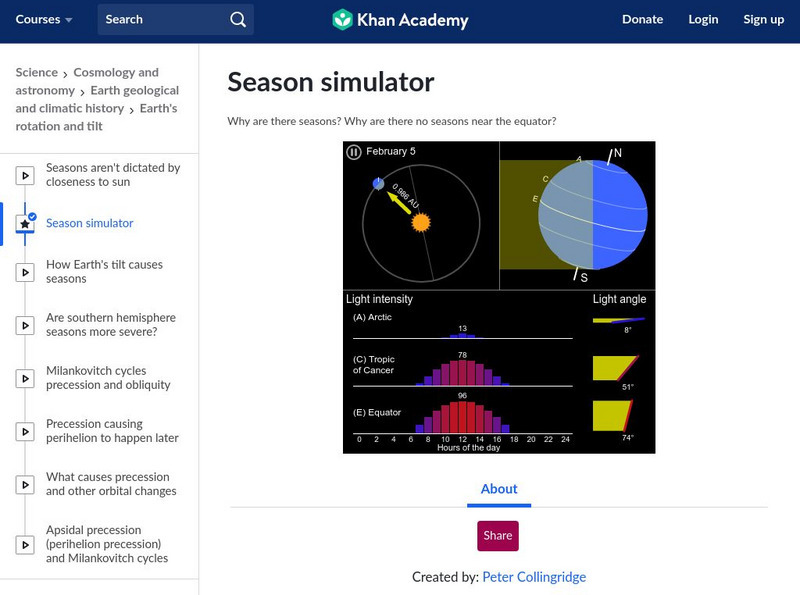
Khan Academy: Cosmology and Astronomy: Season Simulator
This season simulator takes Earth through an entire year cycle allowing the viewer to observe the tilt of the Earth and the intensity of the sunlight.

CK-12 Foundation
Ck 12: Plix: Seasons: Earth's Orbit
[Free Registration/Login Required] An interactive animation demonstrating the Earth's tilted axis and how that causes the seasons. Also included on the site is a short quiz on the topic.
Science Education Resource Center at Carleton College
Serc: Modeling Earth's Seasons by Rotation and Revolution
In this lesson, students will discuss, define, and demonstrate the Earth's rotation and revolution around the sun in a counterclockwise position. They will be able to predict seasons based on the amount of light that hits the Earth.
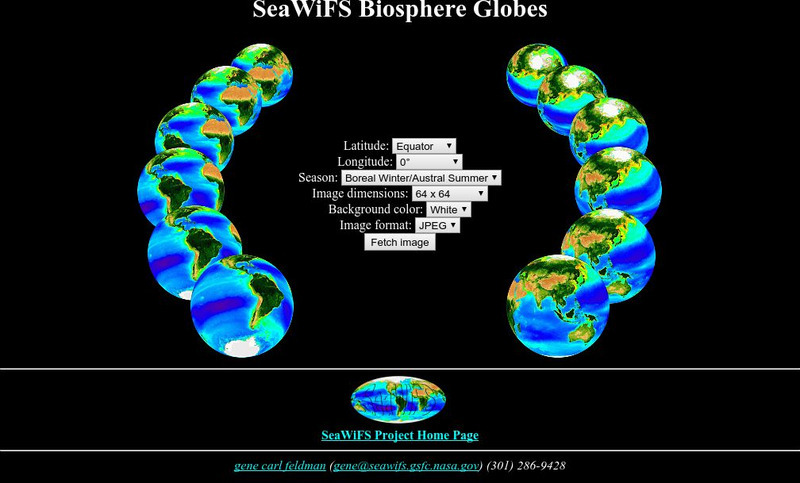
NASA
Nasa: Sea Wi Fs Biosphere Globes
This interactive globe allows you to get any view of the earth by entering latitude, longitude and season criteria.
Scholastic
Scholastic: Study Jams! Science: Our Solar System: A Day on Earth
A video and a short multiple-choice quiz on how the Earth's tilt on its axis, its rotation, and its orbit around the Sun give us a 24-hour day, a 365-day year, and our seasons.
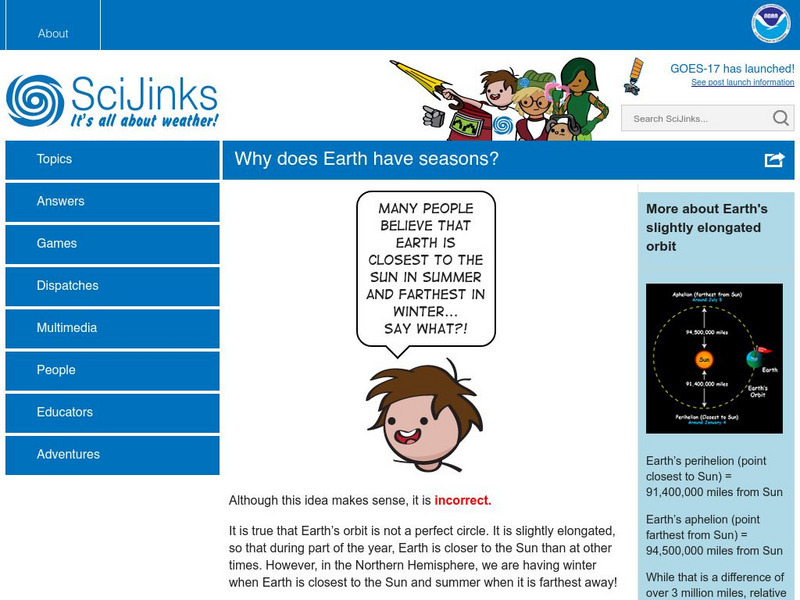
NASA
National Aeronautics and Space Administration: Scijinks: Seasons
An explanation about the rotation of the Earth and why the Earth has seasons.
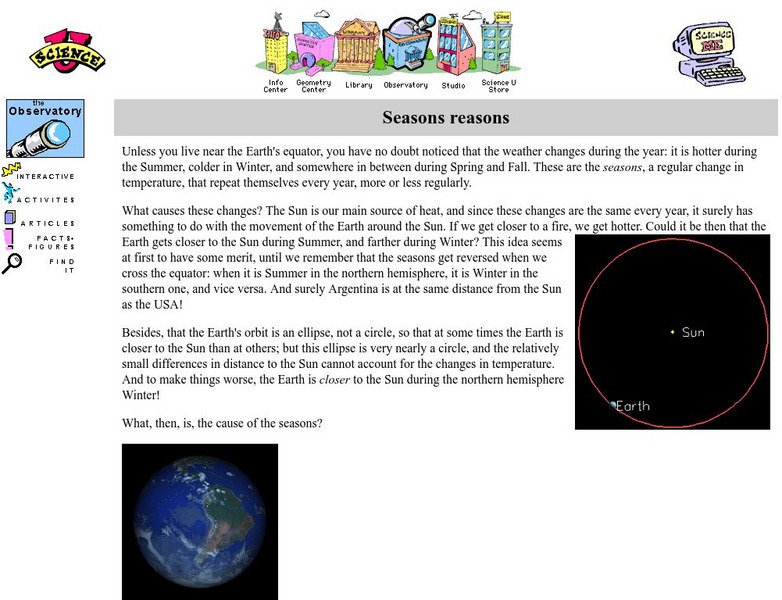
Science U
Science U: Reasons for the Seasons
This webpage uses diagrams and video to explain the causes of the seasons.
Sophia Learning
Sophia: Earth and Sun
A slideshow exploring Earth's rotation and revolution around the sun. Learn that because of Earth's axis tilt we experience the seasons!
Science Buddies
Science Buddies: Project Ideas: The Reasons for the Seasons
In this astronomy science fair project, investigate how the earth's axial tilt creates seasons. The Science Buddies project ideas are set up consistently beginning with an abstract, objective, and introduction, followed by a section on...