Hi, what do you want to do?





NOAA
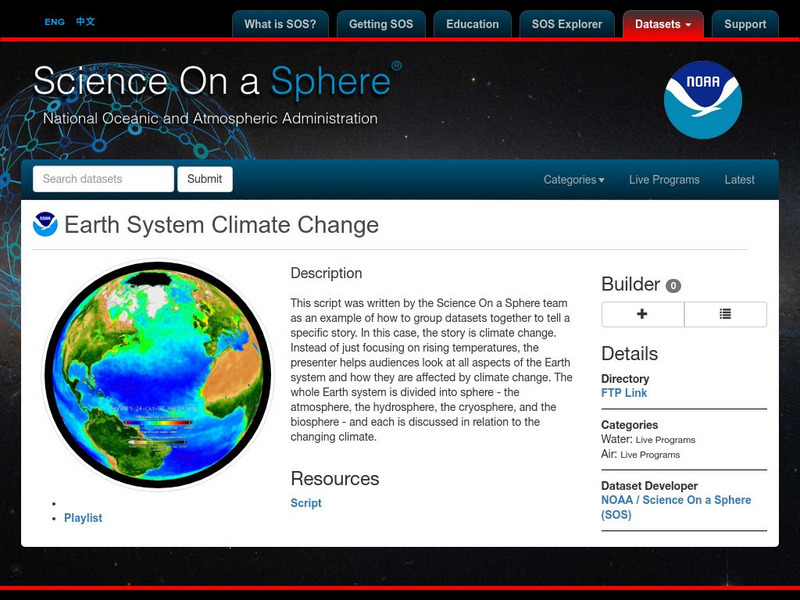
Noaa: Earth System Climate Change
As viewed from space, the Earth appears beautiful and serene. As you well know, however, here standing on Earth, it's complicated! Complex, that is. And, it's constantly changing. Often changes on Earth happen so slowly it would be...
University Corporation for Atmospheric Research
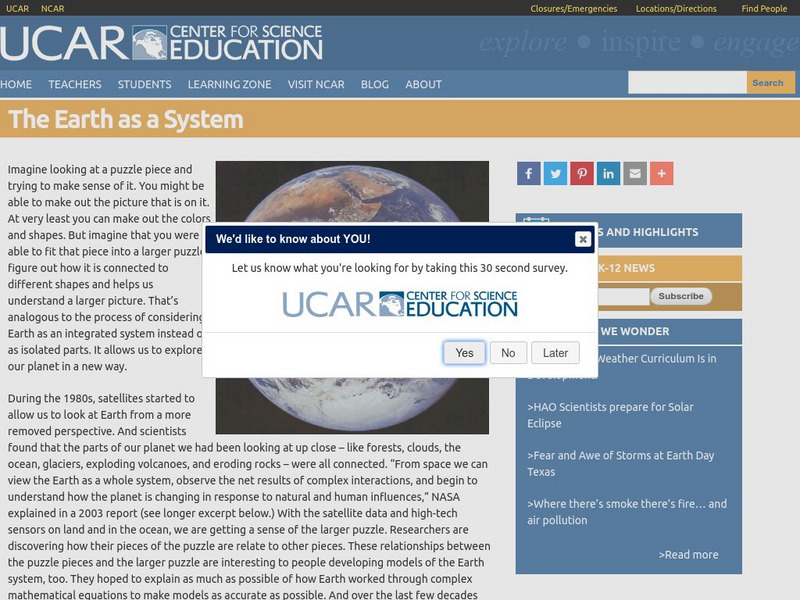
Ucar: The Earth as a System
An overview of content about Earth and its atmosphere. The module was developed for middle school science teachers to provide background information for teaching the curriculum.

University Corporation for Atmospheric Research
Ucar: Cycles of the Earth System: Make Convection Currents!
In this lesson, students will understand that temperature changes can cause density changes in water and in air.
CK-12 Foundation
Ck 12: Earth Science: Effect of Atmospheric Circulation on Climate
[Free Registration/Login may be required to access all resource tools.] Looks at how atmospheric circulation cells affect the climate of regions.
NOAA
Noaa: Weather Systems and Patterns
Imagine our weather if Earth were completely motionless, had a flat dry landscape and an un-tilted axis. This, of course, is not the case; if it were, the weather would be much different. The local weather that impacts our daily lives...
CK-12 Foundation
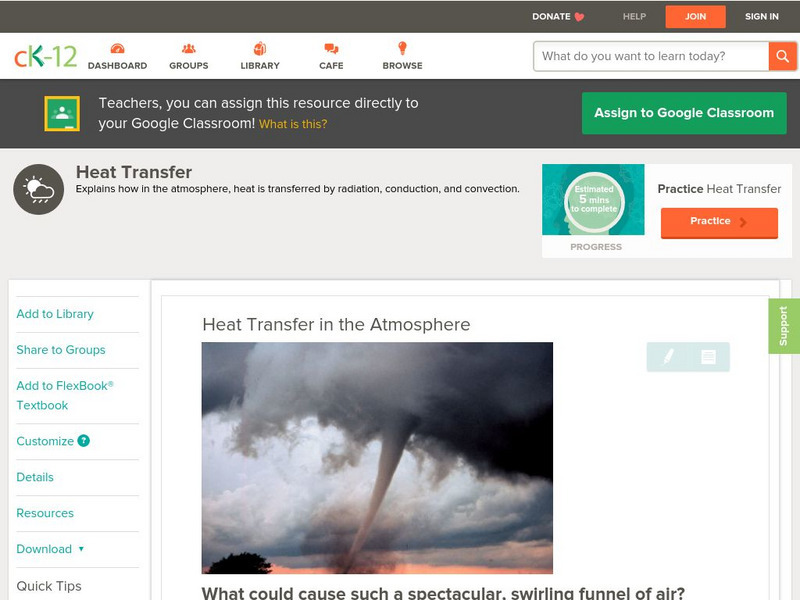
Ck 12: Earth Science: Heat Transfer in the Atmosphere
[Free Registration/Login may be required to access all resource tools.] Looks at how heat is transferred in the atmosphere.
Encyclopedia of Earth
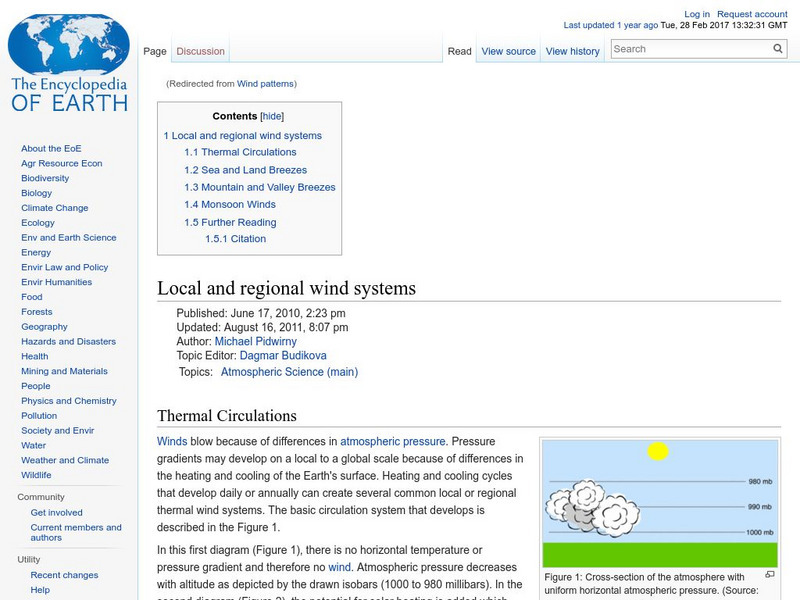
Encyclopedia of Earth: Local and Regional Wind Systems
Read about regional and local wind systems, including information on changes in atmospheric pressure, thermal energy in the atmosphere, sea and land breezes, mountain and valley breezes, and monsoon winds.
PBS
Pbs Learning Media: Global Weather Machine
In this illustrated essay from NOVA Online, explore the cyclical process of weather creation and the effects of El Nino on the global weather system.
PBS
Pbs Learning Media: What Causes the Gulf Stream?
This video segment adapted from NOVA uses satellite imagery to illustrate the Gulf Stream's path and animations to explain how atmospheric phenomena cause it to move. [1:51]
Science Buddies
Science Buddies: Tracking Geomagnetic Storms in the Ionosphere
The Sun is the ultimate source of the energy that powers weather systems on Earth. Geomagnetic storms are sun-powered storms in the upper atmosphere, arising from energized particles that are periodically ejected by the Sun. Among other...
PBS
Pbs Learning Media: Above the Clouds: Telescopes on Mauna Kea
This video segment adapted from First Light explains why the highest peak in the Pacific, Mauna Kea, is an ideal site for astronomical observations. Featured are new telescope technologies that allow astronomers to explore the universe...
TeachEngineering
Teach Engineering: Our Big Blue Marble
Students are introduced to the fabulous planet on which they live. Even though we spend our entire lives on Earth, we still do not always understand how it fits into the rest of the solar system. Students learn about the Earth's position...
PBS
Pbs/global Weather Machine
This site explains wind systems as part of a global weather scheme, with illustrations.
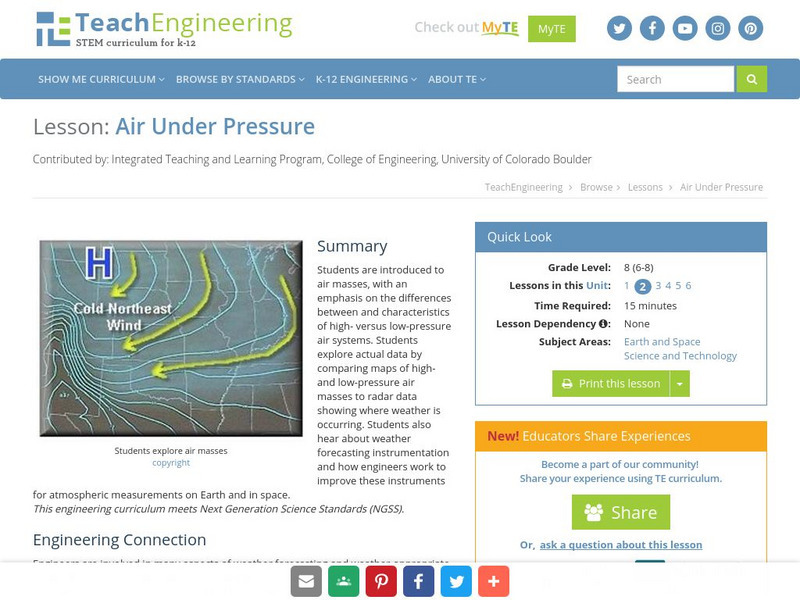
TeachEngineering
Teach Engineering: Air Under Pressure
Learners are introduced to air masses, with an emphasis on the differences between and characteristics of high - versus low-pressure air systems. Students also hear about weather forecasting instrumentation and how engineers work to...
NASA
Nasa: Imagine the Universe: Welcome to the World of X Ray Astronomy
Site recounts how X-rays were discovered as well as who discovered them. Offers graphics, links to facts on this topic, a quiz, and teacher resources.
University of Illinois
University of Illinois: Illinois State Water Survey: Nitrogen Cycle: Human Impact on the Nitrogen Cycle
An overview of the impact of human activities on the environment and how those actions effect the nitrogen cycle.