Hi, what do you want to do?





American Geosciences Institute
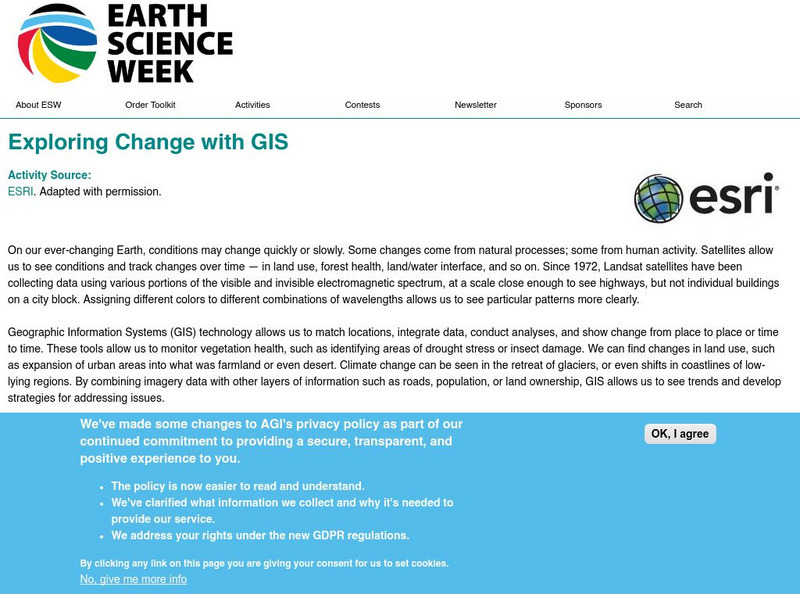
American Geosciences Institute: Earth Science Week: Exploring Change With Gis
Gives an overview of how Geographic Information Systems technology is used to monitor changes in conditions on the Earth. Provides a link to the website with lessons on using GIS. (Due to site changes, you may need to search for teachers...

American Geosciences Institute
American Geosciences Institute: Earth Science Week: Exploring Energy With Gis
In this lesson, students will learn how Geographic Information Systems technology is used to locate energy reserves around the Earth. Provides link to website with lessons on using GIS. (Due to site changes, you may need to search for...
University of Kentucky
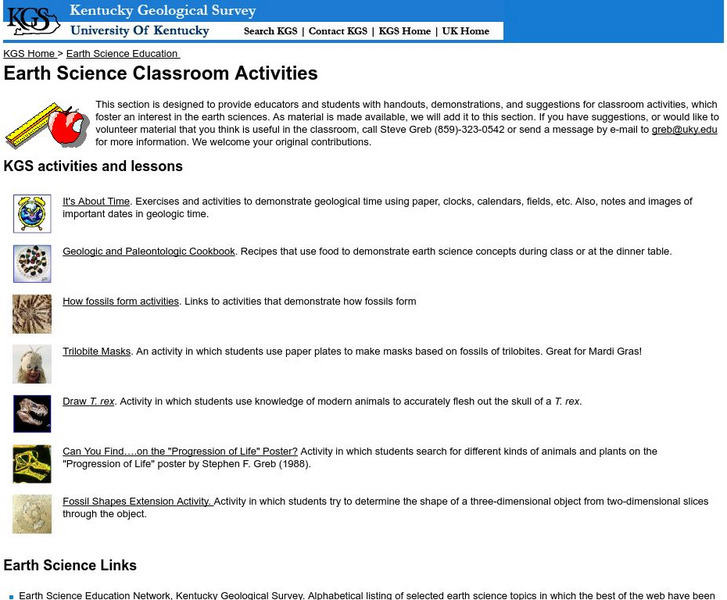
University of Kentucky: Earth Science Classroom Activities
A collection of links to activities and lessons that could be used for Earth science concepts including the foil record, creating a timeline of Earth's history, plate tectonics, dinosaurs, and the progression of life on Earth.
American Geosciences Institute
American Geosciences Institute: Earth Science Week: Core Sampling
Simulate core sampling with this lesson. Students will see layers of Earth with this activity.
American Geosciences Institute
American Geosciences Institute: Earth Science Week: Measuring Permeabilities of Soil, Sand, and Gravel
This investigation will help middle schoolers learn that different geologic materials have different characteristics.

American Geosciences Institute
American Geosciences Institute: Earth Science Week: Modeling an Oil Reserve
Doing this investigation will help students understand how geoscientists identify and explore petroleum-rich reserves.
American Geosciences Institute
American Geosciences Institute: Earth Science Week: Monitoring Life in the Rocky Intertidal Ecosystem
This activity will allow students to learn the sampling techniques used in the field by citizen scientists who participate in LiMPETS, five national marine sanctuaries along the West Coast.
American Geosciences Institute
American Geosciences Institute: Earth Science Week: Natural Gas Formation
In this investigation, young scholars make a simple model of how gasses can form from decaying material. They will also explore the effects of temperature on gas formation.
American Geosciences Institute
American Geosciences Institute: Earth Science Week: Plant an Ozone Monitoring Garden
Students monitor local ozone by looking in their neighborhoods for ozone-injured plants or establishing similar gardens outside their schools or in their backyards.
American Geosciences Institute
American Geosciences Institute: Earth Science Week: Products Made From Petroleum
Small groups to research products made from petroleum other than fuels. The challenge is to find such products "hiding in plain sight."
American Geosciences Institute
American Geosciences Institute: Earth Science Week: Ring of Fire
Students identify plate boundaries as well as continents, countries, and bodies of water to become familiar with an area known as the "Ring of Fire."
American Geosciences Institute
American Geosciences Institute: Earth Science Week: Seismic Calendar
Students investigate how often earthquakes of various magnitudes happen within specific geographic regions.
American Geosciences Institute
American Geosciences Institute: Earth Science Week: Hurricane Tracking
Students track and plot hurricanes paths for study.
American Geosciences Institute
American Geosciences Institute: Earth Science Week: Mineral Electrical Conductivity
The purpose of this activity is to test the conductivity of various minerals with a simple electrical circuit and draw conclusions about which ones would be used in electronics.
American Geosciences Institute
American Geosciences Institute: Earth Science Week: Predict the Flow
Using a common modeling compound, students form a "volcano" and examine its topography to predict which way lava will flow down its slopes.
Science Buddies
Science Buddies: Measuring the Earth's Core With Seismic Waves
When an earthquake occurs, seismic shock waves travel out through the earth from the source of the event. The shock waves travel through the earth (body waves), or along the Earth's surface (surface waves), and can be recorded at remote...

Other
Massachusetts Department of Education: Sunlight Warms Earth's Surface
This unit contains a series of lessons that allow students to explore the effect of sunlight on Earth's natural surfaces of sand, soil, rock, and water. In addition, students explore how the color and material of a surface affects how...

Science Education Resource Center at Carleton College
Serc: Why Is the Earth Still Hot Inside?
In this lesson, students conduct heat transfer experiments to investigate why the Earth is still hot at its core, even after billions of years since its formation. They will learn that the rate of heat transfer is dependent on an...

Alabama Learning Exchange
Alex: Researching the Oceans of the Earth
This unit is a result of collaboration between the librarian and the 5th grade Science teacher. The Ocean Unit developed by the librarian is hands-on research in various areas of the library utilizing print, software and Internet access....
Discovery Education
Discovery Education: Dynamic Earth, Tsunami
Use this site to teach your students what a tidal wave or tsunami is from this lesson plan. The discovery activity shows how a tsunami happens.
American Geosciences Institute
American Geosciences Institute: Earth Science Week: Exploring for Petroleum Modeling an Oil Reserve
Experience the process of searching and drilling for oil in this hands-on activity.
American Geosciences Institute
American Geosciences Institute: Earth Science Week: Finding Slope
A lesson plan that explores the importance of the slope of the soil to a soil's property. Understand how the soils slope affects many aspects of the property from the flow of water to planting.
Science Education Resource Center at Carleton College
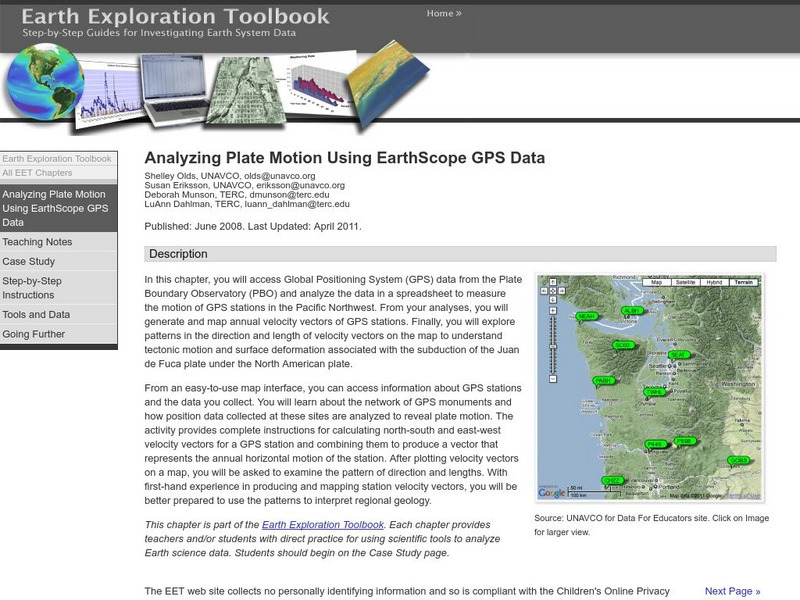
Serc: Analyzing Plate Motion Using Earth Scope Gps Data
In this chapter, you will access Global Positioning System (GPS) data from the Plate Boundary Observatory (PBO) and analyze the data in a spreadsheet to measure the motion of GPS stations in the Pacific Northwest. From your analyses, you...
Science Buddies
Science Buddies: Kinesthetic Astronomy: Earth's Rotation
This kinesthetic activity will demonstrate concepts like rotation and orbit, clarify movement and direction, and help students understand why earthlings see different things in the sky.
Other popular searches
- Earth Science Moon Phases
- Branches of Earth Science
- Earth Science Minerals
- Earth Science Inquiry
- Earth Science Lesson
- Earth Science Lesson Plans
- Basic Earth Science
- And Earth Science
- Earth Science Map Reading
- Earth Science and Art
- Earth Science Vocabulary
- Science Earth Layers