Hi, what do you want to do?






CK-12 Foundation
Ck 12: Earth Science: Experiments and Hypotheses Study Guide
[Free Registration/Login may be required to access all resource tools.] This study guide summarizes key points about the scientific method and hypotheses.
Science Buddies
Science Buddies: The Big Dig
Even though many cities have recycling programs, a lot of trash still ends up in the dump. Find out which materials will break down and which materials won't. Will the results of this experiment change which products you often buy?

American Geosciences Institute
American Geosciences Institute: Earth Science Week: Earth's Hydrologic Cycle
In this experiment, students create a model of the water cycle and learn about its crucial role in moving water around the Earth.
American Geosciences Institute
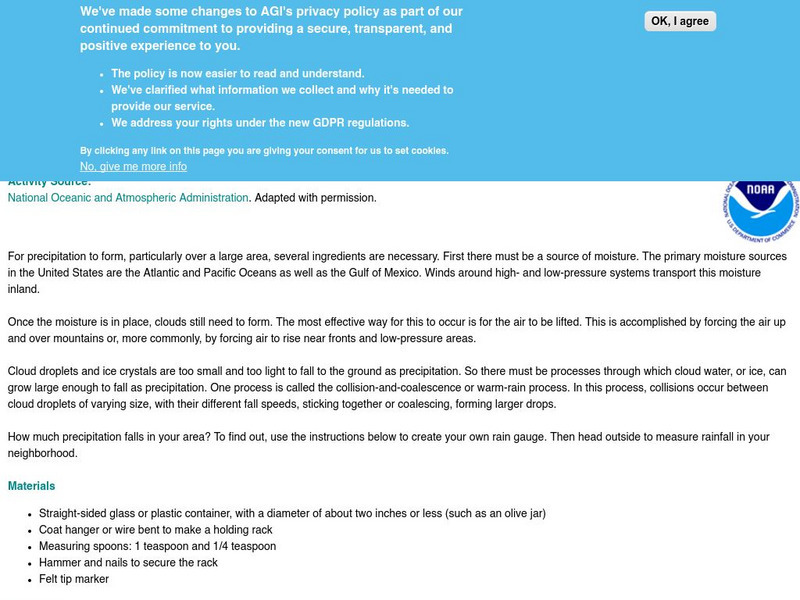
American Geosciences Institute: Earth Science Week: Build a Rain Gauge
In this experiment, students build and calibrate a rain gauge and use it to measure and record how much rain falls in their local area each time it rains.
American Geosciences Institute
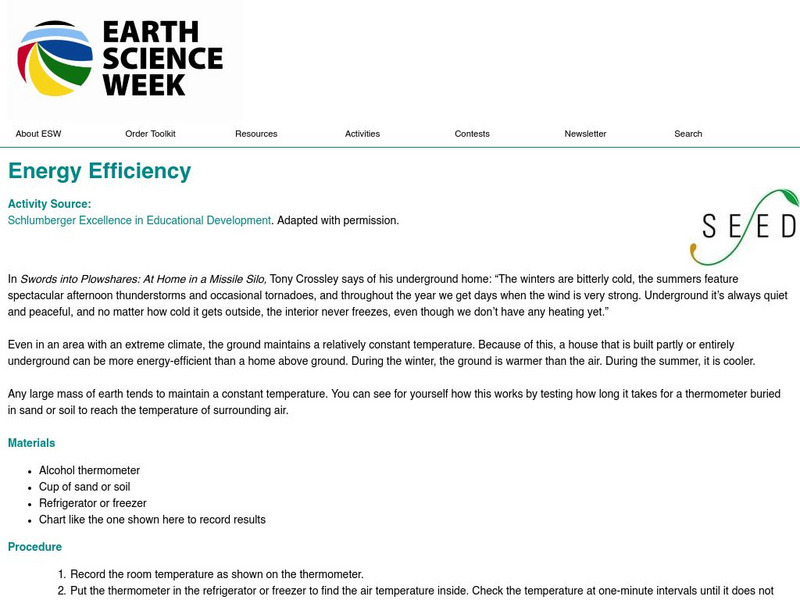
American Geosciences Institute: Earth Science Week: Energy Efficiency
In this simple experiment, students learn about the insulating characteristics of soil and how this relates to energy efficiency.
Science Buddies
Science Buddies: Do Large Mammals Align Themselves With Earth's Magnetic Field?
In this science fair project, use Google Earth to determine if large mammals align themselves in respect to the earth's magnetic field. The Science Buddies project ideas are set up consistently beginning with an abstract, objective, and...
Science Buddies
Science Buddies: A Matter of Degrees: Tilt of Earth's Axis Affects the Seasons
In this science fair project, use a globe and a heat lamp to investigate how the angle of the Sun affects global warming. This project includes the objective, background questions, a list of all the materials you'll need, and the...

Science Buddies
Science Buddies: What Goes Up, Must Come Down
Standing on a balcony near the top of the 179-foot tall Tower of Pisa, a young scientist dropped two iron balls into the crowd below. The scientist, young Galileo, was not trying to knock his fellow professors on the head, but was trying...
Science Buddies
Science Buddies: Project Ideas: The Reasons for the Seasons
In this astronomy science fair project, investigate how the earth's axial tilt creates seasons. The Science Buddies project ideas are set up consistently beginning with an abstract, objective, and introduction, followed by a section on...
Science Buddies
Science Buddies: Nitrogen Fixing Bacteria and Nitrogen Fertilizers
Plants need nitrogen to build proteins and nucleic acids to grow healthy stems and leaves. Though the Earth's atmosphere is made up of 79% nitrogen, the form of nitrogen found in the atmosphere cannot be used by plants. In this...
Science Buddies
Science Buddies: How Does the Intensity of Light Change With Distance?
How far would you have to travel so that the light of the full sun would provide "daylight" no brighter than twilight on Earth? This project describes a method to verify the inverse square law: how light, sound, electrical signals, and...
Children's Museum
The Children's Museum of Indianapolis: Beyond Spaceship Earth
This unit of study explores the International Space Station through STEM experiences in space science education. Students become a spacecraft crew and launch from Earth to discover how microgravity affects the orbit of the International...
PBS
Pbs Learning Media: Super Scientists
Grab your science tools and explore with PBS KIDS. Through hands-on activities and exciting media that transports you to space and in the Earth, this collection will bring science to life in your classroom. These resources help students...
Science Buddies
Science Buddies: Growing, Growing, Gone! An Experiment on Nitrogen Fertilizers
Plants need nitrogen to build proteins and nucleic acids to grow healthy stems and leaves. Though the Earth's atmosphere is made up of 79% nitrogen, the form of nitrogen found in the atmosphere cannot be used by plants. In this...
Bill Nye
Bill Nye: Orbiting Marbles
Try this at-home science experiment to learn how Earth's gravity pulls an object so that it's constantly changing direction.
TeachEngineering
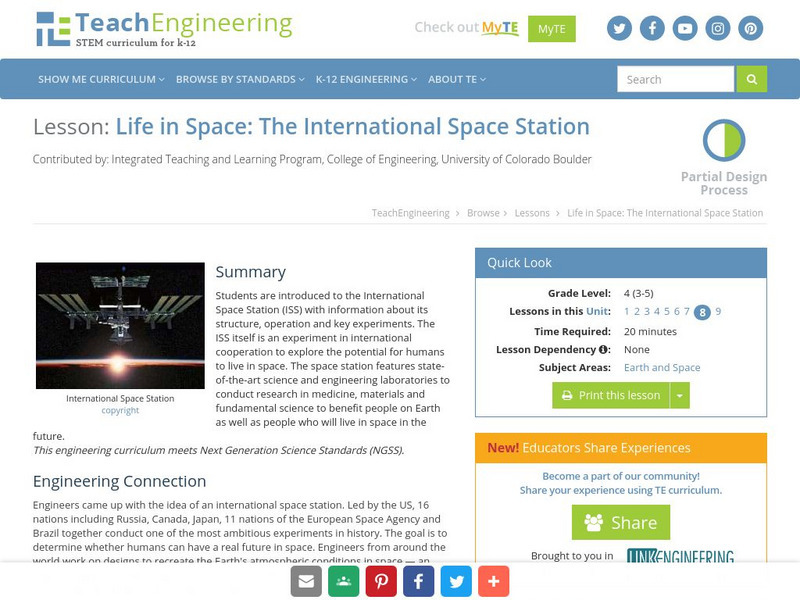
Teach Engineering: Life in Space: The International Space Station
Students are introduced to the International Space Station (ISS) with information about its structure, operation and key experiments. The ISS itself is an experiment in international cooperation to explore the potential for humans to...