Hi, what do you want to do?






BBC
Bbc Earth: The 25 Biggest Turning Points in Earth's History
From the birth of a planet to the evolution of the human race, interactive details the 25 biggest milestones that shaped Earth's history
Annenberg Foundation
Annenberg Learner: Planet Earth
A series of seven instructional, hour-long videos presenting Earth-science topics such as plate tectonics, oceans, climate changes, natural resources, the Sun, and the future of our planet. Closed captioning option provided for each video.
Science Education Resource Center at Carleton College
Serc: Planets Made Real: Creating Size and Distance Scale of Planets
An activity where students build a scale model of the solar system based on a marble they pick from a bowl. After choosing a marble that represents Earth, students must calculate the size of the other planets and the sun. Site includes...
Science Education Resource Center at Carleton College
Serc: Know Your Neighbors: Researching the Planets
Students will study planets and moons in our solar system by working online and other resources. This lesson has students working together to generate a spreadsheet of data found. Students will use this information to describe why Earth...

OneWorld UK
One World: The Story of an Island and a Planet
Elementary students will appreciate these stories of how man's appearance on planet Earth affected all creatures and life!
Georgia Department of Education
Ga Virtual Learning: Astronomy: The Earth
In this interactive tutorial students will learn what causes the seasons, diurnal cycles and how the constellations move through the sky. Learn we are able to see other planets and how astronomical events affected life on the Earth.
Georgia Department of Education
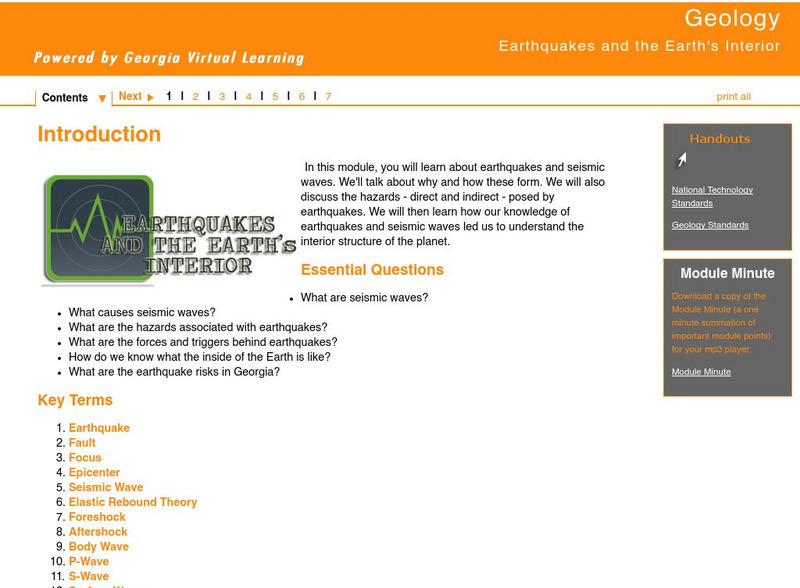
Ga Virtual Learning: Earthquakes and the Earth's Interior
In this interactive tutorial you will learn about earthquakes and seismic waves. Learn about why and how these form and also discuss the hazards - direct and indirect - posed by earthquakes. You will then learn how our knowledge of...
Other
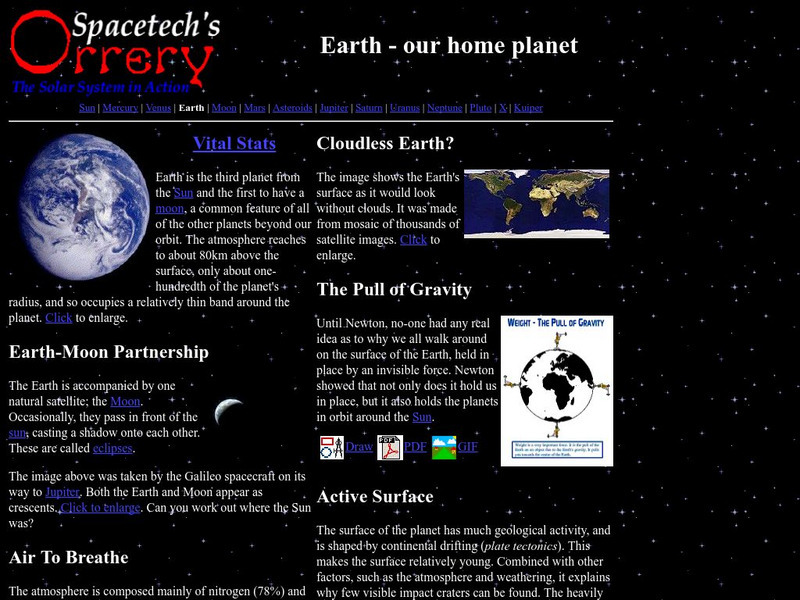
Spacetech's Orrery: Earth Our Home Planet
This site provides a very interesting overview of our home planet, Earth. Content includes a focus on the atmosphere, the pull of gravity, and the active surface.
Planet Pals
Planet Pals: Earth Day
This PlanetPals.com site provides the "Greatest Earth Day Pages Ever!" Includes activities, teaching aides, earth science and history, and more.
Cosmos 4 kids
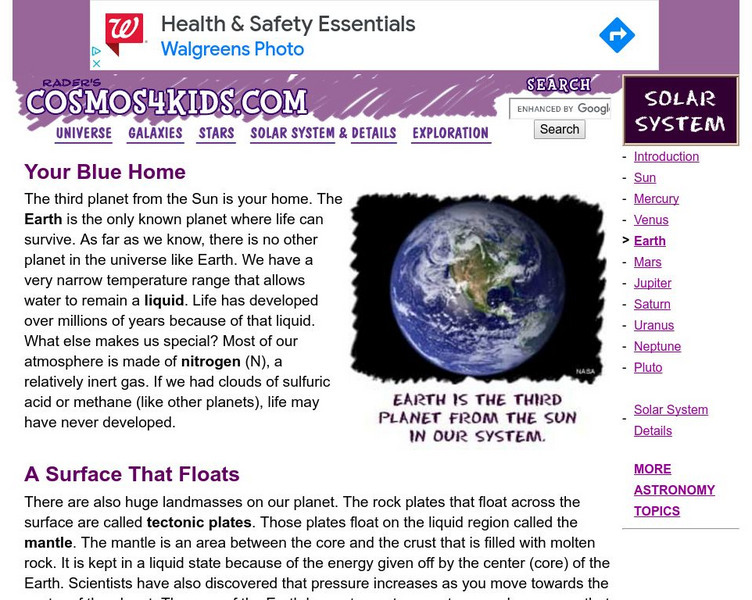
Cosmos4 Kids: Solar System: Earth
Learn the basic facts about planet Earth, and its unique position as the only known planet where life can survive. The brief, to the point text makes this site most suitable for younger researchers.
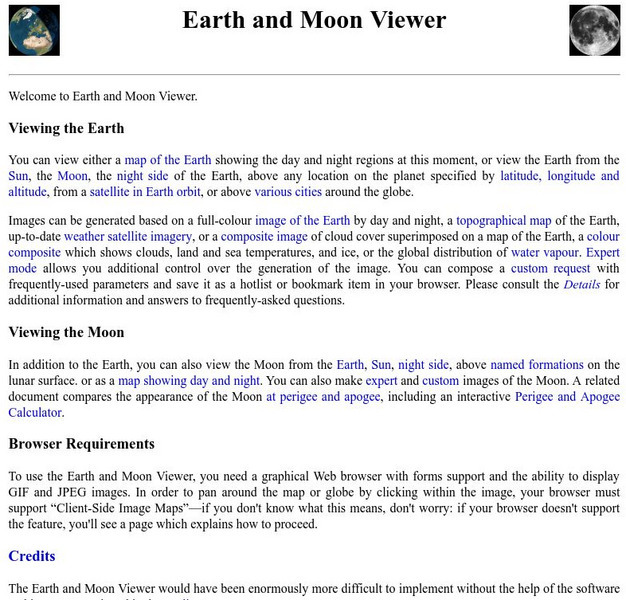
Fourmilab Switzerland
John Walker: Earth and Moon Viewer and Solar System Explorer
This website provides numerous images of the Earth and moon, shown from various vantage points.
California Institute of Technology
Spitzer Science Center: Historias Desde Espacio: Premiacion a Las Planetas
All the planets are competing to see who is the best planet in the Solar System. Read the story in Spanish to learn the results of the pageant. Excellent source of information presented in a fun manner.
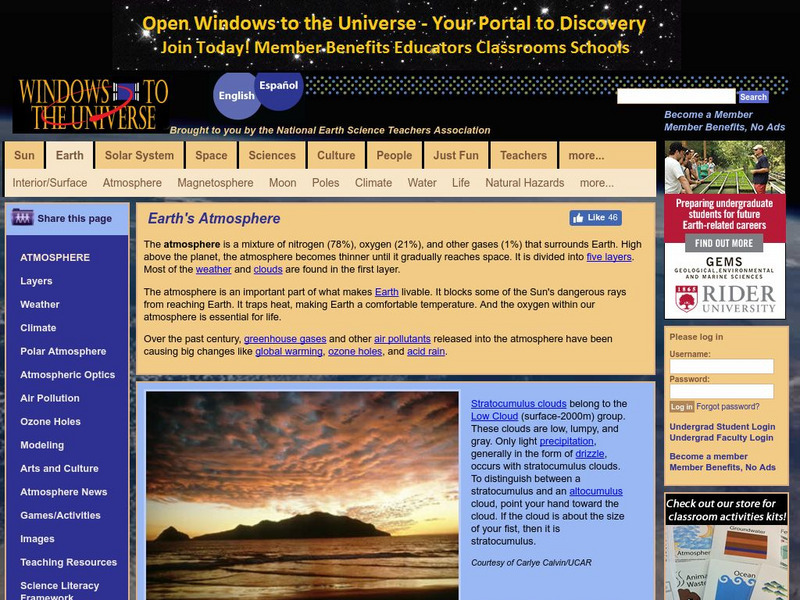
National Earth Science Teachers Association
Windows to the Universe: The Earth's Atmosphere
Windows to the Universe offers information on the Earth's atmosphere. The site contains links to a weather crossword puzzle and images.
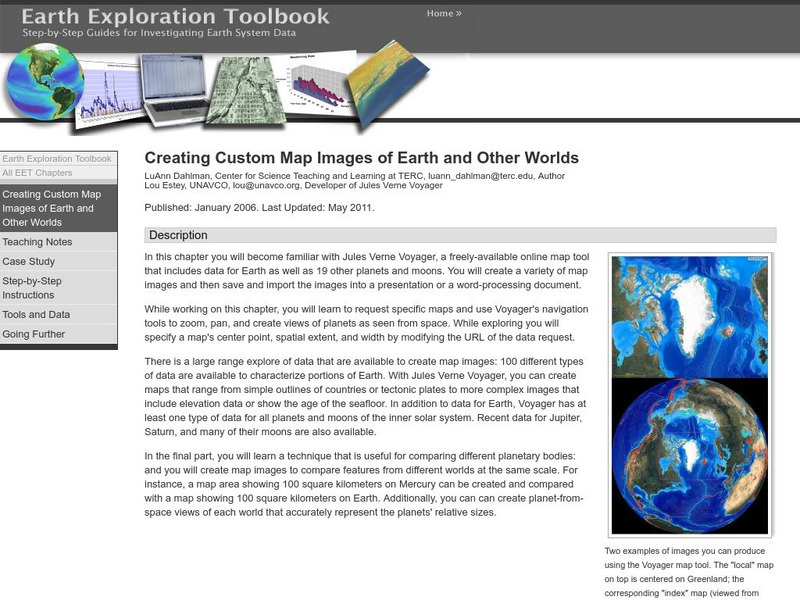
Science Education Resource Center at Carleton College
Serc: Creating Custom Map Images of Earth and Other Worlds
Become familiar with Jules Verne Voyager, a freely-available online map tool that includes data for Earth as well as several other planets and moons. Create a variety of map images and then save and import the images into a presentation...
NASA
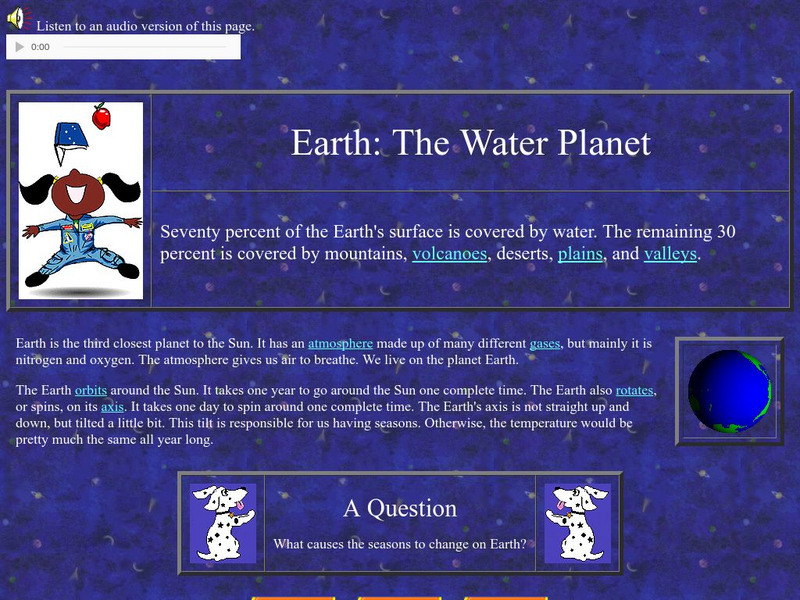
Nasa Star Child: The Planet Earth
Facts about the Earth including its orbit, its atmosphere, and its landforms. Includes a discussion question on seasons, with facts about them, and the answer. A linked page covers similar material in a "Level 2" version, and has a...

Other
Reach the World: Geogames Build Planet Earth
Practice your mapping skills with Build Planet Earth! This animated 3D globe challenges players to locate the Poles, continents, countries, and cities. Colorful graphics and sound effects as well as a teacher's lesson plan are included.
NASA
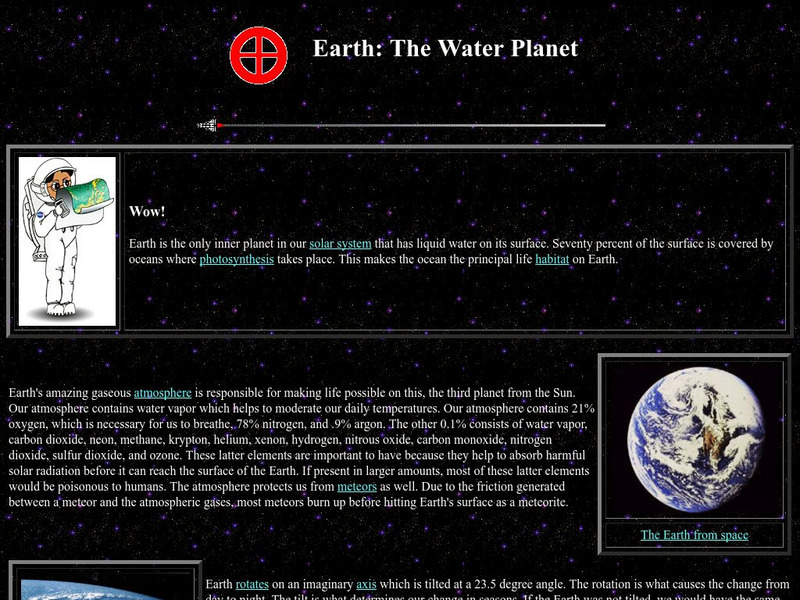
Nasa Star Child: Earth the Water Planet
Use this site to read about planet Earth. See a photo of the Earth from space, and learn quick facts about the earth's atmosphere, axis, and surface.
NASA
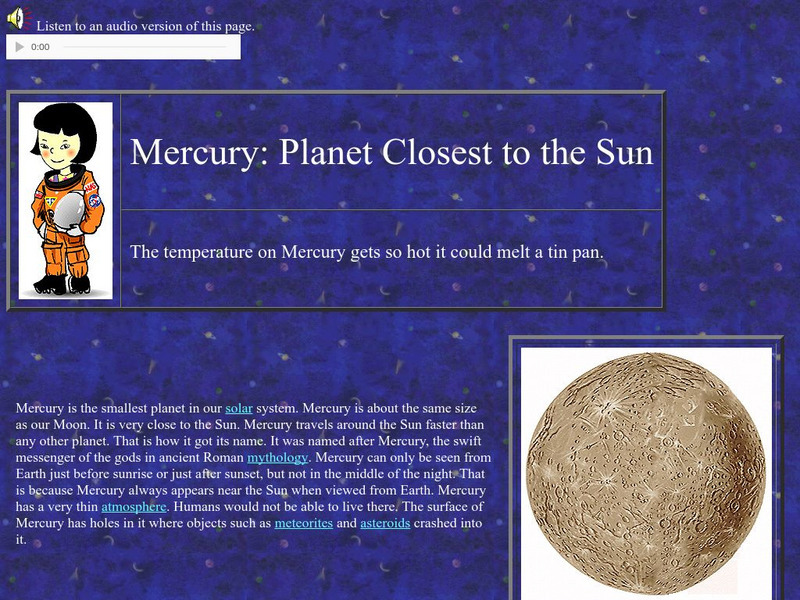
Nasa Star Child: The Planet Mercury
Basic facts about the planet Mercury including its size, its name, and its atmosphere. Includes a discussion question on its visibility from Earth, with facts, and the answer. A linked page covers similar material in a "Level 2" version,...
NASA
Nasa: Image Science Center: Ask the Space Scientist
A NASA scientist, Dr. Sten Odenwald, answers many students' questions. Topics include planets, galaxies, black holes, the origin of the universe, and common misconceptions about space.

NASA
Nasa: Planetary Geology
This unit teaches students about the forces that shape planets and help them to evolve. Lessons provide background information and assessments.
Rice University
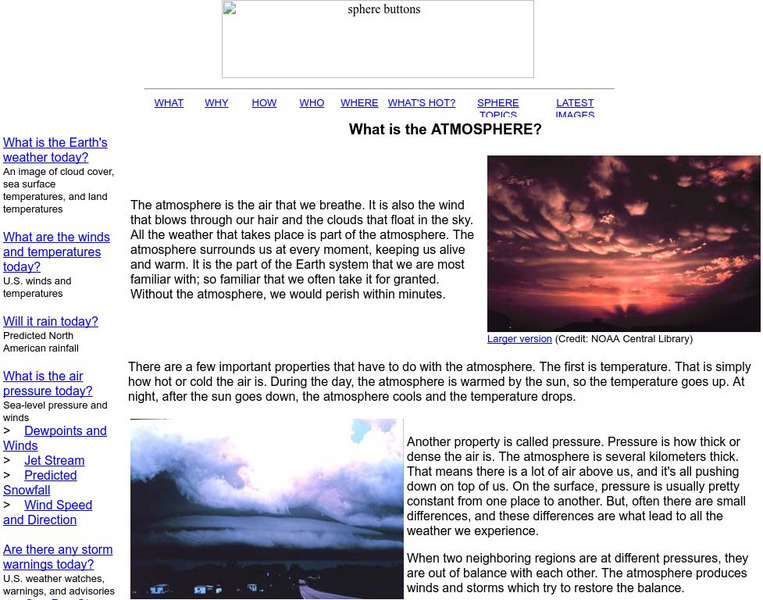
Museums Teaching Planet Earth: Atmosphere
This introduction to the atmosphere details the important properties of the atmosphere: temperature, pressure, and humidity.
PBS
Wnet: Thirteen: Savage Earth: The Restless Planet Earthquakes
Discussion of liquefaction and landslides which are two of the many effects of earthquakes.
Other
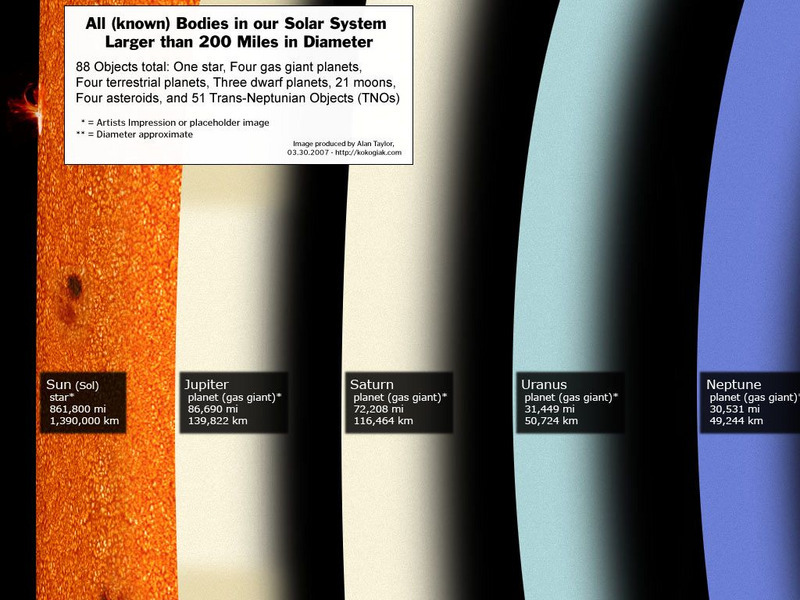
All (Known) Bodies in Our Solar System Larger Than 200 Miles in Diameter
How big is the Earth compared to the Sun? Is Mars bigger than the Moon? Seeing all bodies in the solar system larger than 200 miles in diameter side by side provides an excellent comparison and an interesting perspective.

NASA
Nasa: Students K 4
NASA-sponsored coverage and research on a range of topics related to space exploration -- flying weather stations, comets, first steps on the Moon, and other space-related topics -- are presented in age-appropriate activities, lesson...