Hi, what do you want to do?





Libre Text
Libre Texts: Geochemistry: The Earth and Its Lithosphere
The Earth has been in a state of continual change since its formation. The major part of this change, involving volcanism and tectonics, has been driven by heat produced from the decay of radioactive elements within the Earth. The other...
Other
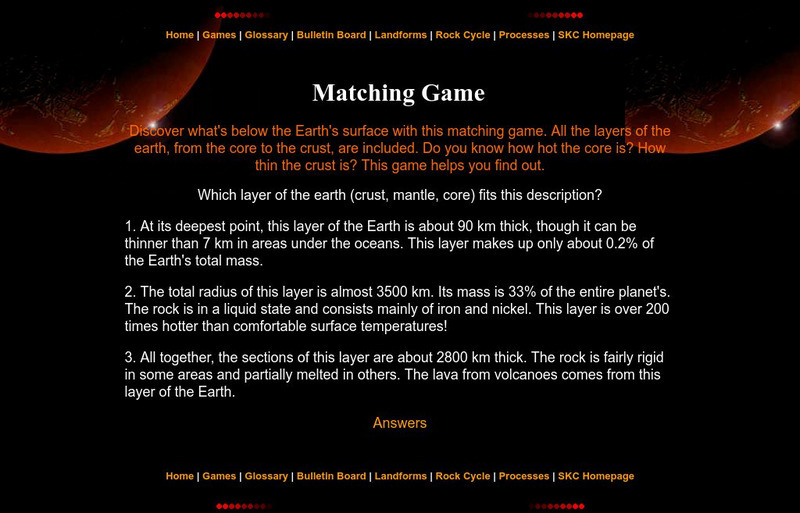
Face of the Earth: Matching Game
Matching game on the earths core and crust. Students test their knowledge and learn what is below the earth's surface.

PBS
Pbs: Scientific American Frontiers: Earth on the Move
The interactive resource examines the plate tectonics, magnetic reversals, and continental drift of the Earth. An animation of the Earth's continental drift over the last 750 million years is included.
TeachEngineering
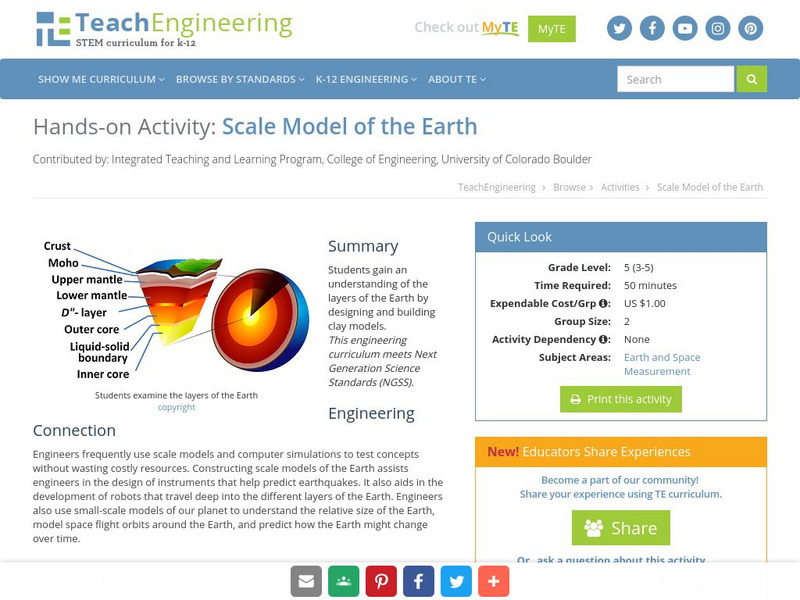
Teach Engineering: Scale Model of the Earth
In this activity, students gain an understanding of the layers of the Earth by designing and building a clay model.

Other
University of Texas Arlington: Isostasy, Gravity, Magnetism, and Internal Heat
An in-depth look at how isostasy works and the processes taking place during glaciation and the melting of glaciers. Looks at gravity and the effects of density differences within the crust and mantle, and at Earth's magnetic field and...
Smithsonian Institution
National Museum of Natural History: Paleobiology: Geologic Time: Hadean Eon
Journey into the past while reading this comprehensive overview of the Hadean Eon that covers topics such as the formation of the earth, its surface and atmosphere, fossil evidence, erosion and plate tectonics.

National Geographic
National Geographic: Encyclopedia: Mantle
An in-depth look at the structure and composition of Earth's mantle, with lots of visuals. Covers lithosphere, Mohorovicic discontinuity, asthenosphere, transition zone, lower mantle, the d double-prime region, mantle convection, mantle...
The Franklin Institute
The Franklin Institute: Land Mass Formation
The Franklin Institute has provided a demonstration that theorizes how the earth's crust was formed. This is a lesson plan that needs only a few materials.
PBS
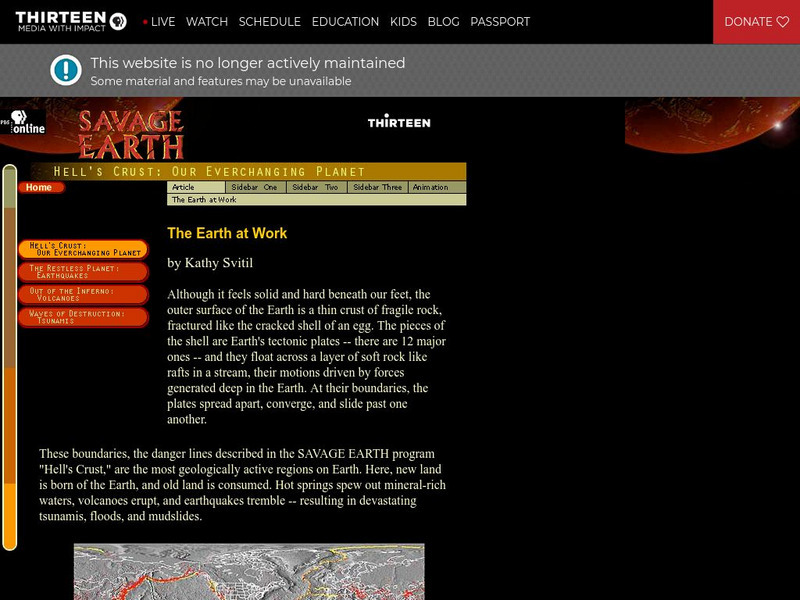
Wnet: Thirteen: The Earth at Work
This site from PBS provides a description of the mechanisms behind the plate movements, types of movements, and the resulting earthquakes, faults, and images and animations of several of the topics presented.
Vision Learning
Visionlearning: Earth Science: Plate Tectonics Ii: Plate Boundaries and Forces
Instructional module focusing on plate tectonics. Discussion includes plates, plate boundaries, and driving forces. Site also includes an interactive practice quiz and links relating to the topic.
The Franklin Institute
Franklin Institute Online: Earthforce in the Crust
Learn more about earthquakes as well as plate tectonics. Site offers links to current quakings as well as earthquake science, teacher lessons, interactives, and earthquake history.
PurposeGames
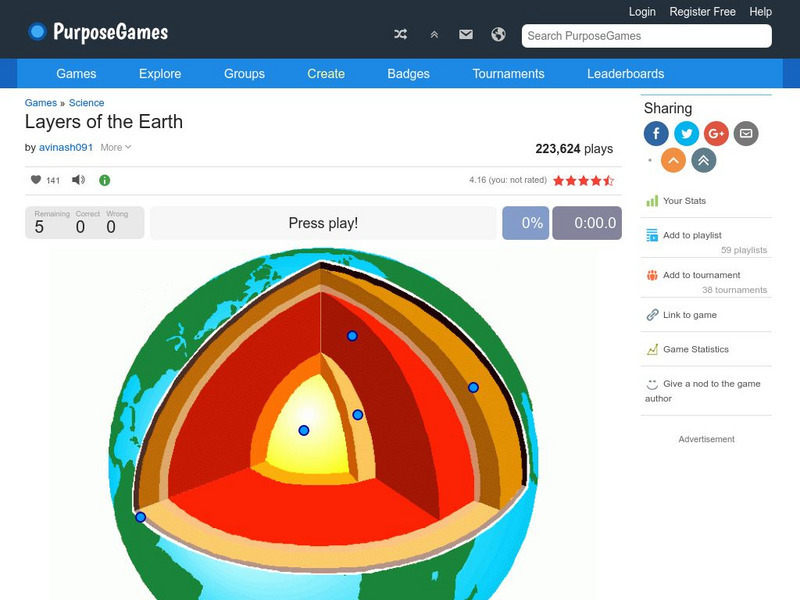
Purpose Games: Layers of the Earth
Players will test their knowledge of the layers of the Earth. Know terms such as core, crust, and upper and lower mantle.
Science4Fun
Science4 Fun: Composition of the Earth
Provides a discussion of the layers of the earth including the crust, mantle, inner core, and outer core.
World Geography Games
World Geography Games: Earth's Layers
Explore the layers of the Earth through this interactive quiz.
National Earth Science Teachers Association
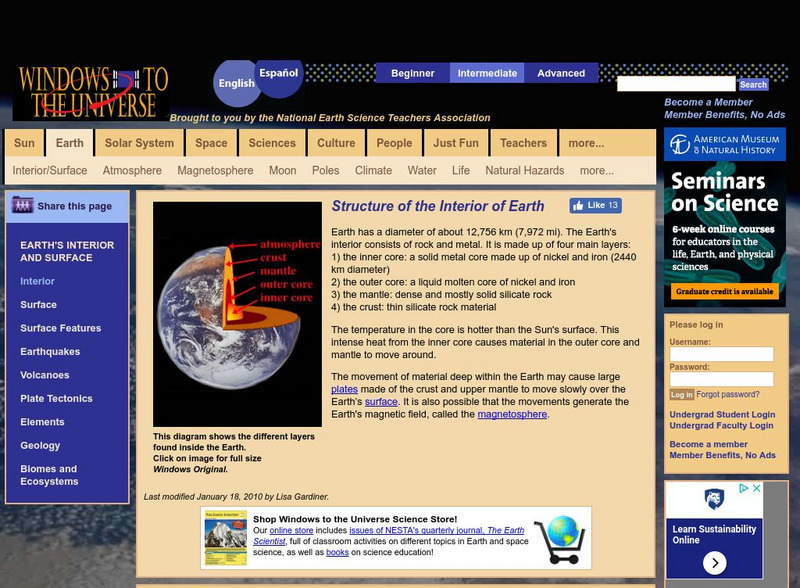
Windows to the Universe: Structure of Earth's Interior
Windows to the Universe provides a brief overview of the structure of the interior of Earth.
Georgia Department of Education
Ga Virtual Learning: Earthquakes and the Earth's Interior
In this interactive tutorial you will learn about earthquakes and seismic waves. Learn about why and how these form and also discuss the hazards - direct and indirect - posed by earthquakes. You will then learn how our knowledge of...
Read Works
Read Works: A Hole in the Planet
[Free Registration/Login Required] An informational text about the layers of the Earth and a place near the Canary Islands where there is a hole in the crust. A question sheet is available to help students build skills in reading...
Center for Educational Technologies
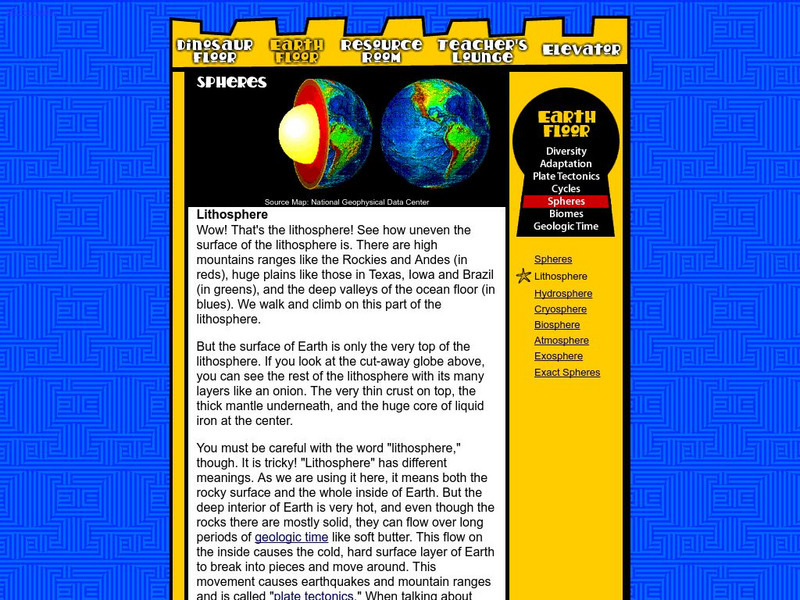
Nasa: Classroom of the Future: Spheres: Lithosphere
At this site from the NASA Classroom of the Future, you can learn about the many different layers of the earth and see what the earth would look like cut in half.
Incorporated Research Institutions for Seismology
Iris: Seismic Tomography [Pdf]
Learn how seismic tomography imaging helps scientists understand the formation of the Earth's interior.

National Institute of Educational Technologies and Teacher Training (Spain)
Ministerio De Educacion: Los Cambios en El Medio Natural I
In this unit you can learn about the internal structure of the Earth. It has 13 interactive activities.
Annenberg Foundation
Annenberg Learner: Earth and Space Science: The Geologic Timeline
Take this online quiz and test your knowledge of geological history, and the formation of our atmosphere, water, crust, oxygen, tectonic plates, Moon, and the rest of the Earth.
Sophia Learning
Sophia: Geology: Plate Tectonics
An basic introduction to plate tectonics and the Earth's processes related to this phenomenon.
Science Education Resource Center at Carleton College
Serc: Uncovering Plate Tectonics
In this investigation, young scholars will be given an opportunity to make the connection between plate boundary movement and the topographic features of the earth.
Science Education Resource Center at Carleton College
Serc: Geo Blocks 3 D Interactive 3 D Geologic Blocks
This interactive tutorial on visualizing geologic features contains animated block diagrams that show how the surface expressions of dipping layers, folds, igneous intrusions, and faults are related to subsurface structure and cross...
Other popular searches
- Earth's Crust Diagram
- Earth's Crust Model
- Blank Diagram Earth's Crust
- Formation of Earth's Crust
- Folds in Earth's Crust
- Earth's Crust Elements
- The Earth's Crust
- The Earths Crust
- Bill Nye Earths Crust
- Folds in Earths Crust
- Earths Crust Movement
- Minerals of Earths Crust