Hi, what do you want to do?






National Wildlife Federation
I Speak for the Polar Bears!
Climate change and weather extremes impact every species, but this lesson focuses on how these changes effect polar bears. After learning about the animal, scholars create maps of snow-ice coverage and examine the yearly variability and...

Curated OER
Why Polar Bears Are White
Learners are introduced to the concept of camouflage and protective coloration as well as Arctic animals. They examine how color can help animals in the wild. Students discuss where polar bears live and why they are white.

Curated OER
Polar Bear Literacy Activity
Young scholars generate vocabulary words synonymous or related to "noise." In this literacy lesson, students listen to the book Polar Bear, Polar Bear, What do You Hear? by Bill Martin and Eric Carle and discuss the meaning of vocabulary...

Curated OER
Polar Bear Drawing
In this coloring page worksheet, students study a black line drawing of a bear which appears to be a polar bear. Students color the picture.

Curated OER
March of the Polar Bears: Global Change, Sea Ice, and Wildlife Migration
Young scholars study global change and how these changes impact wildlife. In this polar bears lesson students analyze maps and data to understand climate change.

Curated OER
Polar Bears and Ice
Students explore the Arctic food chain. They examine the needs of the polar bear and the threat that global warming poses to them. Students write a letter to a local political representative explaining what they have studied and...

Curated OER
Polar Bears
First graders explain what keeps Polar Bears warm in the Arctic by experiencing a layer of blubber to protect them. They read Little Polar Bear by Hans de Beer.

Curated OER
It Bears Repeating!!!
Students research bears and their characteristics with a specific study on North American bears and polar bears. In this bear study instructional activity, students read books about polar bears and wild bears. Students complete...

Curated OER
Which Bear?
Students study bears. In this science lesson, students compare black, grizzly and polar bears. Students measure the bear tracks and compare the bear habitats and diet.

Curated OER
Global Warming
First graders discover the effects of global warming on polar bears. In this life science lesson, 1st graders model the polar bear's habitat and observe what happens as they raise the temperature. They record their observation in the...

Curated OER
Travel to the Polar Lands
Second graders receive an "Expedition Ticket" to travel through the Polar Regions- the Arctic and the Antarctic. They research polar bears and make drawings that are to scale.

Curated OER
Goldilocks and the Real Bears
Students participate in a comparison lesson where they compare fictional bears to real life bears. In this science/language arts lesson, students read Goldilocks and the Three Bears. Students observe characteristics...

Curated OER
Call Me Bond, Hydrogen Bond
As amazing as James Bond is, the surface tension of water does not allow him to walk on it! In this series of little lab activities, physical scientists play with the properties of water due to the hydrogen bonds and resulting polarity....

Curated OER
How Much Does a Bear Weigh?
Students estimate how many children in their class it would take to equal the mass of one adult bear. They then weigh and record their measurement on a chart to check their estimate.

Curated OER
Animals of the Cold
Students access the Internet to research information about animals found in the coldest parts of the world. They gather data for collaborative exchange and research answers to teacher designed questions. They create original works of art...

Curated OER
Sand & Water: Arctic in the Sun
Students chill out on a hot day with this outdoor activity. In this early childhood physical education lesson, students have fun experimenting through play with ice and toy animals in water.

Curated OER
Life-Cycle Sleuth
Students analyze an animal's life cycle and behaviors, and examine what animals need to stay alive and reproduce. They develop theories and hypotheses about the reasons for migrations, using the Journey North online project.

Curated OER
Creating a Classification System
Learners create classification system for Arctic-dwelling animals, the Arctic hare in particular.

Curated OER
Species Charades
Students identify endangered species. In this endangered species activity, the teacher leads a discussion about endangered species, then the class plays a game of charades to pantomime animal behavior.

Curated OER
Animal Slideshow
Second graders view animal fact sheets, and make a slide about an animal. In this animal classification activity, 2nd graders list facts that help classify the animal. Students use Microsoft paint and color their animal. Students...

Curated OER
Our Five Senses
Students identify their five senses and how the are used everyday. As a class, they develop a list of sounds they hear at a zoo and compare them with a list of sounds they hear at a park or school. They create an instrument on their...

Curated OER
Graphic Organizers Aid Comprehension
Students create story webs to aid comprehension of ecosystems. In this reading strategies lesson, students discover the importance of organizing information while reading a nonfiction text. Students produce story webs to communicate...

Curated OER
"Who Am I?" - Quiz #2
In this "Who Am I?" quiz worksheet, students examine the 12 clues regarding noteworthy scientists born between 1452 and 1951. Students identify the scientists and click on links to check their answers.
Smithsonian Institution
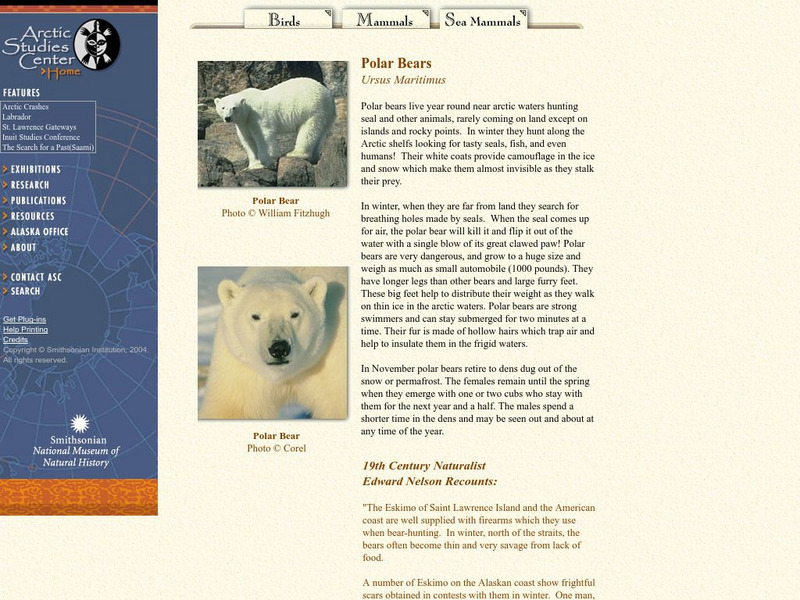
National Museum of Natural History: Arctic Studies Center: Polar Bear
The Smithsonian National Museum of Natural History, in a section titled "North American Mammals," offers a general overview of the polar bear. Additional content includes detailed drawings, photographs, and a map showing the polar bear's...