Hi, what do you want to do?






Walter Fendt
Walter Fendt: Apps Zur Physik
This site, in German, offers numerous apps that illustrate common physics principles. Apps are organized into categories: mechanics, oscillations and waves, electrodynamics, optics, thermodynamics, the theory of relativity, physics of...
Other
Siemens Science Day: Physical Science: Through the Looking Glass
Students will make their own spectroscope, learn how light is bent by a diffraction grating, and explore how various forms of light differ.

Vision Learning
Visionlearning: Physics: Light I: Particle or Wave
Instructional module focusing on light. Discussion includes historical development of particle versus wave theories and the scientific studies leading to the understanding of light waves today. Site also includes an interactive practice...
BBC
Bbc: Gcse Bitesize: General Properties of Waves
Light travels as waves. Waves can be described by their amplitude, wavelength and frequency. The speed of a wave can be calculated from its frequency and wavelength.

Georgia State University
Georgia State University: Hyper Physics: Sound Propagation
This page and the many pages which are indexed to focus on the behaviors of sound which characterize it as a wave. Reflection, refraction, interference, diffraction and more are clearly illustrated and explained.

Ducksters
Ducksters: Physics for Kids: Wave Behavior
Kids learn about the behavior of waves in the science of physics including reflection, refraction, diffraction, polarization, absorption, and interference.
Other
Weather Photography
Source of information on the subject of weather photography. There are great links, images and tips on equipment to use. For the intermediate to advanced photographer.
Pennsylvania State University
Kettering University: Vibration & Waves
A short tutorial providing general information about waves, their categories, properties and behaviors. Includes several animations and some practice questions with answers.
Wikimedia
Wikipedia: Wave
An in-depth encyclopedia article from Wikipedia on waves gives a definition for what a wave is. Other content in the article includes a list of examples and characteristics of waves, information about the difference between transverse...
Wolfram Research
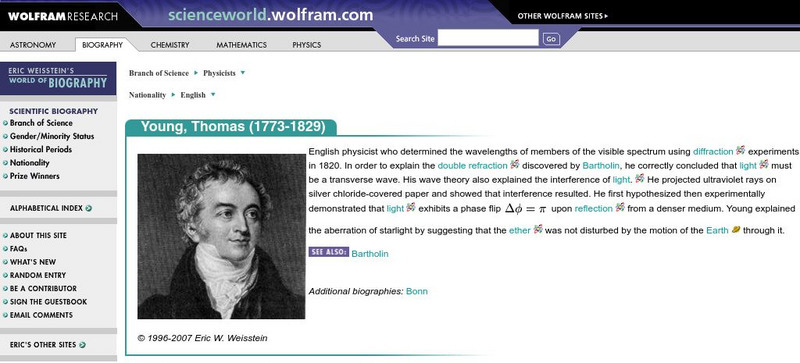
Wolfram Science World: Young, Thomas
This site from ScienceWorld provides a very short but factual biographical sketch of Thomas Young (1773-1829 CE) and describes his most notable scientific discoveries and contributions. Links are also provided throughout for additional...
Learn AP Physics
Learn Ap Physics: Physics B: Waves
A site dedicated to help students prepare for the AP Physics B test. This specific site reviews waves including traveling waves, standing waves, resonance, speed of electromagnetic waves, Doppler shift, Doppler effect, interference,...
Synopsys
Synopsys: A Gentle Intro to Optical Design: Why Is the Sky Blue?
Discusses Rayleigh scattering in plain language and attributes the blueness of the skies to this phenomenon. Discussion of scattering is just one topic of many on this lengthy page of optical topics.
Georgia Department of Education
Ga Virtual Learning: Astronomers' Tools
In this interactive tutorial students will learn about a few of the instruments used to further our knowledge of the Universe around us.

National High Magnetic Field Laboratory
Magnet Academy: Heinrich Hertz
The discovery of radio waves, which was widely seen as confirmation of James Clerk Maxwell's electromagnetic theory and paved the way for numerous advances in communication technology, was made by German physicist Heinrich Hertz. In the...

Ducksters
Ducksters: Physics for Kids: Behavior of Light as a Wave
Kids learn about the behavior of light as a wave in the science of physics including reflection, refraction, and diffraction.