Hi, what do you want to do?






Curated OER
Thermoelectricity
Students conduct a series of experiments on thermoelectricity. In this physics lesson, students investigate how thermocouple works. They determine the voltage generated when different conductive materials are held at different temperatures.

Curated OER
Life Processes and Water
Explain the properties of water. Identify the properties of water that make it a polar molecule Describe hydrogen bonds and how they differ from covalent bonds Discuss the differences between hard water and soft water Compare the heat of...

Curated OER
Electricity and Thermodynamics Review
In this electricity and thermodynamics worksheet, students review the major concepts of both series circuits and parallel circuits, they review types of thermal transfer, they match electricity terms with their definitions, they fill in...

Curated OER
Sunlight and Warm Air
Learners discuss radiant energy from the sun, performing a simple experiment with sun glasses and bright light to demonstrate the concept. Students further participate in simple in-class experiments to demonstrate: air density as it...

Curated OER
Metals, Non-Metals, Metalloids
Students describe properties of various elements. They arrange the elements based on properties in order to explain the organization of the periodic table. They label elements as metal, non-metal, or metalloid.

Curated OER
Metalloids
Middle schoolers discuss metalloids, their use as semiconductors, and their impact on the computer industry. They work in groups to create a visual timeline showing the evolution of the computer.

Curated OER
Series/Parallel Circuits
Students engage in a instructional activity that is concerned with the concept of series and parallel circuits. They conduct research using a variety of resources. They have class discussion and the instructional activity includes...

Curated OER
Power: Work and Energy
Students explore how work and energy create power. They complete activities involving simple machines, energy, energy conversion, and the role of conductors and insulators. They choose from a menu of options the activities they would...

Curated OER
Conductivity
Students work together to create a simple conductivity tester. They discover the difference between conductors and insulators. They test different types of materials for their conductivity as well.

Curated OER
Energy
Students distinguish between kinetic an potential energy. They recognize that energy is conserved when changing from one form to another. Students compare the scientific meaning of work with its everyday meaning.

Curated OER
Changing State
Pupils investigate the cooling and heating of water. In this online science experiment lesson, students work in groups to make predictions regarding freezing and boiling points and then test those predictions as they complete the virtual...

Curated OER
Window Treatments for Energy Savings
Students investigate energy-saving window treatments. In this environmental lesson, students research how energy-saving windows work by conducting an experiment using a thermometer and graphing data. Students identify why energy-saving...

Curated OER
The Elements
Fifth graders explore the differences between elements. In this elements and atoms lesson students complete an activity that shows how chemicals react to a flame test.

Curated OER
Scouting for Circuits
Fifth graders investigate electricity and how it used in a circuit to be useful energy. They also use this investigation in order to understand how energy can change forms and still be considered useful if put into the right form.

Curated OER
Resistance
In this resistance worksheet, students use batteries, a breadboard, washers and more to make a parallel circuit and create resistance. Students then answer 7 questions.

Curated OER
Physics Quiz
For this physics worksheet, students complete short answer questions about physics concepts such as electricity, space, light, and more. Students complete 20 short answer questions.

E-learning for Kids
E Learning for Kids: Science Underwater City: What Are Good and Poor Conductors of Heat?
John and Jessi are going underwater, and they need to stay warm. Help them learn about conductors of heat so they can stay warm.

Physics Classroom
The Physics Classroom: Thermal Physics: Rates of Heat Transfer
Through illustrated examples and interactive examples, students investigate the topic of the rate of heat transfer.
Utah State Office of Education
Utah Science: Properties and Behaviors of Heat, Light and Sound
How can scientists lump heat, light and sound together when investigating properties and behaviors? This learning module will address that question through a series of activities.

Concord Consortium
Concord Consortium: Molecular Workbench Showcase: Heat and Temperature
A tutorial that explores the concepts of heat and temperature, the transfer of energy between substances, the relationship of temperature and the movement of atom, and thermal radiation. The tutorial includes animations, interactive...
TeachEngineering
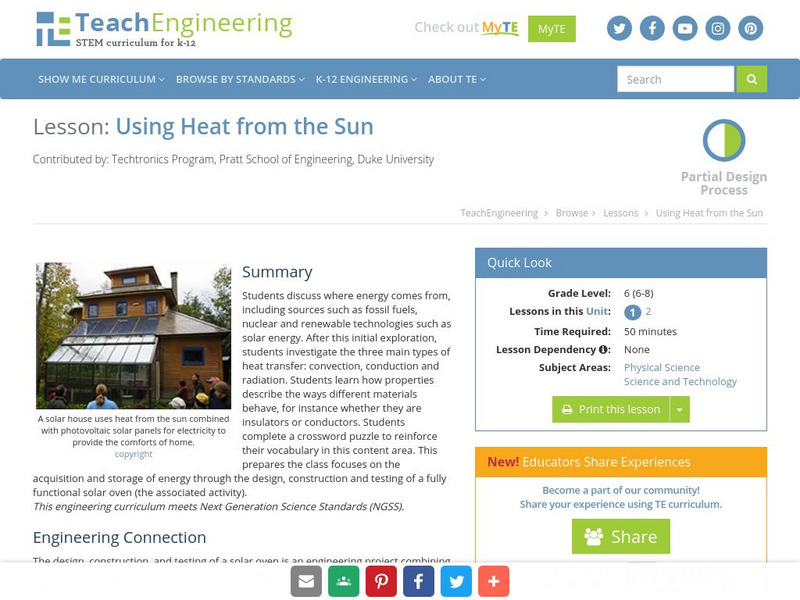
Teach Engineering: Using Heat From the Sun
In this lesson plan, students will first discuss where energy comes from, including sources such as fossil fuels, nuclear, and such renewable technologies as solar. After this initial exploration, students will investigate the three main...
PBS
Pbs Learning Media: The Structure of Metal
In this interactive activity from the NOVA Web site, animations explain different aspects of the properties of metal.
BBC
Bbc: Gcse Bitesize: Energy and Heating
Energy is transmitted by conduction, convection or radiation.The conductivity of materials can be compared by examining the time taken to transmit energy through them. This lesson explains how conduction works and provides a link to a test.
TeachEngineering
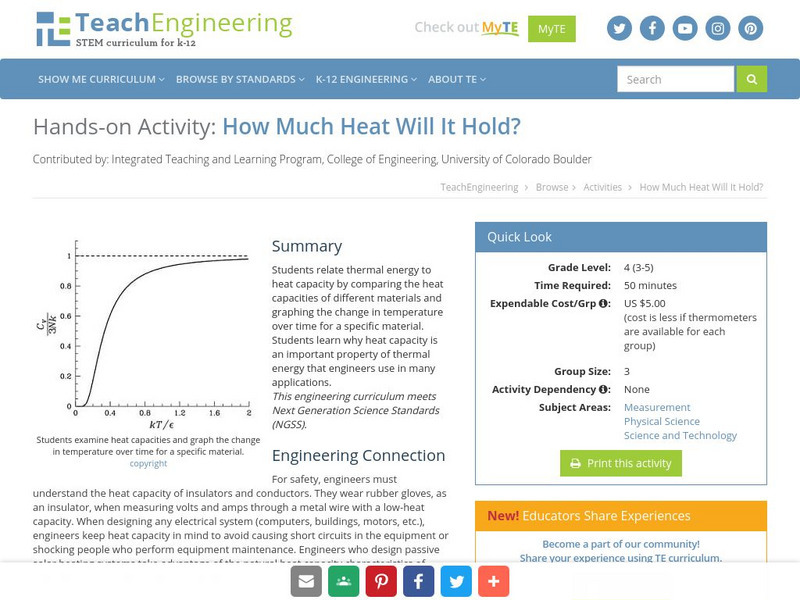
Teach Engineering: How Much Heat Will It Hold?
Students relate thermal energy to heat capacity by comparing the heat capacities of different materials and graphing the change in temperature over time for a specific material. Students learn why heat capacity is an important property...