Hi, what do you want to do?





TeachEngineering
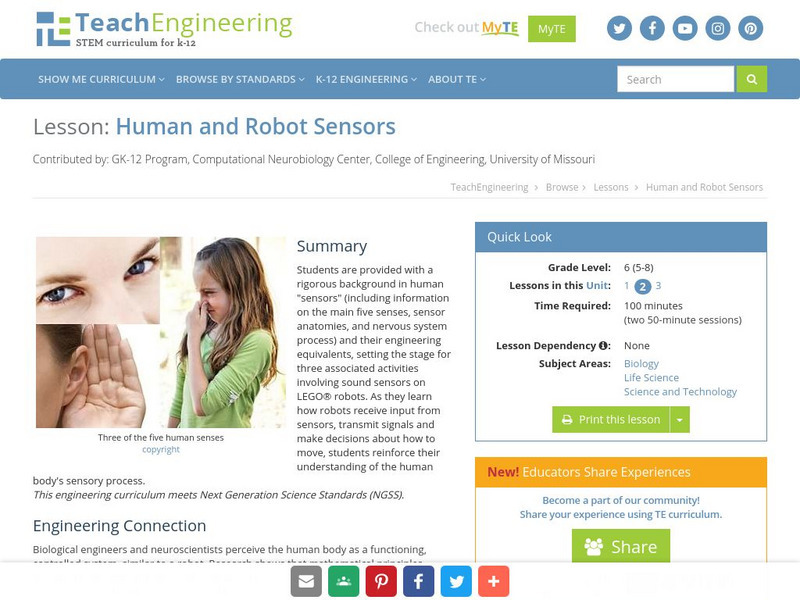
Teach Engineering: Human and Robot Sensors
Students are provided with a rigorous background in human "sensors" (including information on the main five senses, sensor anatomies, and nervous system process) and their engineering equivalents, setting the stage for three associated...
TeachEngineering
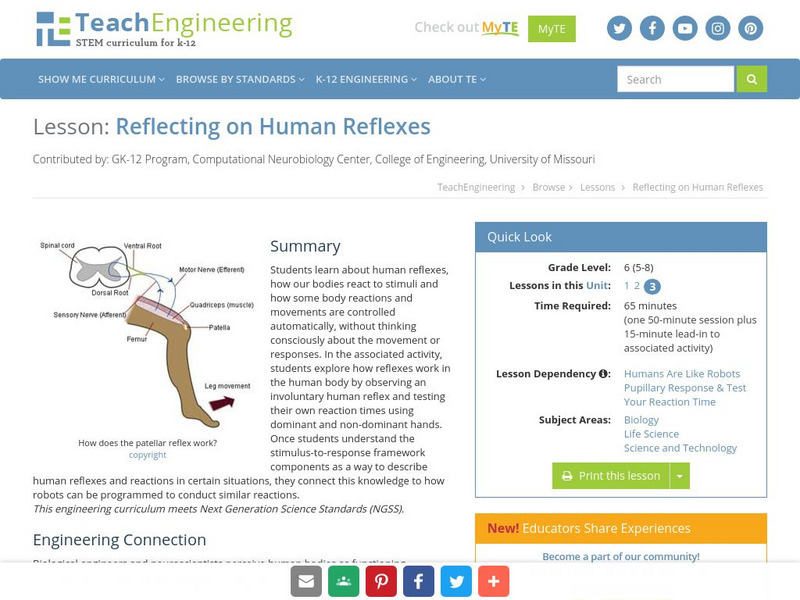
Teach Engineering: Reflecting on Human Reflexes
Students learn about human reflexes, how our bodies react to stimuli and how some body reactions and movements are controlled automatically, without thinking consciously about the movement or responses. In the associated activity,...
TeachEngineering
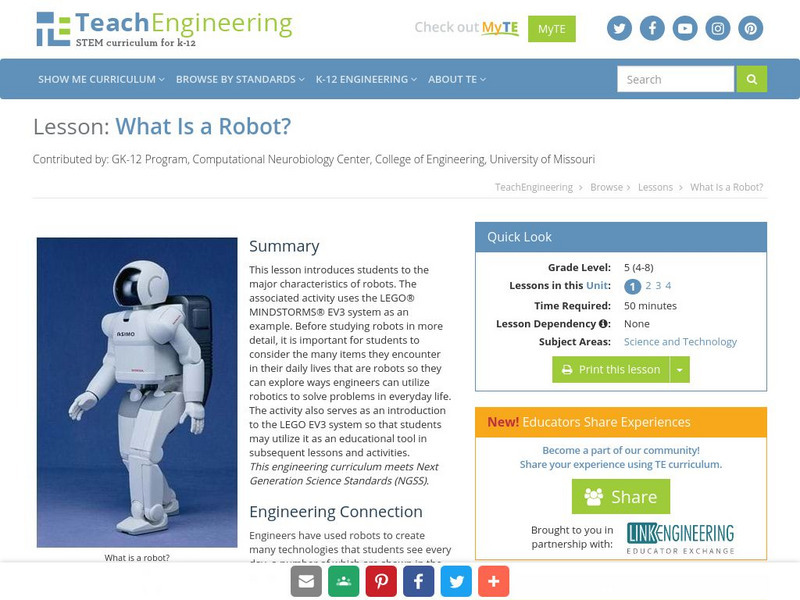
Teach Engineering: What Is a Robot?
This lesson plan introduces learners to the major characteristics of robots. The associated activity uses the LEGO MINDSTORMS NXT system as an example. Before studying robots in more detail, it is important for students to consider the...
TeachEngineering
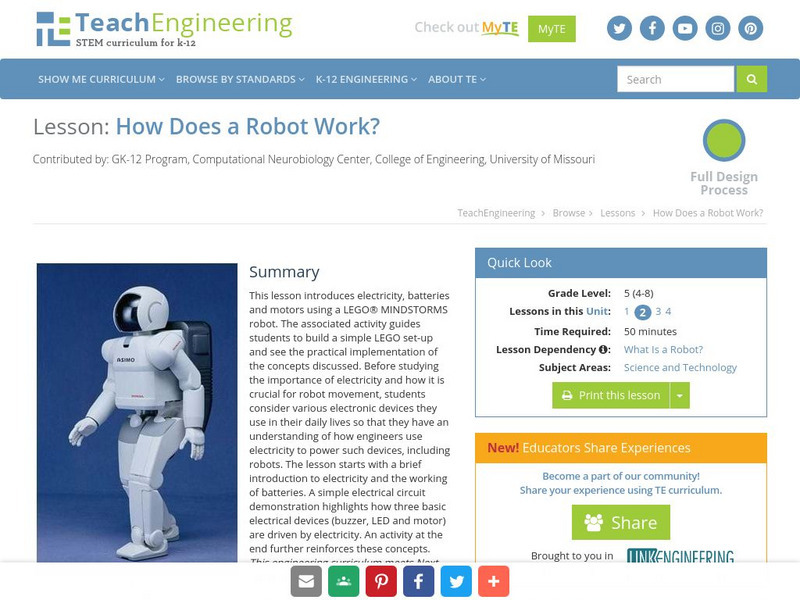
Teach Engineering: How Does a Robot Work?
This lesson plan introduces electricity, batteries and motors using a LEGO MINDSTORMS NXT robot. The associated activity guides students to build a simple LEGO NXT set-up and see the practical implementation of the concepts discussed....
TeachEngineering
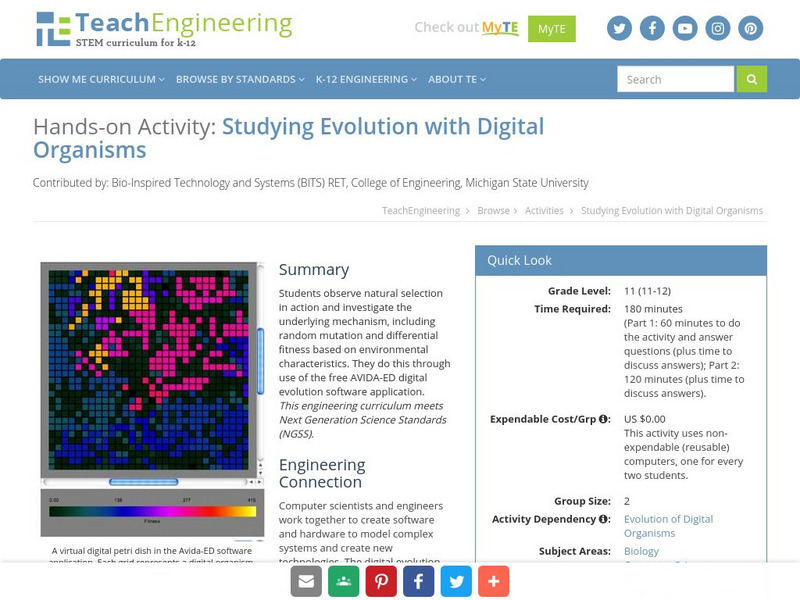
Teach Engineering: Studying Evolution With Digital Organisms
Students observe natural selection in action and investigate the underlying mechanism, including random mutation and differential fitness based on environmental characteristics. They do this through use of the free AVIDA-ED digital...
TeachEngineering
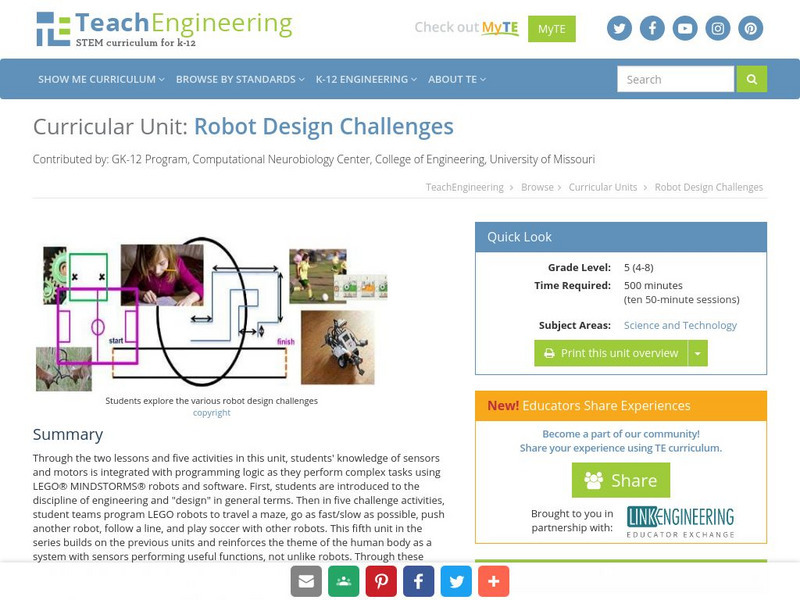
Teach Engineering: Robot Design Challenges
Through the two lessons and five activities in this unit, students' knowledge of sensors and motors is integrated with programming logic as they perform complex tasks using LEGO MINDSTORMS NXT robots and software.
TeachEngineering
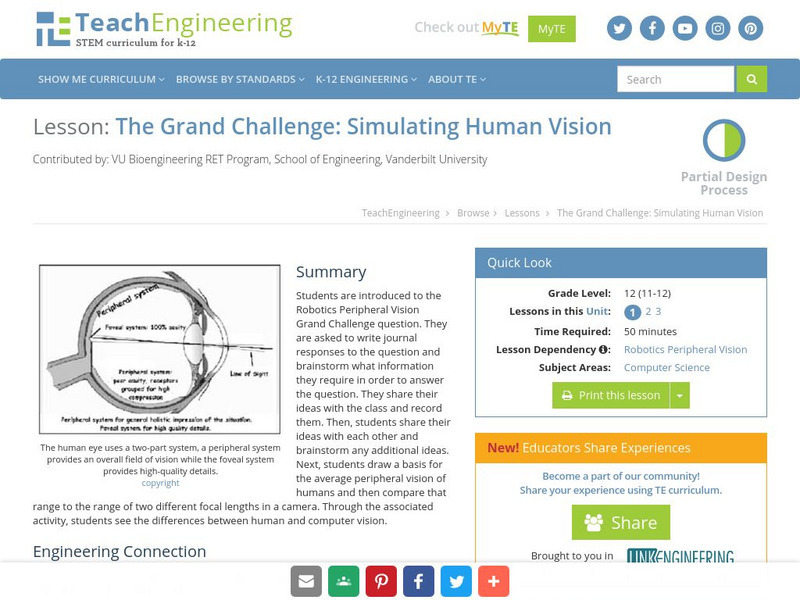
Teach Engineering: The Grand Challenge: Simulating Human Vision
Students are introduced to the Robotics Peripheral Vision Grand Challenge question. They are asked to write journal responses to the question and brainstorm what information they require to answer the question. Their ideas are shared...
TeachEngineering
Teach Engineering: Sextant Solutions
The earliest explorers did not have computers or satellites to help them know their exact location. The most accurate tool developed was the sextant to determine latitude and longitude. In this activity, the sextant is introduced and...
Science Education Resource Center at Carleton College
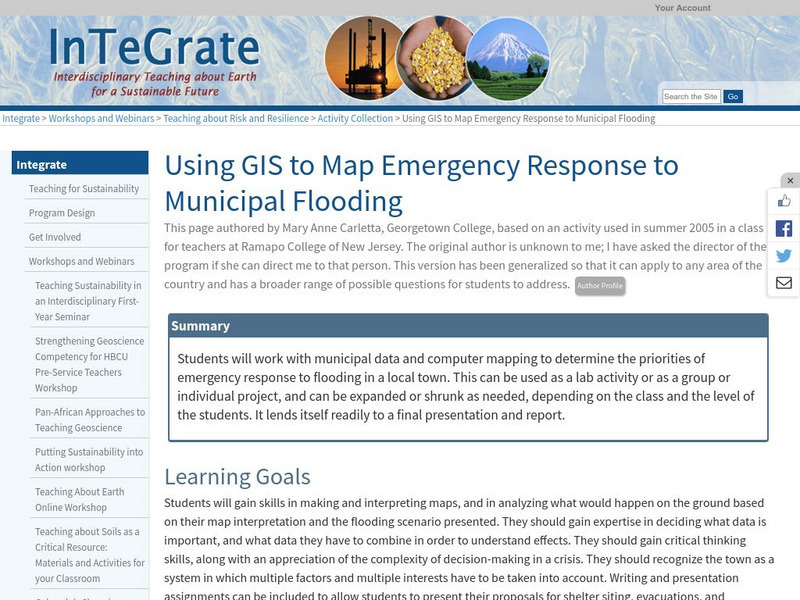
Serc: Using Gis to Map Emergency Response to Municipal Flooding
In this lesson students will work with municipal data and computer mapping to determine the priorities of emergency response to flooding in a local town. This can be used as a lab activity or as a group or individual project, and can be...
TeachEngineering
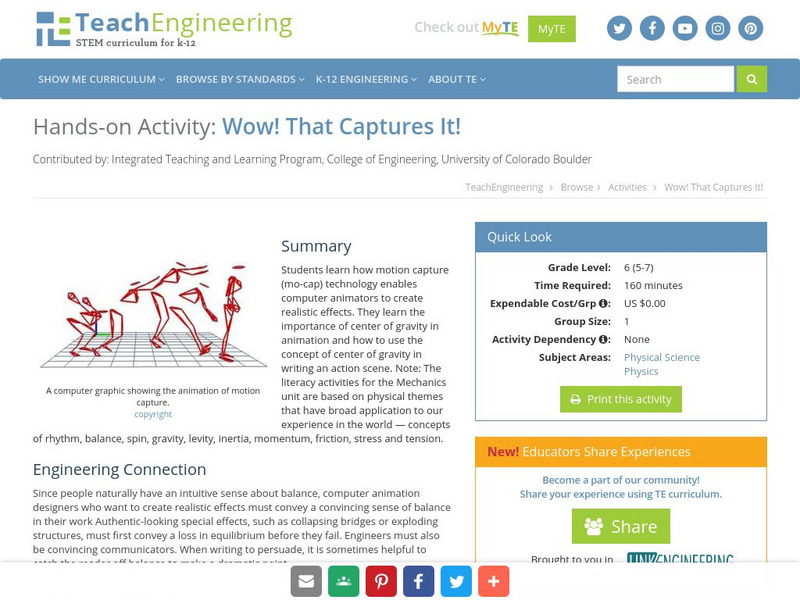
Teach Engineering: Wow! That Captures It!
Students learn how motion capture (mo-cap) technology enables computer animators to create realistic effects. They learn the importance of center of gravity in animation and how to use the concept of center of gravity in writing an...
TeachEngineering
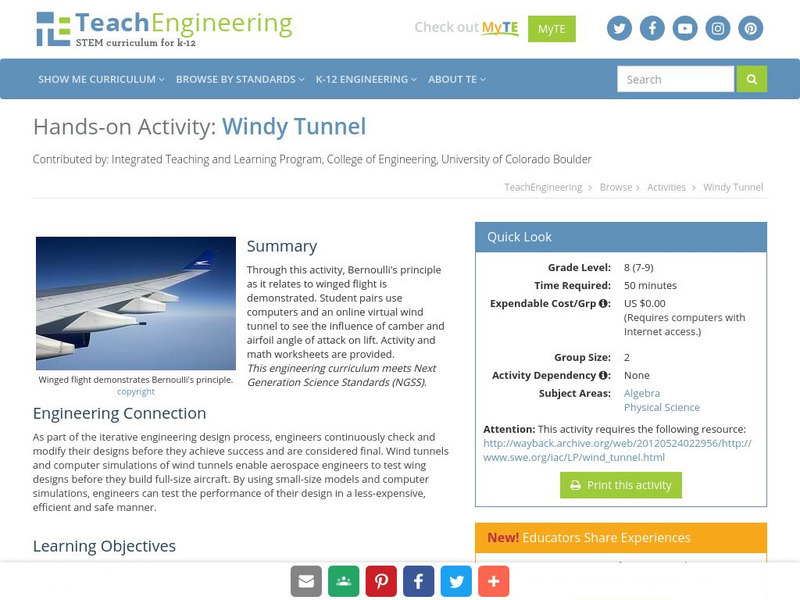
Teach Engineering: Windy Tunnel
The purpose of this activity is to demonstrate Bernoulli's Principle as it relates to winged flight. The students will use computers to see the influence of camber and airfoil angle of attack on the lift.
TeachEngineering
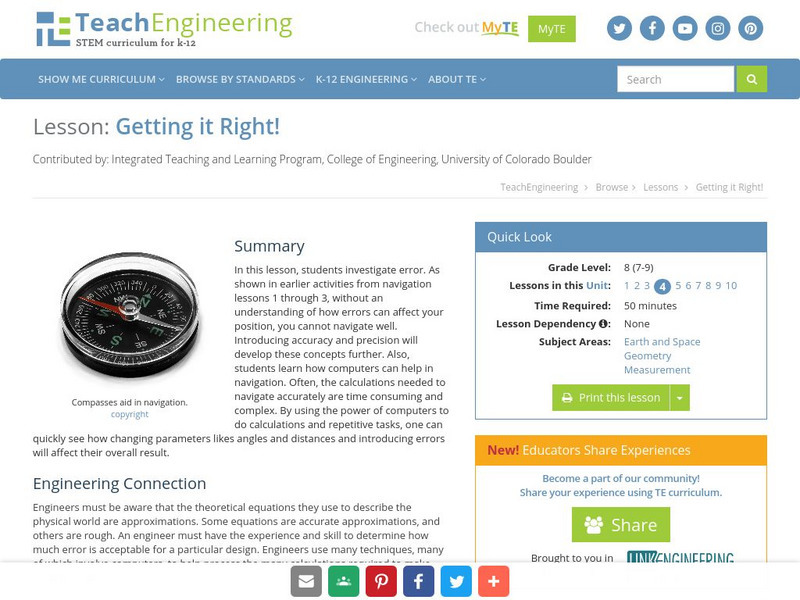
Teach Engineering: Getting It Right!
In this lesson, students will investigate error. As shown in earlier activities from navigation lessons 1 through 3, without an understanding of how errors can affect your position, you cannot navigate well. Introducing accuracy and...
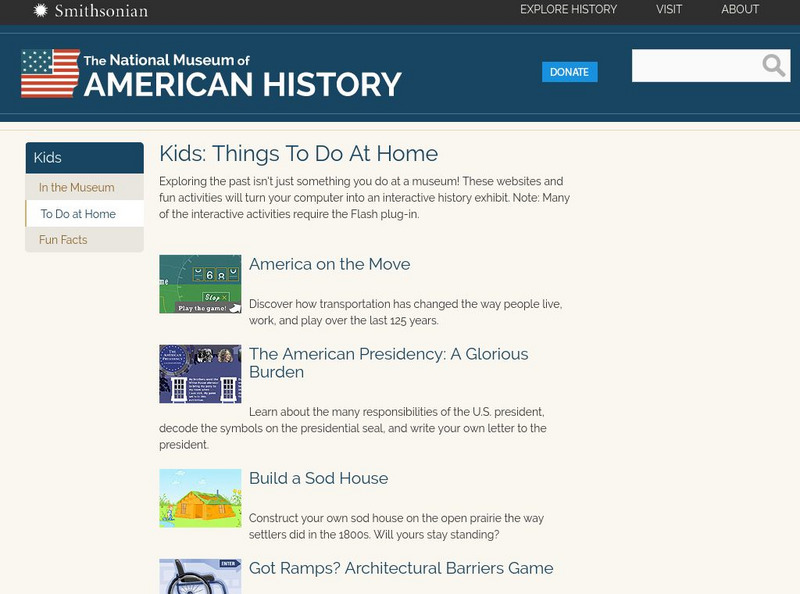
Smithsonian Institution
National Museum of American History: Things to Do at Home
Families can come together through games designed to make history something fun and integral to family life. Build a sod house like prairie settlers did in the 1800s. Go back in time to visit five families that lived in the same house...
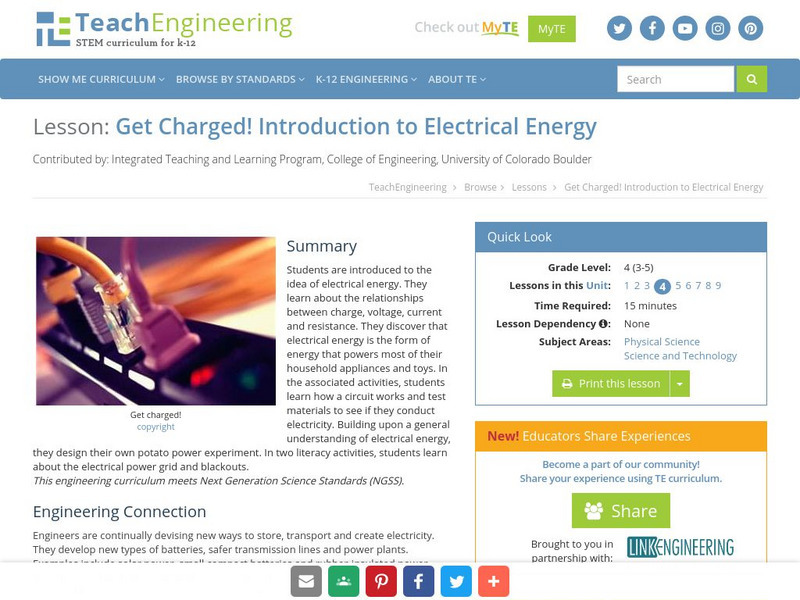
TeachEngineering
Teach Engineering: Get Charged!
Students are introduced to the idea of electrical energy. They learn about the relationships between charge, voltage, current and resistance. They discover that electrical energy is the form of energy that powers most of their household...

Other
Essdack: Tammy's Technology Tips for Teachers
Tammy's Technology Tips for Teachers provides a variety of helpful computer activities, presentations, web sites, and resources of use to educators teaching kindergarten to 8th grade.
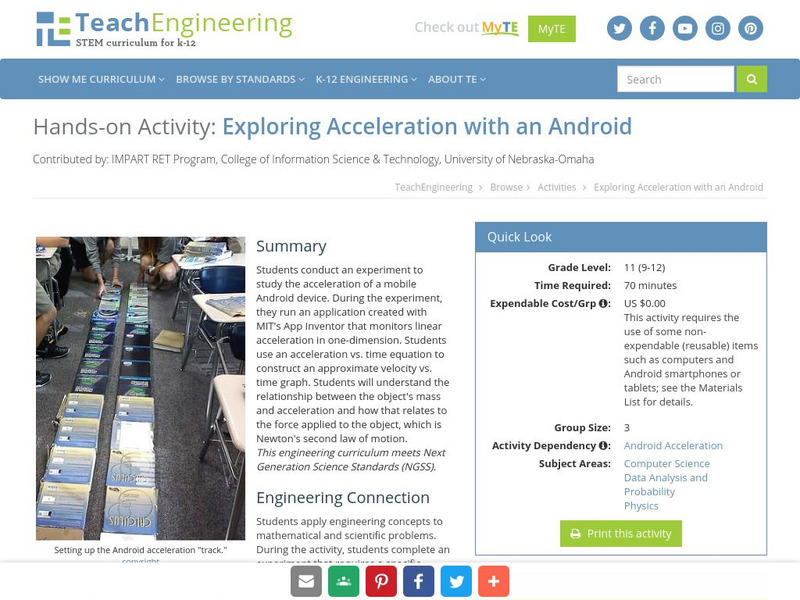
TeachEngineering
Teach Engineering: Exploring Acceleration With an Android
Students conduct an experiment to study the acceleration of a mobile Android device. During the experiment, they run an application created with MIT's App Inventor that monitors linear acceleration in one-dimension. Students use an...
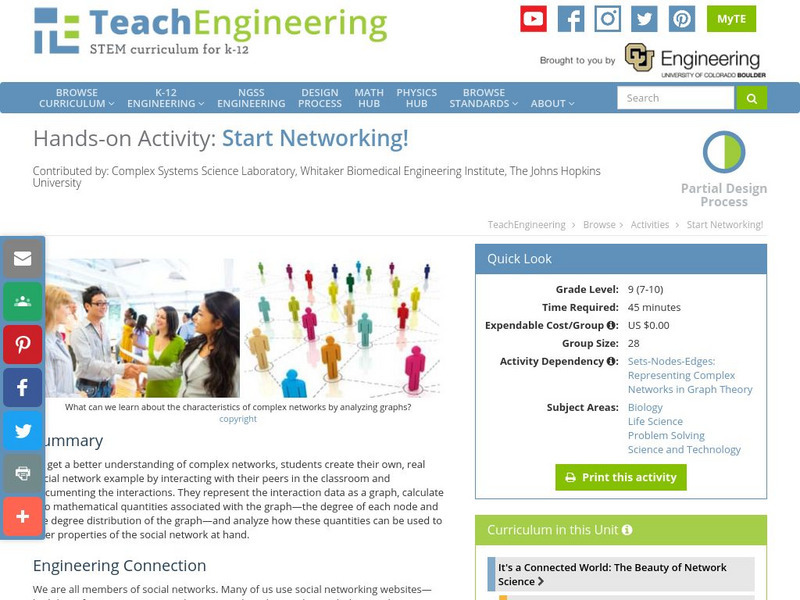
TeachEngineering
Teach Engineering: Start Networking!
To get a better understanding of complex networks, students create their own, real social network example by interacting with their peers in the classroom and documenting the interactions. They represent the interaction data as a graph,...
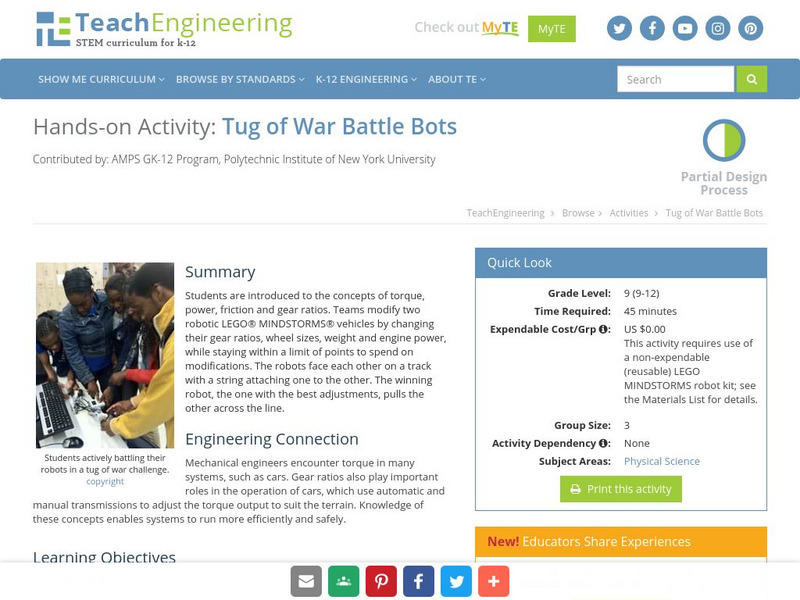
TeachEngineering
Teach Engineering: Tug of War Battle Bots
Students are introduced to the concepts of torque, power, friction and gear ratios. Teams modify two robotic LEGO vehicles by changing their gear ratios, wheel sizes, weight and engine power, while staying within a limit of points to...
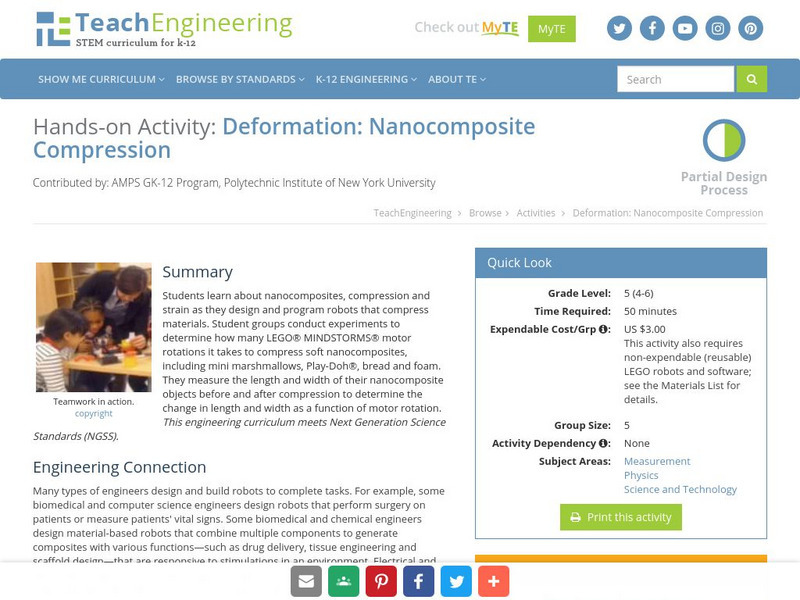
TeachEngineering
Teach Engineering: Deformation: Nanocomposite Compression
Students learn about nanocomposites, compression and strain as they design and program robots that compress materials. Student groups conduct experiments to determine how many LEGO MINDSTORMS NXT motor rotations it takes to compress soft...
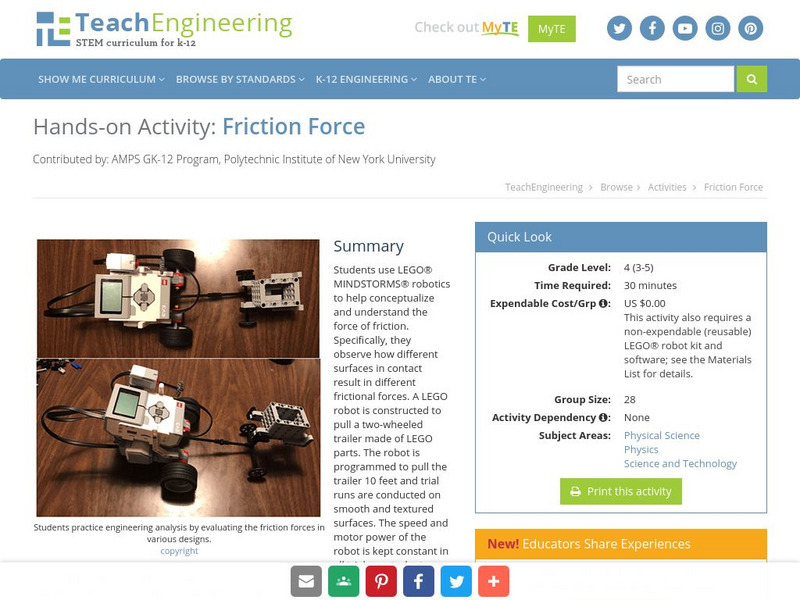
TeachEngineering
Teach Engineering: Friction Force
Students use LEGO MINDSTORMS robotics to help conceptualize and understand the force of friction. Specifically, they observe how different surfaces in contact result in different frictional forces. A LEGO robot is constructed to pull a...
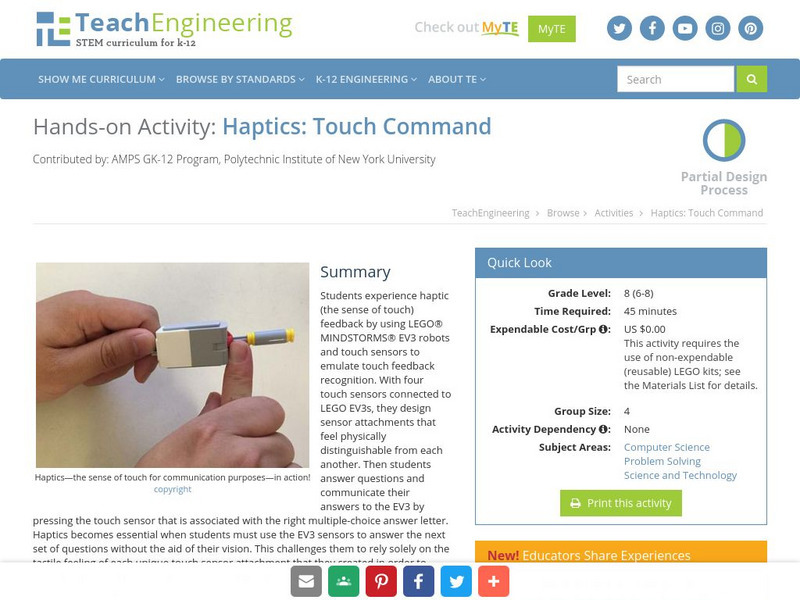
TeachEngineering
Teach Engineering: Haptics: Touch Command
Students experience haptic (the sense of touch) feedback by using LEGO MINDSTORMS NXT robots and touch sensors to emulate touch feedback recognition. With four touch sensors connected to LEGO NXTs, they design sensor attachments that...
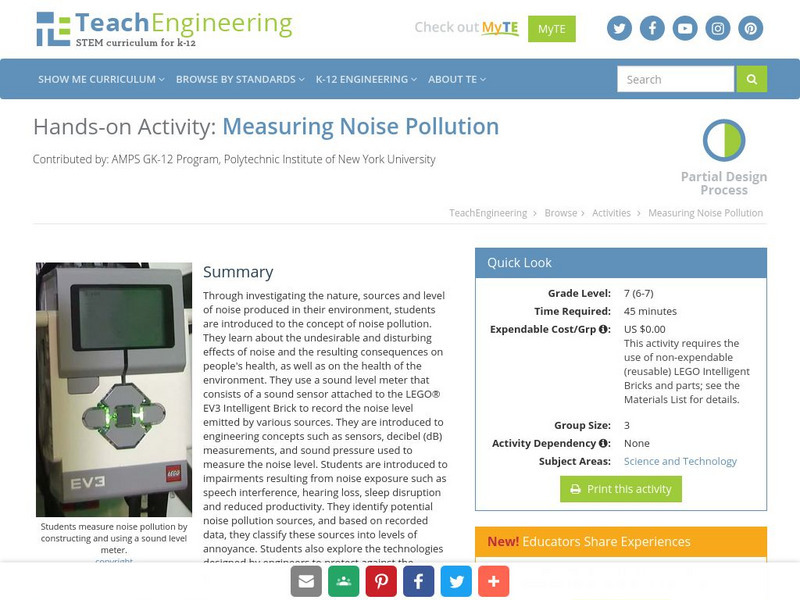
TeachEngineering
Teach Engineering: Measuring Noise Pollution
Through investigating the nature, sources and level of noise produced in their environment, students are introduced to the concept of noise pollution. They learn about the undesirable and disturbing effects of noise and the resulting...
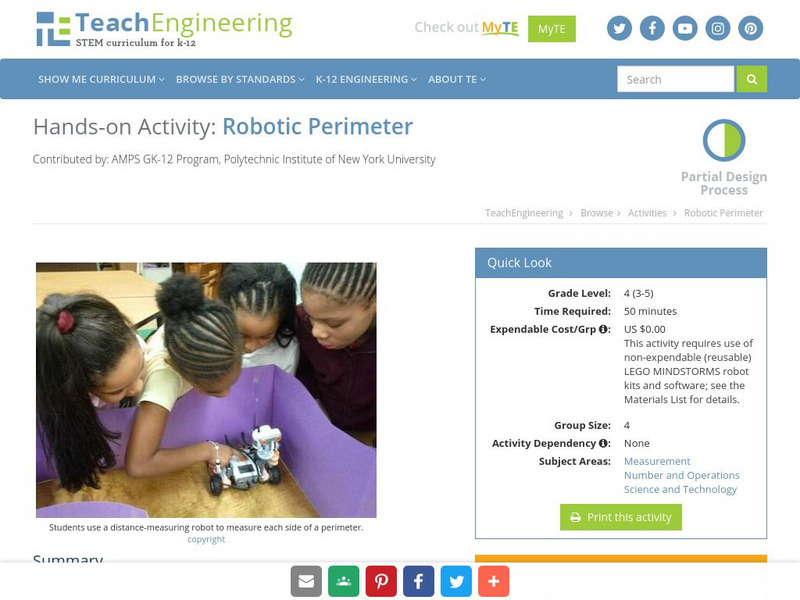
TeachEngineering
Teach Engineering: Robotic Perimeter
Students learn and practice how to find the perimeter of a polygonal shape. Using a ruler, they measure model rooms made of construction paper walls. They learn about other tools, such as a robot, that can help them take measurements....
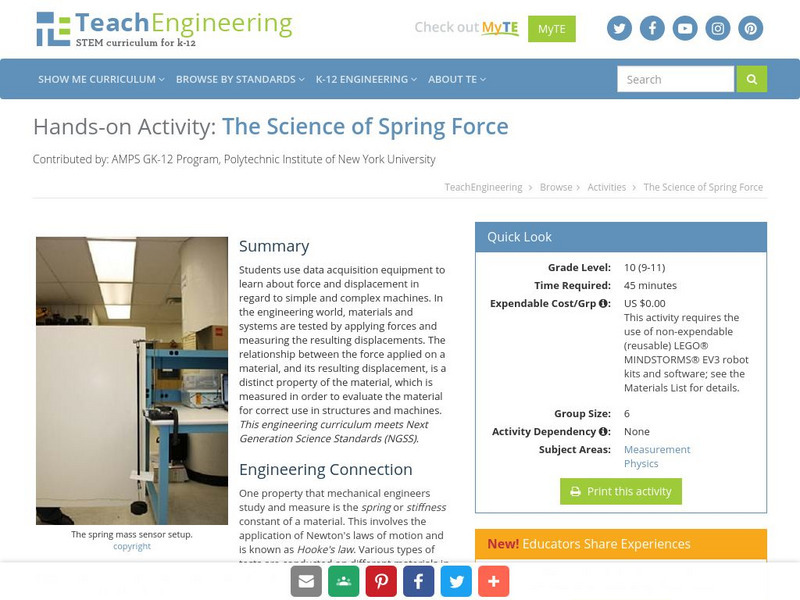
TeachEngineering
Teach Engineering: The Science of Spring Force
Students use data acquisition equipment to learn about force and displacement in regard to simple and complex machines. In the engineering world, materials and systems are tested by applying forces and measuring the resulting...