Hi, what do you want to do?






Computer Hope
Computer Hope: Information About Computer Floppy Drives
Informative site detailing the use of computer floppy dirves. Content includes a focus on floppy drive ABCs, floppy history, floppy cable, creating a floppy boot disk, floppy disk definitions, and coverage of 3.5 and 5 1/4 floppy diskettes.
BBC
Bbc: Science & Nature Hot Topics Computer Viruses
This BBC "hot topic" contains a description of the types of computer viruses. It also provides different ways to prevent or eliminate computer viruses.
Virginia Tech
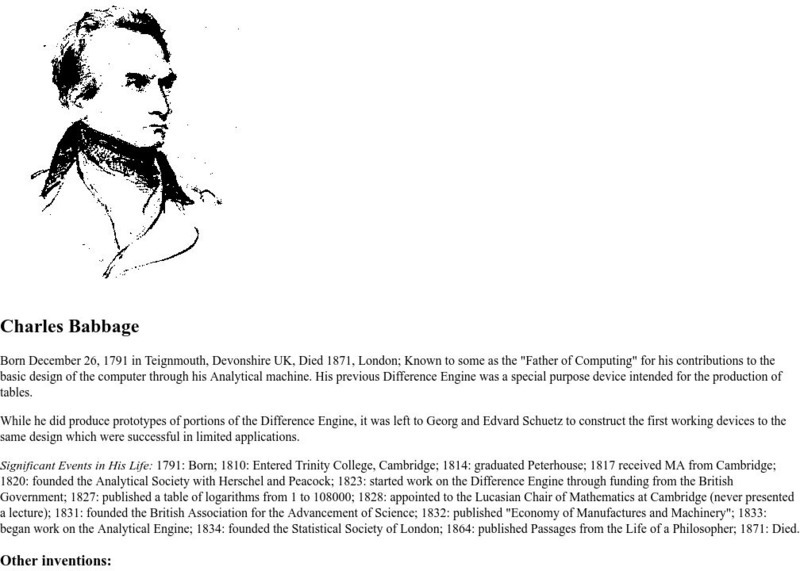
Virginia Tech: Charles Babbage
Learn about Charles Babbage; computer pioneer, philosopher, politician, newtonian, industrialist who lived from 1791 to 1871.
Other
A Brief History of Computers and Networks
Provides historical information on computers and networks, from the beginning of mechanical calculators in the 1640's to modern times.
Computer Hope
Computer Hope: Information About the Computer Cpu
A complete guide to the computer CPU, including CPU ABCs, known CPU bugs, processor history and information, technical support, processor definitions as well as information on math coprocessors, compatible Intel processors, interposer,...
Smithsonian Institution
Smithsonian Education: Carbons to Computers
Provides an excellent timeline of the history of the American office. Great pictures, easy to read, and the history is broken into eras for easy researching.

Other
The History of Programming Languages
Brief history of programming languages is provided in this research paper at this site.
Other
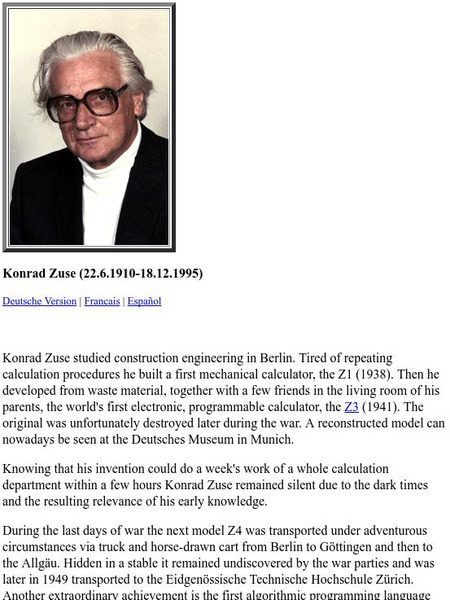
Rtd; Konrad Zuse (1910 1995)
Biographical information about the engineer Konrad Zuse is provided at this site. Tells of his accomplishments and contribution to computer history.

Agnes Scott College
Agnes Scott College: Ada Byron, Lady Lovelace
Ada Byron, Lady Lovelace (1815-1852), was one of the most picturesque characters in computer history. The daughter of the poet Lord Byron, she was raised to be a mathematician and scientist and contributed to the work of Charles Babbage.

Great Idea Finder
The Great Idea Finder: Computer Mouse
A short article about the computer mouse and the inventor, Douglas Engelbart.
Other
The Apple Museum
The Apple Museum provides in depth information on the history of the Apple company and its products. Contributing to this information are articles written in reference to the company and/or its products. Code names, video clips, specs...
PBS
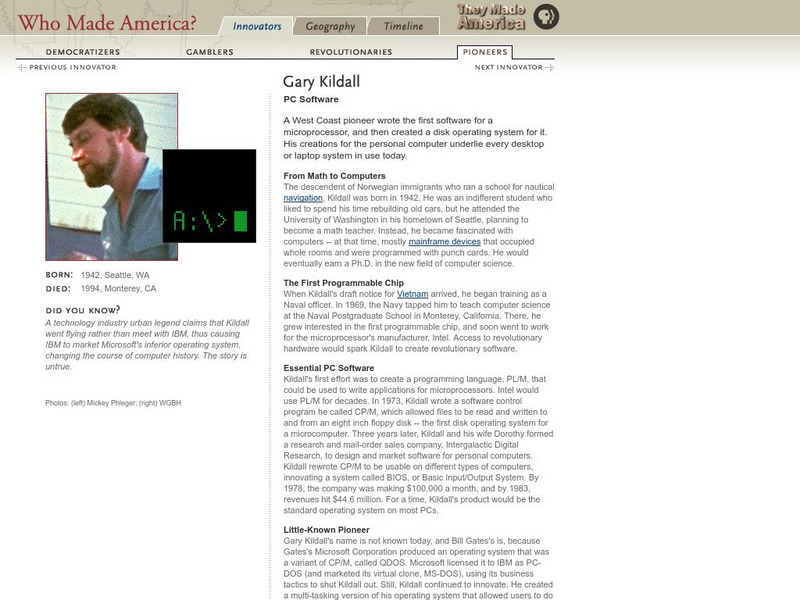
Pbs: Who Made America?: Innovators: Gary Kildall
One-page profile of influential innovator, Gary Kildall, a pioneer in the computer age whose vision and ideas created the first disc operating system for a microcomputer.
Virginia Tech
Virginia Tech: The Eniac
This site has the description and history of the ENIAC, including its development and use in World War II.
Rock and Roll Hall of Fame
Rock & Roll Hall of Fame: Sti Lesson 15: The Changing American Landscape
The rise of American cities between 1865 and 1900 was spawned by the industrial revolution. Technological advancements in industry and transportation fathered the enormous growth of large cities across the United States. This led to the...
History of Computing Science
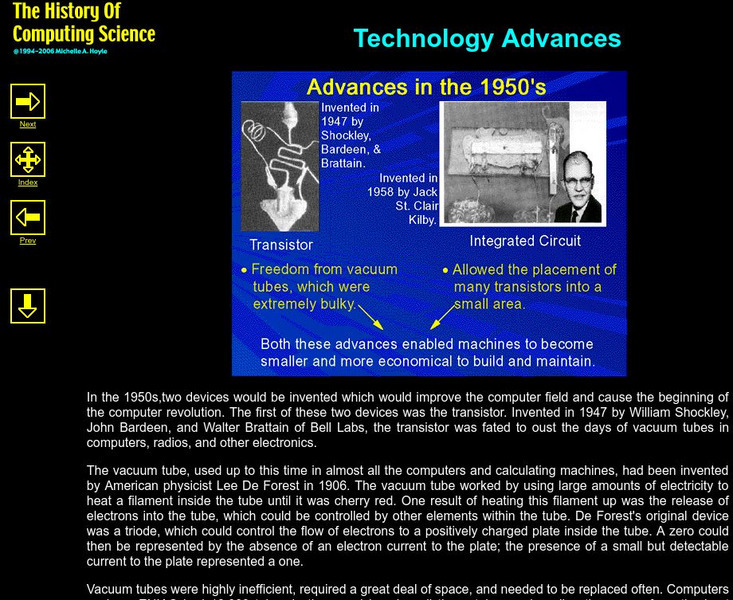
History of Computing Science: Technology Advances
The transistor and the integrated circuit were two inventions that fueled the technology explosion. This lecture presents a brief discussion of these two inventions.

Other
D Green: The First Generation Computers
Discusses the first generation computers, the Bendix G-15, and first generation technologies.

History of Computing Science
History of Computing Science: Edvac
EDVAC (Electronic Discrete Variable Automatic Computer) was an early computer that was one of the first to use the binary number system to represent information. This lecture is a brief presentation of the EDVAC.

University of St. Andrews (UK)
University of St. Andrews: St. Andrews: History of the Four Color Theorem
The University of St. Andrews offers a brief history of the first math problem to be solved with computers.
History of Computing Science
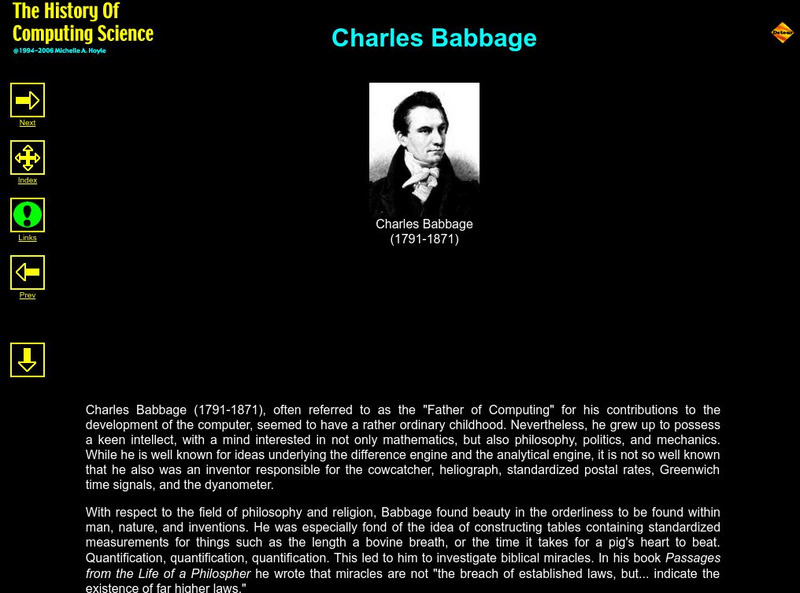
History of Computing Science: Charles Babbage
This is a brief biography of Charles Babbage, also known as the "Father of Computing".
PBS
Pbs Learning Media: Technology Over Time
In this interactive activity adapted from A Science Odyssey, learn how technology in the home has changed through the years. Scroll through a timeline from 1900 to 2010 to explore technological innovations in the home (such as...
National Library of France
National Library of France: Heaven and Earth
Learn how art through the ages has been influenced by the Earth and the heavens. See paintings that attempted to explain the Earth's creation from a scientific standpoint, sacred architecture that provided a place to worship the heavens,...

National High Magnetic Field Laboratory
Magnet Academy: Timeline of Electricity and Magnetism: 1940 1959
Defense-related research leads to the computer, the world enters the atomic age and TV conquers America.

National High Magnetic Field Laboratory
Magnet Academy: Timeline of Electricity and Magnetism: 1960 1979
Computers evolve into PCs, researchers discover one new subatomic particle after another and the space age gives our psyches and science a new context.
Other
E Cycle Best: A Concise History and Evolution of Tablet P Cs (Infographics)
Check out the illustration of the progress of personal computing tablets. Could it be true that they actually began in the nineteenth century?
Other popular searches
- History of Computer Science
- Computer History Webquests
- Apple Computer History
- Computer History Timeline
- Research Computer History
- Personal Computer History
- Computer History Time Line
- Computer History Web Quests
- Electronic Computer History
- History of Computer
- Computer History Lesson
- Research on Computer History