Hi, what do you want to do?






Columbus City Schools
To Measure its Mass or Volume?
Atoms, elements, and molecules, oh my! Teaching the fundamentals of chemistry to curious sixth graders has never been easier to accomplish. Here is a resource that pulls together everything needed to get them off to a good start,...

Rensselaer Polytechnic Institute
Molecules to the Max!—Educators Resource Guide
From molecules to nanotubes, an engaging unit explores the world of tiny science. Fifteen hands-on experiments and lessons engage young scientists as they learn chemistry. Discussions, worksheets, and data analysis reinforce the concepts...
CK-12 Foundation
Ck 12: Molecular Compounds
[Free Registration/Login may be required to access all resource tools.] Students investigate compounds, and learn the ways in which molecules are named.
TeachEngineering
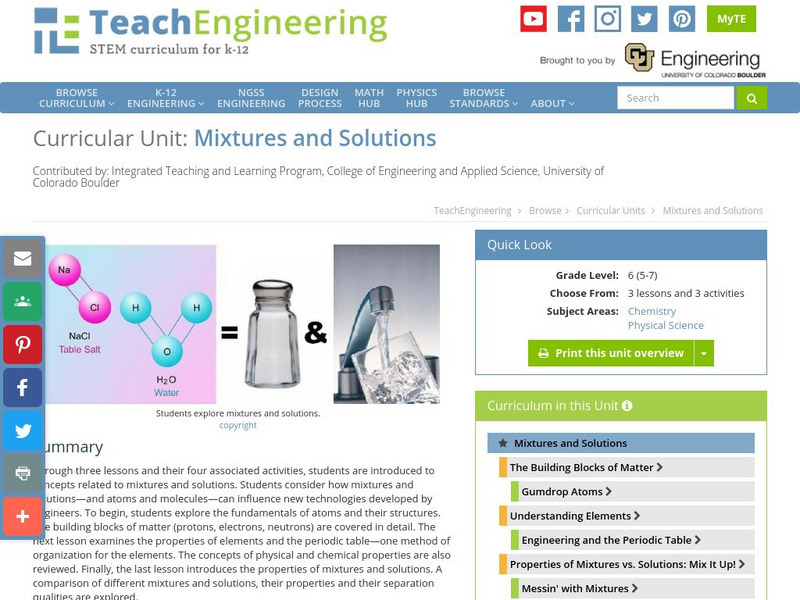
Teach Engineering: Mixtures and Solutions
This unit covers introductory concepts of mixtures and solutions. Students think about how mixtures and solutions, and atoms and molecules can influence new technologies developed by engineers. The first lesson explores the fundamentals...

CK-12 Foundation
Ck 12: Life Science: Organic Compounds
[Free Registration/Login may be required to access all resource tools.] The main chemical components of living organisms are known as organic compounds and are built around the element carbon. Living things are made up of very large...
CK-12 Foundation
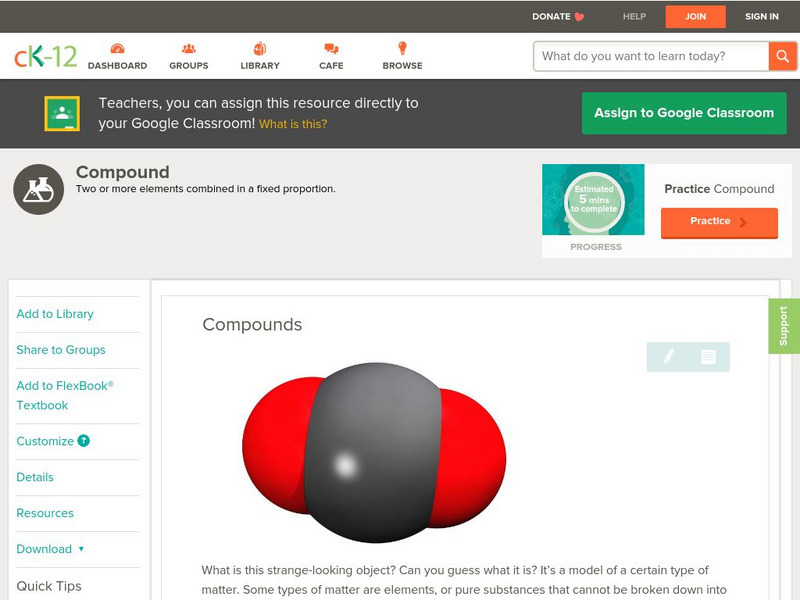
Ck 12: Physical Science: Compounds
[Free Registration/Login may be required to access all resource tools.] Explores compounds and their properties, the elements that form them, and their structure.
CK-12 Foundation
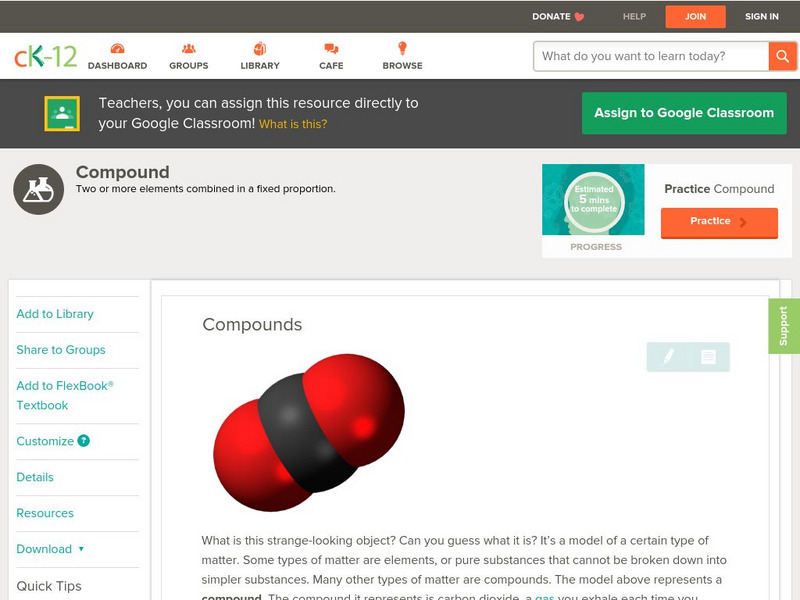
Ck 12: Physical Science: Compounds
[Free Registration/Login may be required to access all resource tools.] Investigates compounds and their properties, the elements that form them, and their structure.
CK-12 Foundation
Ck 12: Chemistry: Naming Binary Molecular Compounds
[Free Registration/Login may be required to access all resource tools.] Covers molecular compound, binary molecular compound, molecules, and naming of binary molecular compounds.
CK-12 Foundation
Ck 12: Polarity and Intermolecular Forces
[Free Registration/Login may be required to access all resource tools.] The following online tutorial describes how the electronegativity difference between two atoms in a covalent bond results in the formation of a nonpolar covalent,...
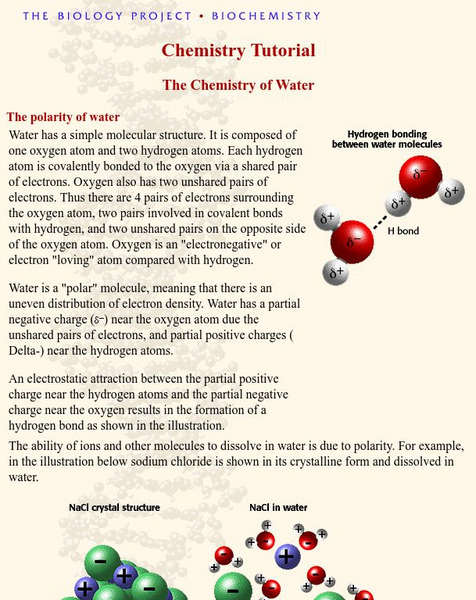
University of Arizona
Ua: Chemistry Tutorial
This general tutorial begins with an explanation of the polarity of the water molecule and the effects this polarity has on the properties of water. Goes on to introduce organic molecules and has a thourough tutorial on the third page.

University of Alberta
The University of Alberta: Infrared Spectroscopy
Complete this interactive tutorial and learn about interpreting the infrared spectrum ("I" "R") that provides information about the functional groups in a molecule. Included are 12 labs and a quiz.
BBC
Bbc: Gcse Bitesize: Covalent Bonds
A covalent bond is formed between non metal atoms, which combine together by sharing electrons. Covalent compounds have no free electrons and no ions so they don't conduct electricity.
CK-12 Foundation
Ck 12: General Chemistry
[Free Registration/Login may be required to access all resource tools.] Students will be introduced to some of the basic concepts of chemistry.
CK-12 Foundation
Ck 12: Chemistry: Molecular Formula
[Free Registration/Login may be required to access all resource tools.] Defines molecular formula and describes how to write molecular formulas.
Sophia Learning
Sophia: Chemical Reactions: Lesson 4
This lesson will present a basic understanding of the periodic chart of elements and how to predict chemical reactions based on given information. It is 4 of 9 in the series titled "Chemical Reactions."

Georgia Department of Education
Ga Virtual Learning: Ap Biology: Chemistry of Life
Through informational text, interactive activities, animations, and video clips, students examine the chemistry of living things, and they learn how interactions from atoms are fundamental to life as we know it.

CK-12 Foundation
Ck 12: Fifth Grade Science: Physical Science: Types of Matter
[Free Registration/Login may be required to access all resource tools.] Discusses elements, atoms, compounds, molecules, and crystals. Looks at mixture and different types of them.