Hi, what do you want to do?






Curated OER
Habitat Dynamics
Students develop an interactive diary to record bird seed consumption. In this habitat activity, students predict and record the amount of birdseed eaten each week by birds.

Curated OER
Flipbook Succession
Students review succession charts for their native area before going to an outside site to view the changes. At the site, they follow the transect line and observe the changes in the plant life. They draw the changes on note cards that...

Curated OER
Flowering Phenology: How Do Plants Know When to Flower?
Students study the process of plant reproduction and the biotic and abiotic factors that affect flowering phenology. In this plant reproduction instructional activity, students describe the interaction of environmental factors as it...

Curated OER
Finding the Basal Area of a Forest Plot to Determine Stocking Levels
High schoolers use graphs and plots to measure the basal area and stocking levels. In this graphing instructional activity students work in the field the use their data to help them complete a lab activity.

Curated OER
A Living Watershed
Students, through this series of lessons, use local resources, speakers, print and video materials, as well as standard text materials to study the ecosystem of the local watershed.

Curated OER
Survival Of The Fittest
Seventh graders examine the concept of an ecosystem and how there is a variety of representations of life that exist there. They look at the equilibrium that is reached in stable communities and how the variable of change in...

Curated OER
the Wonder of Wetlands
Students explore the importance of the wetland ecosystem, its properties and functions, as well as, the many birds, animals, and plant life found there.

Curated OER
The Arctic and Taiga Ecozone of Canada
Students discover the differences in the Arctic and Taiga regions of Canada. They identify physical and human characteristics of both region. They also practice using an atlas.

Curated OER
The Arctic and Taiga Ecozone of Canada
Students examine the various sub-regions of the Arctic and Taiga zones in Canada. Using the online Canadian Atlas, they locate and describe the characteristics of each zone. They organize their information into a chart and share it with...
CK-12 Foundation
Ck 12: Life Science: Levels of Ecological Organization
[Free Registration/Login may be required to access all resource tools.] Ecosystems are organized into several different levels, and they can be studied at any one of the various levels of organization. Learn more about levels of...

Khan Academy
Khan Academy: What Is Ecology?
A webpage giving an overview of ecology. Learn about the biotic and abiotic factors that make up an ecosystem as well as the different levels of ecology.
TeachEngineering
Teach Engineering: Biomes and Population Dynamics
This lesson begins with a PowerPoint slideshow that covers important ecological concepts about biomes, limiting factors, carrying capacity, and population growth. Students will look at the population dynamics involved with the diversity...
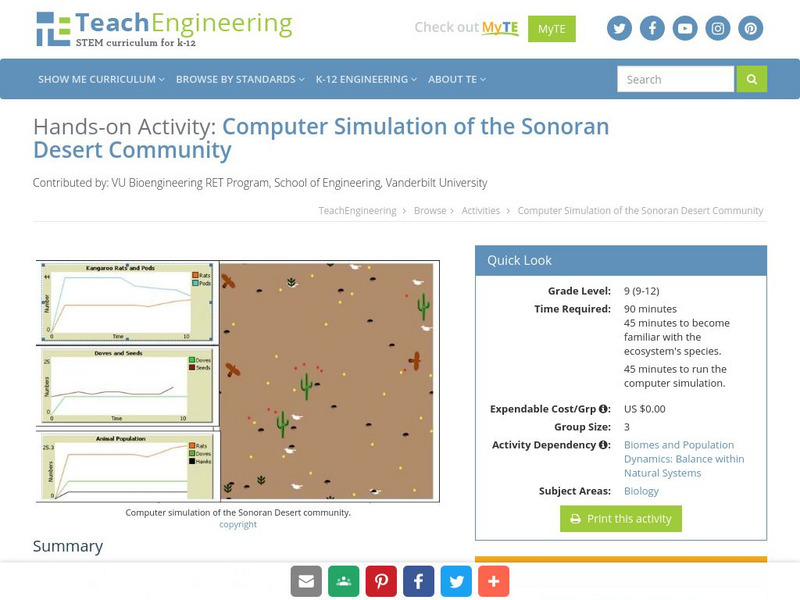
TeachEngineering
Teach Engineering: Computer Simulation of the Sonoran Desert Community
The computer program's simulation of a Sonoran desert community should ultimately strengthen the student's comprehension of what is required for a natural ecosystem to sustain itself (remain in balance). This computer simulation program...

CK-12 Foundation
Ck 12: Life Science: 12.2 Ecological Organization
See how ecosystems are organized into several different levels, and an ecosystem can be studied at any one of the various levels of organization.
Science Struck
Science Struck: The 6 Chief Levels of Organization in Ecology
Describes six levels of organization in the biological world - individual species, population, community, ecosystem, biome, and biosphere.
Science Education Resource Center at Carleton College
Serc: Environmental Interactions: Connectedness of a Natural System
A field experience where students undergo an exploration in a natural environment. They are introduced to the concepts of species, population, community, ecosystem, niche, and biosphere.

ClassFlow
Class Flow: Populations & Communities
[Free Registration/Login Required] This flipchart features the levels of ecological organization. Students can move objects to reveal decryptions and answers! An Activote quiz accompanies this flipchart, but may have to be downloaded and...
Other
My Science Box: Ecosystem Organization
In this lesson plan, learners will learn about the different levels in the hierarchy of ecology and explain the relationships: organism, population, community, ecosystem, biome, and biosphere. They will also discover why different...
Sea World Parks & Entertainment
Sea World: Biodiversity
Depicts biodiversity with a brief narrative. Includes vocabulary, bibliography, and one activity. Subject matter at an upper intermediate grade level or higher.

Michigan State University
Michigan State University: How Pesticide Resistance Develops
An individual organism's genes determine its physical and behavioral traits. When individuals reproduce, they pass along unique combinations of genes to their offspring. Different environments favor individuals with different physical...