Hi, what do you want to do?





ReadWriteThink
Read Write Think: Once Upon a Fairy Tale Teaching Revision as a Concept
Contains plans for five lessons that teach the difference between revision and editing using fractured fairy tales. In addition to objectives and standards, this instructional plan contains links to sites used in the lessons as well as...

Annenberg Foundation
Annenberg Learner: Analyzing Complex Text
During this lesson, students will use close reading strategies to analyze aspects of the setting in The Adventures of Huckleberry Finn by Mark Twain. [7:57] CCSS.ELA-Literacy.CCRA.R.10, RL.11-12.10a/b Text Complexity
ReadWriteThink
Read Write Think: Defining and Exploring an Author's Stylistic Choices
Contains plans for two lessons that teach students how to recognize an author's use of style in literature. These plans use "Their Eyes Were Watching God" by Zora Neale Hurston as an example, but the basic ideas can be adapted to other...
ReadWriteThink
Read Write Think: Focusing Reader Response Through Vocabulary Analysis
This lesson plan enables young scholars to compile a list of vocabulary words in association with a recently read novel. Included in the lesson plan is an overview, practice, objectives, downloadable resources, an interactive tool, and...
ReadWriteThink
Read Write Think: Solving Word Meanings: Engaging Strategies for Vocabulary Dev.
A 5-lesson unit where students learn to use context clues and semantic gradients together to determine the meanings of unfamiliar words.
ReadWriteThink
Read Write Think: Using Word Storms to Explore Vocabulary and Encourage Thinking
Contains plans for seven lessons about working dogs that teach critical thinking skills and a vocabulary strategy called Word Storms. In addition to objectives and standards, this instructional plan contains links to sites used in the...
Lumen Learning
Lumen: Rhetorical Reading: Academic Reading Strategies
This lesson focuses on reading strategies including understanding your purpose, and before, during, and after reading strategies.
ReadWriteThink
Read Write Think: Guided Comprehension: Summarizing
Lesson that introduces students to the comprehension technique of summarizing. Students learn using the QuIP (questions into paragraphs) method which involves organizing information and putting it in writing.
Better Lesson
Better Lesson: Discussing "The True Story of the Three Little Pigs"
In this lesson, 1st graders will work with "The True Story of the Three Little Pigs" Jon Scieszkaby. They will describe the characters, setting, and key details in the story and help the teacher record the details on a circle map.
Better Lesson
Better Lesson: Assessing Theme
This is an introductory lesson on the concept of theme. Students choose two words that sum up the theme of the novel "So B. It" by Sarah Weeks. They then analyze a passage to find evidence of their choices and create a theme map. They...
ReadWriteThink
Read Write Think: Plot Structure: A Literary Elements Mini Lesson
Contains plans for two lessons that ask students to apply Freytag's Pyramid (also known as Freytag's Triangle) to pieces of writing, oral storytelling, and television shows. In addition to objectives and standards, this instructional...
ReadWriteThink
Read Write Think: Abc Bookmaking Builds Vocabulary in the Content Areas
Six 50-minute lessons build vocabulary through the content areas by making an ABC book. It can become a classroom resource. Links include a non-fiction book list, checklist, word list, rubric, and a storyboard chart. There is also a link...
ReadWriteThink
Read Write Think: Critical Media Literacy: Commercial Advertising
In this instructional activity, young scholars will examine mass media critically and become aware of how much advertising is around them. They will realize the impact media has on social equality, what people buy, and on culture.
ReadWriteThink
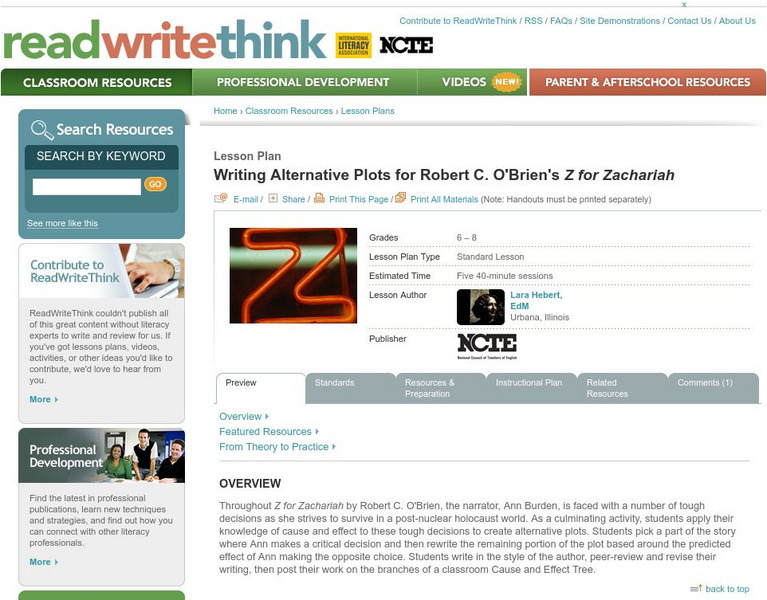
Read Write Think: Writing Alternative Plots for Robert O'brien's Z for Zachariah
Lesson in which students are required to write an alternative plot to O'Brien's science fiction novel. Includes an interactive graphic organizer, handouts, and a rubric.
E Reading Worksheets
E Reading Worksheets: Patterns of Organization: Compare and Contrast
This learning module provides an explanation of the compare and contrast text structure. An explanation of the compare and contrast text structure is provided, and the compare and contrast text structure is demonstrated in a video...
E Reading Worksheets
E Reading Worksheets: Figurative Language Activities
Numerous activities, games, quizzes, lessons, and PowerPoint presentations are provided for the topic of "figurative language" in writing. Students will have numerous exposures to examples. Students will also be able to practice...
Better Lesson
Better Lesson: Sl.4.2: Pose an Respond to Specific Questions
Links to 38 lessons and activities that build student skills in standard SL.4.2: Pose and respond to specific questions to clarify or follow up on information and make comments that contribute to the discussion and link to the remarks of...
Better Lesson
Better Lesson: Speaking, Listening and Writing Compound Contrasting Sentences
Students will be answering text-dependent questions in which they will have to describe the differences between the different characters, settings, and major events in our stories using complex contrasting sentences. The students will...
Lumen Learning
Lumen: Writing Process: Finding Evidence
This lesson focuses on finding evidence to support your thesis, how to incorporate your findings into your own work, and how to effectively quote, paraphrase, and summarize your information. CCSS.ELA-Literacy.CCRA.W.9, W.11-12.1b...

Library of Congress
Loc: Teachers: Personal Stories and Primary Sources
Young scholars will explore the value of personal stories and first-hand accounts when exploring history, in this case, the events of the early twentieth century, which included World War I and the Great Depression. Through this...
Better Lesson
Better Lesson: Violence & Video Games, the Debate
In this lesson, 6th graders read and discuss an article about video games and violence, then participate in a debate. They are divided into groups and each group prepares an argument and their evidence, then one person from each group...

Sophia Learning
Sophia: Referencing the Author's Purpose
This lesson explains how to reference an author's purpose when answering a reading comprehension question. This tutorial shares an audio version of the lesson's content. [3:14] RI.11-12.6 Eval Purpose, Rhetoric, Style
Better Lesson
Better Lesson: Using Word and Picture Clues to Make an Inference
First graders will use text evidence to make inferences about word and word phrase meanings in a text. Word and picture clues will be used to help students form inferences.
ReadWriteThink
Read Write Think: Teaching Poetry Through Riddles
Excellent teaching resource that attempts to teach poetic concepts to middle schoolers by using riddles. Discusses riddles' use of metaphor, simile, and imagery, and relates these concepts to the students' understanding of poetry....