
Curated OER
Louisiana History-Unit 4: Early People of Louisiana and a Meeting of Different Worlds
The Poverty Point Culture of Louisiana is described in detail within four slides of this six-slide PowerPoint. Four detailed paragraphs help describe the economic legacy that existed in Louisiana. A table, map, and photo are included to...

Curated OER
Automobile-Accident Reconstruction
Students investigate an accident and relate it to math. In this trigonometry lesson, students measure the accident scene, the friction produced, and the speed from the skid marks. They create a poster of their findings.

Curated OER
Patterns & Balance
Students compare and contrast the difference in the two sets of images and discuss the visual interest in the first set and the different visual interest created in the second set of prints.

Curated OER
Patchwork Math
Students recognize and identify shapes in their environment. They investigate why objects can be composed of several different shapes. They follow a pattern to recreate designs using various shapes.

Curated OER
Linear Systems: Graphical Interpretation of Vectors
In this graphical interpretation of vectors learning exercise, students execute operations of addition and multiplication by a scalar. They sketch results and determine the commutativity of vector addition. This three-page learning...

Curated OER
Rhythm and Movement
Third graders identify the rhythms and movements found in different works of art. In this visual arts activity, 3rd graders view samples of art work and use hand gestures to demonstrate the movement of the image. Students pick one art...

Curated OER
Terrific Tessellations
Students explore tessellations that are found in nature and everyday objects. They observe the works of M.C. Escher. Students create their own tessellations using pencil and paper.

Curated OER
Tangram Tantrums
Students discuss tangram vocabulary, and act out slide, flip, and turn. They observe tangram puzzles on a web page, and solve their own tangram puzzles.

Curated OER
Self Portraits Part 2
Sixth graders explore the concept of Cubist art. In this visual arts lesson, 6th graders examine examples of Pablo Picasso's work and they create self portraits in Cubist style.
Scholastic
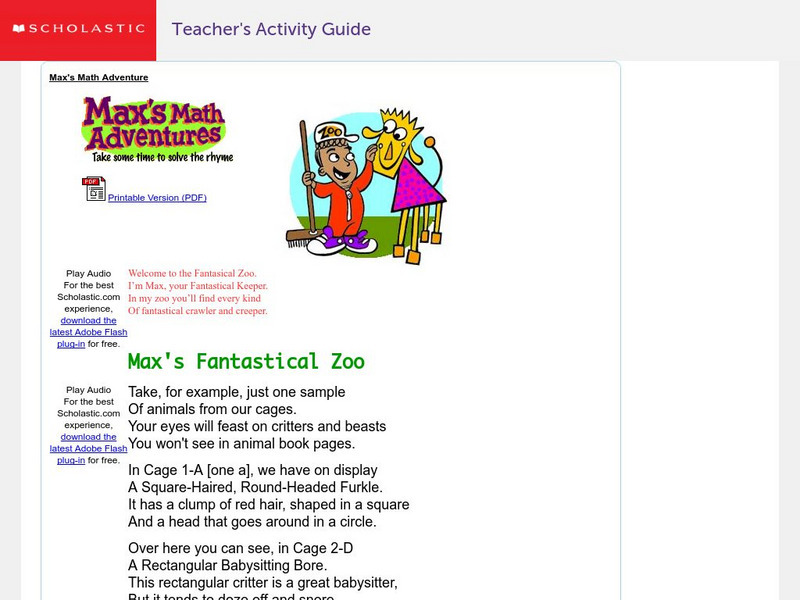
Scholastic: Max's Math Adventures: Max's Fantastical Zoo
Use this rhyming description of Max's Fantastical Zoo to make some amazing animals from geometric shapes. There is a teacher's guide for easy lesson planning.

Curated OER
Bubbles
"What is so fascinating about bubbles? The precise spherical shape, the incredibly fragile nature of the microscopically thin soap film, the beautiful colors that swirl and shimmer, or most likely, a combination of all these phenomena?...