Smithsonian Institution
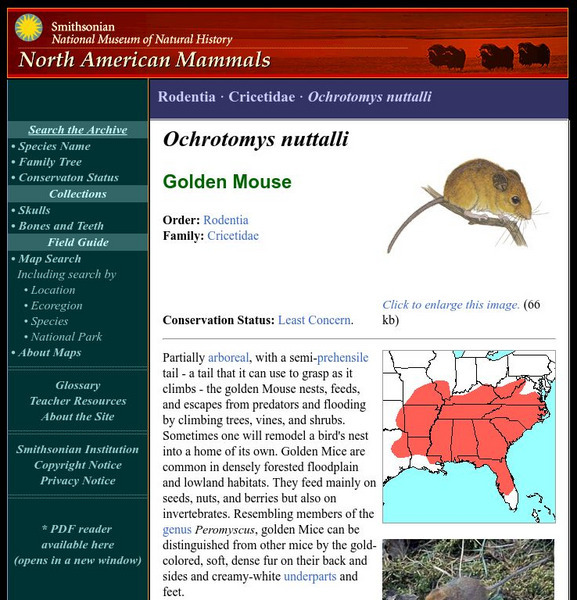
National Museum of Natural History: American Mammals: Golden Mouse
Partially arboreal, with a semi-prehensile tail - a tail that it can use to grasp as it climbs - the golden Mouse nests, feeds, and escapes from predators and flooding by climbing trees, vines, and shrubs. Sometimes one will remodel a...

Quia
Quia: Egyptian Numerals
Practice changing Egyptian numerals into our everyday numbers we use and vice versa. Three hints are available. This game is set up with a game show format. See how high you can climb on the money chart!

PBS
Pbs Teachers:you Can Make It on Your Own: Robo Wars
Enter a robot design competition. Assemble a motor-powered vehicle that can climb up the steepest ramp angle, using a specified selection of parts, and make improvements in the design as needed.

PBS
Pbs Teachers: Scientific American: Going to Extremes: High Anxiety
Investigate the illness known as acute mountain sickness, and describe what happens to the human body when it climbs too high altitudes too rapidly for the body to adjust. Describe ways to avoid altitude sickness.

Ducksters
Ducksters: Explorers for Kids: Sir Edmund Hillary
Explore the biography and life of explorer Sir Edmund Hillary on this website. Learn about the first man to climb Mount Everest.

Scientific American
Scientific American: How Geckos Get a Grip
This article, published by Scientific American (August 27, 2002), explores the latest findings on how geckos cling to surfaces. These findings seem to indicate that small hairs (or setae) in combination with water-based forces allow...

Discovery Education
Discovery Education: 3 M Young Scientist Challenge
Have you ever imagined going on an actual archaeological dig, climbing aboard a NASA spacecraft, or collecting insects in remote rain forests? This NASA site is your chance to join Discovery School winners on their exciting science...
Smithsonian Institution
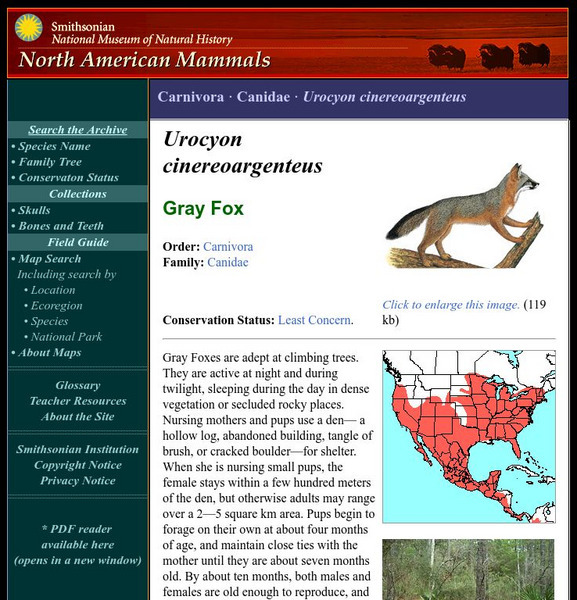
National Museum of Natural History: American Mammals: Common Gray Fox
Gray foxes are adept at climbing trees. They are active at night and during twilight, sleeping during the day in dense vegetation or secluded rocky places. Learn more about the Urocyon cinereoargenteus, more commonly known as a Common...
Smithsonian Institution
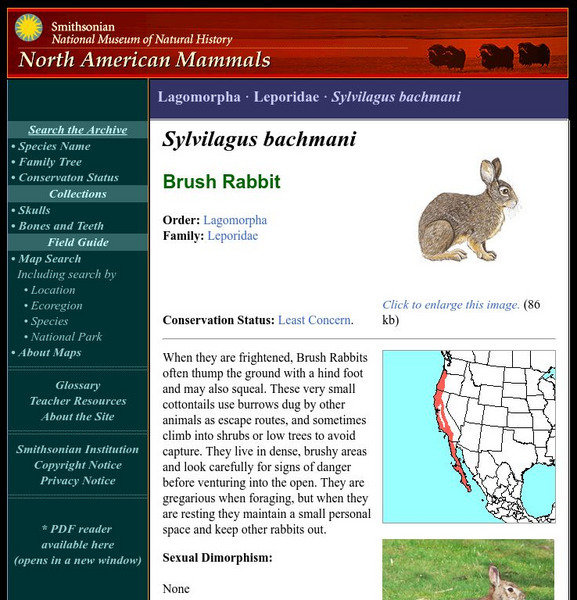
National Museum of Natural History: American Mammals: Brush Rabbit
When they are frightened, Brush Rabbits often thump the ground with a hind foot and may also squeal. These very small cottontails use burrows dug by other animals as escape routes, and sometimes climb into shrubs or low trees to avoid...
Smithsonian Institution
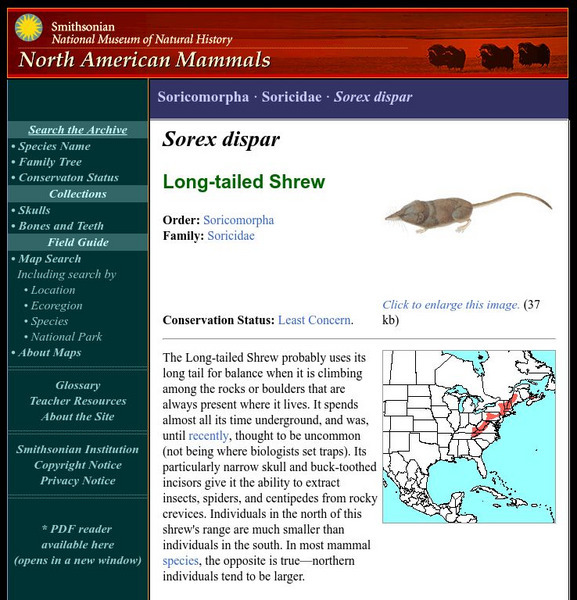
National Museum of Natural History: American Mammals: Long Tailed Shrew
The Long-tailed Shrew probably uses its long tail for balance when it is climbing among the rocks or boulders that are always present where it lives. It spends almost all its time underground, and was, until recently, thought to be...
Smithsonian Institution
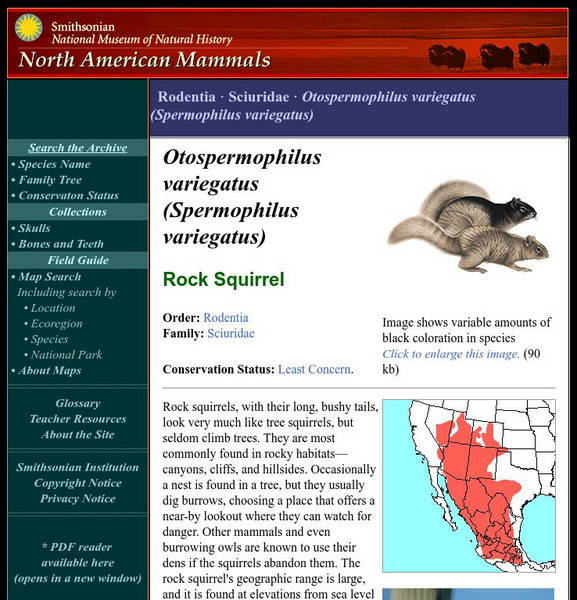
National Museum of Natural History: American Mammals: Rock Squirrel
Rock squirrels, with their long, bushy tails, look very much like tree squirrels, but seldom climb trees. They are most commonly found in rocky habitats: canyons, cliffs, and hillsides. Learn more about the Spermophilus variegatus, more...
Smithsonian Institution
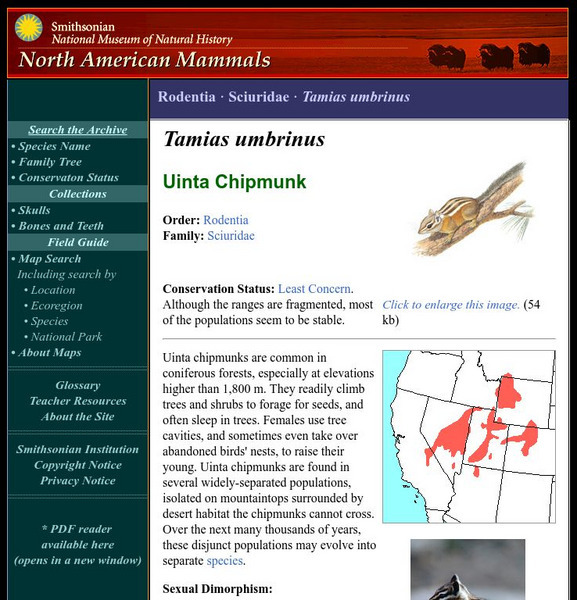
National Museum of Natural History: American Mammals: Uinta Chipmunk
Uinta chipmunks are common in coniferous forests, especially at elevations higher than 1,800 m. They readily climb trees and shrubs to forage for seeds and often sleep in trees. Learn more about the Tamias umbrinus, more commonly known...
Smithsonian Institution
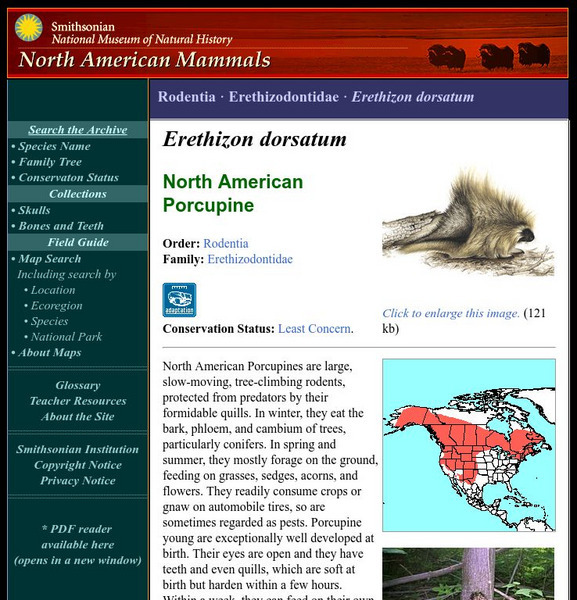
National Museum of Natural History: American Mammals: North American Porcupine
North American Porcupines are large, slow-moving, tree-climbing rodents, protected from predators by their formidable quills. In winter, they eat the bark, phloem, and cambium of trees, particularly conifers. Learn more about the...
Smithsonian Institution
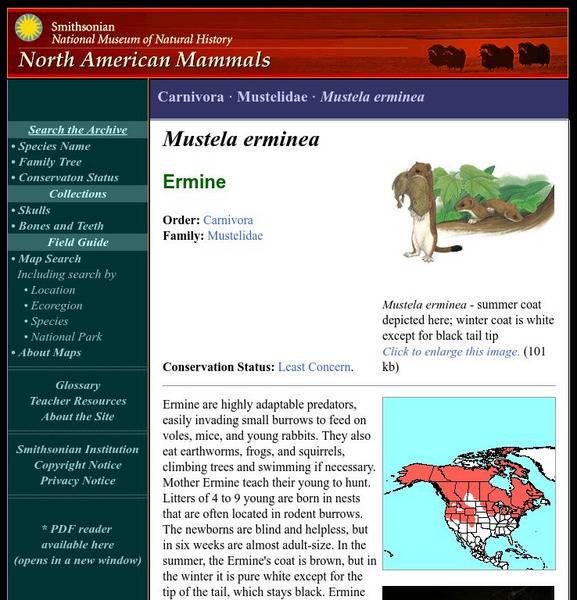
National Museum of Natural History: American Mammals: Ermine
Ermine are highly adaptable predators, easily invading small burrows to feed on voles, mice, and young rabbits. They also eat earthworms, frogs, and squirrels, climbing trees and swimming if necessary. Learn more about the Mustela...
Smithsonian Institution
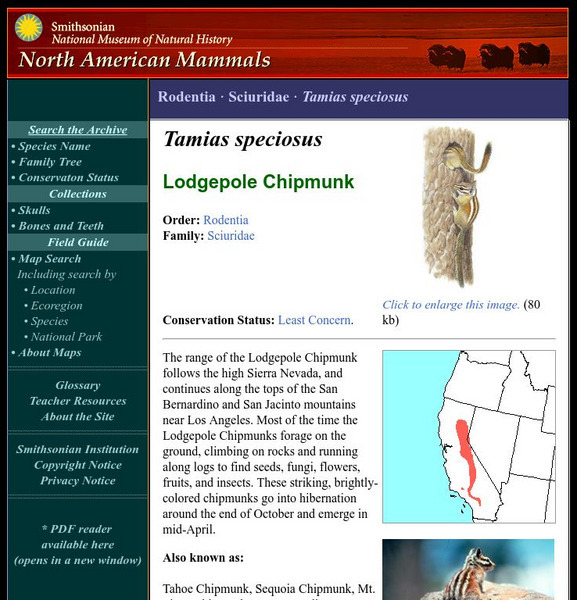
National Museum of Natural History: American Mammals: Lodgepole Chipmunk
The range of the Lodgepole Chipmunk follows the high Sierra Nevada, and continues along the tops of the San Bernardino and San Jacinto mountains near Los Angeles. Most of the time the Lodgepole Chipmunks forage on the ground, climbing on...

PBS
Newton's Apple: Glacier Activity
Learn about how glaciers were formed and then do a simulation activity of a glacier moving slowly down a hill. What does it deposit?

Quia
Quia: Simple Subjects & Predicates Rags to Riches Game
Based on the popular "Who Wants to be a Millionaire?" this game offers the chance to climb to each level, get hints and get feedback.

Curated OER
Esther Dyson
This site provides a brief biography of Esther Dyson, whose role as chairman of EDventure Holdings Inc. inspires women attempting to climb the corporate technology ladder.
Other popular searches
- Mountain Climbing
- Climbing Mount Everest
- Rock Climbing
- Climbing Altitude
- Basic Mountain Climbing
- Climbing Mt. Everest
- Ice Climbing
- Indoor Rock Climbing
- Mountain Climbing Gear
- Climbing Math
- Mountain Climbing Belaying
- High Altitude Climbing