Hi, what do you want to do?






Curated OER
How Much Water is in That River?
Pupils practice measurement using the Hudson River. They calculate the discharge measurement at a location on the Hudson River using ingenuity and a topographic map.

Curated OER
Water Quality Assessment
Students evaluate water quality of different sources. In this water assessment lesson students chemical testing, identify biological factors in the stream, and write a paper on their position of the stream's quality.

Curated OER
Simulating the Effects of Biodegradable Wastes on Dissolved Oxygen
Students evaluate the relationship between biodegradable waste and dissolved oxygen in water. In this biodegradable wastes lesson students complete a lab activity in groups then analyze their results.

Curated OER
Plant Structure and Growth
This plant structure and function PowerPoint addresses the main organs and the factors that affect its development as well as going into detail about the specializations at a cellular level. The cell functions and system...

Curated OER
Acid Rain: Where Have All the Rainbows Gone?
High schoolers study the pH scale and sources of acid precipitation. In this acid rain lesson plan students complete a lab on acid rain then complete a handout.

Curated OER
Falling Hydrogen Ions
Tenth graders define pH and use it to interpret amounts of hydrogen ions in a solution. In this hydrogen lesson plan students read about acid rain, divide into groups and present their information to the class.

Curated OER
Fishing
Young scholars explore the techniques and basic needs of the fisherman. In this fishing lesson, students view a demonstration of the use of fishing equipment. Young scholars research Iowa farm ponds and design a class mural from...

Curated OER
Historical Pollution in the Hudson: Part 2
Ninth graders practice how to format and enter data into an Excel spreadsheet, make a graph, and interpret graphed data. They recognize how the pollution in the Hudson River has changed over time, and explain the consequences of these...

Curated OER
Animal Classification
Students classify animals. In this animal classification lesson, students identify characteristics from each of the 5 categories of vertebrates. Students group animals by categories.

Curated OER
Who Lives In The Water
Students investigate the environment of a stream or lake to collect and observe macroinvertebrates in their natural environment. They record data and summarize the information obtained. Students look to see if there has been any human...

Curated OER
Forest Food Web Activity
Students gain knowledge of food webs and ecological interconnections in the forest, and place different life forms in their proper place in a food chain. Students appreciate the balance of nature and how humans are affected by extinct...

Curated OER
Exploring the Beach
Young scholars explore the beach. In this marine habitat lesson, students inspect sand grains, design beach profiles, classify marine life, and examine natural beach habitats. Young scholars use spreadsheets to record data from their...

Curated OER
Mussel Movements
Students consider the impact of invasive species on local environments. In this ecology lesson, watch the video, Arizona Wildlife Views, which focuses on invasive species. Students develop vocabulary, relate to meaningful comprehension...

The Wild Classroom
The Wild Classroom: Biomes of the World: Coastal Ocean Biome
Learn about the coastal ecosystem. Find out about plants, animals, adaptations, and conservation efforts.
The Wild Classroom
The Wild Classroom: Biomes of the World: The Deep Sea Biome
Learn all about the abyssal ocean ecosystem. Find out about plants, animals, adaptations, and conservation efforts.
The Wild Classroom
The Wild Classroom: Biomes of the World: Oceanic Pelagic Biome
Learn about the oceanic pelagic ecosystem. Find out about plants, animals, adaptations, and conservation efforts.
The Wild Classroom
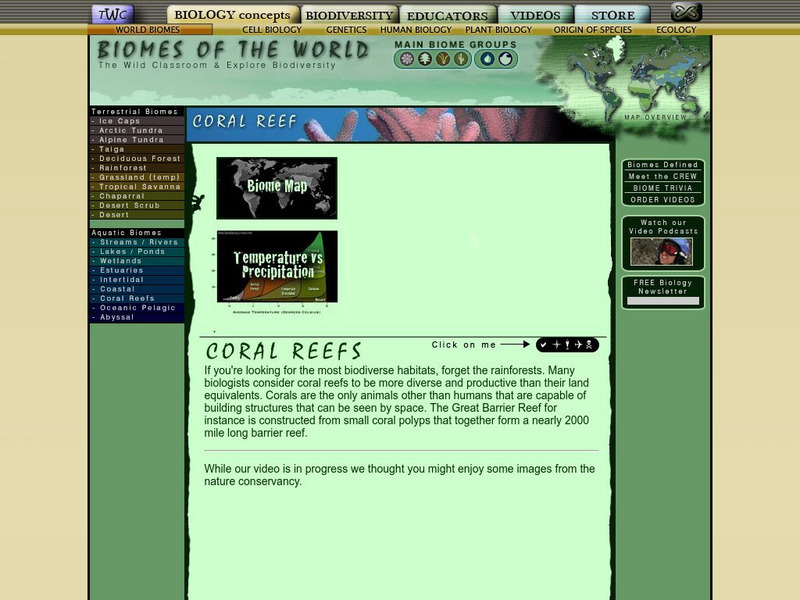
The Wild Classroom: Biomes of the World: Coral Reef Biome
Learn about the coral reef ecosystem. Find out about plants, animals, adaptations, and conservation efforts.
The Wild Classroom
The Wild Classroom: Biomes of the World: Lakes and Ponds
Learn about lake and pond ecosystems. Find out about plants, animals, adaptations, and conservation efforts.

The Wild Classroom
The Wild Classroom: Biomes of the World: Intertidal Zone
Learn about the intertidal ecosystem. Find out about plants, animals, adaptations, and conservation efforts.
The Wild Classroom
The Wild Classroom: Biomes of the World: Streams and Rivers
Learn about stream and river ecosystems. Find out about plants, animals, adaptations, and conservation efforts.
The Wild Classroom
The Wild Classroom: Biomes of the World: Wetlands Biome
Learn about wetlands ecosystems. Find out about plants, animals, adaptations, and conservation efforts.

The Wild Classroom
The Wild Classroom: Biomes of the World: Estuaries Biome
Learn about estuary ecosystems. Find out about plants, animals, adaptations, and conservation efforts.
National Association of Geoscience Teachers
Nagt: From Creeks to the Classroom: Gone Fishin'
Gone Fishin allows participants to become the captain of a fishing boat, competing for fishery resources. Students discover that if they don't set fishing limits and monitor the fish population, soon there are no fish left in the ocean.

The Wild Classroom
The Wild Classroom: Biomes
This excellent resource explores all of the biomes found on planet Earth! A side menu indicates the world's biomes and provides details on each. Colorful interactive maps, video clips, lesson plans, species profiles, and so much more...