Hi, what do you want to do?






Curated OER
What Animals Eat
First graders organize animals according to what they eat. They compare the teeth of plant eaters and meat eaters.

Curated OER
Using the Variation Approach
Students explore and explain geometrical applications, and how to apply these applications to real life.

Curated OER
Can You See It, Touch It, Hear It?
Students develop and practice observational skills through lab activity.

Curated OER
Rock Hounds
Second graders read Byrd Baylor's book "Everybody Needs a Rock", and select a rock, study it, and describe its attributes.

Curated OER
Candy Keys
Young scholars experiment with dichotomus keys using different types of candy. They complete a worksheet while making five different keys. They eat the candy to end the instructional activity.

Curated OER
How Does Radon Get In?
Pupils examine the potential sources of radon entry into homes. They compute the surface area for various objects, create a sketch of their home, calculate the ratio of air leaks to the outside surface area, and conduct a radon audit of...

Curated OER
A View of Amsterdam
Young scholars are introduced to the process of etching during Rembrandt's time. Using a painting of Rembrandt, they answer questions related to it and how the painting makes them feel. They define and demonstrate perspectives and...

Curated OER
Color Dots 3
Students make simple observations, test mixtures, and make generalized inferences from their observations. They observe bleeding of colored inks with water.

Curated OER
Trekking to Timbuktu: Timbuktu's Golden Age of Scholarship
Students study and identify the empire of Songhai through research and describe Timbuktu's role in its economy. They investigate how Timbuktu became an important spiritual and intellectual center of Islam. Students describe the Islamic...

Curated OER
PASS the Arts
Young scholars explore math and art concepts, create digital art examples of the concepts, and incorporate these works into a PowerPoint portfolio with explanation and analysis.

Curated OER
What's Hatching in Kindergarten?
Students identify oviparous animals. They brainstorm a list of animals that lay eggs, read "Chickens Aren't The Only Ones" by Ruth Heller and then add to the list. Students complete a booklet that shows an egg and an oviparous animal.

Curated OER
Internet Gastropod Research
Use the Internet to research gastropods. Using their textbook, students identify questions by topic they are interested in finding more in depth information. They answer each question and cite at least two internet URLs for each. They...

Curated OER
CSI Clamshell Investigation
Students explore predator/prey relationships. They research information on moon snails and claims. Students draw conclusions from the data collected. They use math and graphing to determine if there is a relationship to the clam's size...

Curated OER
Activity # 13 Float or Sink?
Learners have seen that solids, which are more dense than a liquid, that sinks in that liquid and solids, which are less dense than a liquid, that floats on that liquid. They use a metal boat to float in water. Pupils comprehend that...

Curated OER
Saint John: Harboring the World
Sixth graders write an invitation letter to potential immigrants to St. John, New Brunswick, Canada. Using internet research, 6th graders gather information from a virtual museum exhibit highlighting the positive reasons to move to St....

Curated OER
Wind
Students complete activities to study wind intensity. In this wind study lesson, students discuss wind speed and direction. Students then build a kite and windsock to help them study wind intensity. Students learn to use a wind meter for...

Curated OER
Hands On Math Lessons with Technology
Students explore a variety of math concepts. In this integrating technology lesson, students visit online webtools such as Max's Math Adventure, I Know That Math, Hands on Banking, and more. A description of each website is provided.

Curated OER
How Big Is Your Heart?
Students complete a performance about the heart. In this heart lesson plan, students learn about the heart functions and then perform them.
Khan Academy
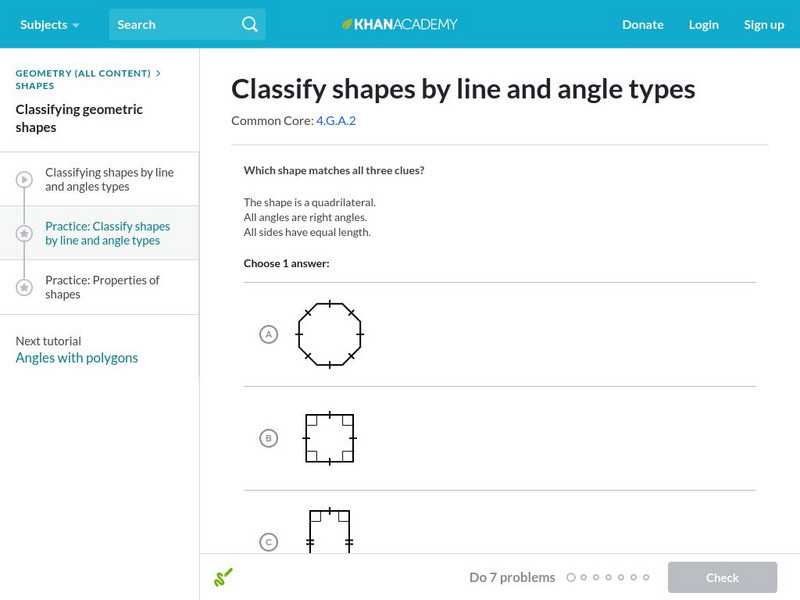
Khan Academy: Classifying Shapes by Line and Angle Types
In this exercise, students practice classifying shapes by line and angle types. Students receive immediate feedback and have the opportunity to get hints and try questions repeatedly.

Khan Academy
Khan Academy: Classify Shapes by Line and Angle Types
Classify shapes based on pictures or attributes, such as angle types and side-lengths. Students receive immediate feedback and have the opportunity to try questions repeatedly, watch a video or receive hints.
Government of Alberta
Learn Alberta: Math Interactives: Classifying Quadrilaterals
This multimedia that includes a short video [1:19] and other interactive activities on Learn Alberta math resource looks at real-world examples of shape classification in the investigation and solving of crimes. The accompanying...
Government of Alberta
Learn Alberta: Math Interactives: Exploring Shape Classification
Investigate the properties of triangles, quadrilaterals, and regular polygons using this interactive Learn Alberta math resource. Students are able to practice classifying shapes based on their different properties. Be sure to follow the...

Khan Academy
Khan Academy: Practice: Classify Shapes by Line and Angle Types
Look at the properties of 2D shapes to see which shapes can belong to the same group. Includes hints.

Better Lesson
Better Lesson: Sorting Shapes
Clean Up this Mess! The classroom shapes are in one big heap. Students will work in teams to come up with a way to sort the shapes by attributes and create a visual representation to model their thinking. Pictures and videos of the...