Hi, what do you want to do?






Alabama Learning Exchange
Alex: The Tree of Life
This is a lesson to help learners understand the phylogeny of organisms and how all organisms are linked in a certain way. By navigating an Internet site, students will learn how organisms are classified.

Alabama Learning Exchange
Alex: The Circles of Life
This is an inquiry based cooperative learning unit that can be used in biology as a graduation exam review or in botany for a nine week project. The students will learn the life cycle of mosses, ferns, gymnosperms and angiosperms. The...

CK-12 Foundation
Ck 12: Life Science: 9.13 Arachnids
Understand the behaviors, characteristics, and classification of arachnids.
CK-12 Foundation
Ck 12: Life Science: 9.8 Types of Mollusks
Understand the characteristics, diversity, and classification of mollusks.
CK-12 Foundation
Ck 12: Life Science: 9.14 Importance of Arthropods
Understand the behaviors, characteristics, and classification of arthropods.
Estrella Mountain Community College
Estrella Mountain Community College: The Diversity of Life
Detailed information about each of the five kingdoms. Each kingdom is separately described, but information is also summarized in a table.
University of California
Ucmp: Phylogenetic Systematics: Evolutionary Trees
This page provides an introduction to phylogenetic systematics, the way that biologists reconstruct the pattern of events that have led to the distribution and diversity of life. A tutorial "journey" into the Introduction, Methodology,...
Other
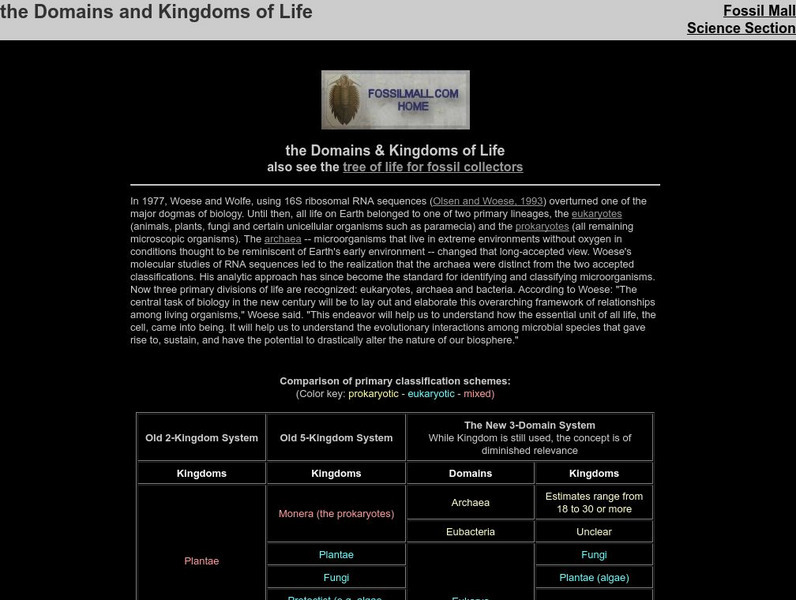
The Domains and Kingdoms of Life
This site is a description of the history behind the 5 Kingdom system suggested by Robert Whittaker. An extensive list of resources is included.
PBS
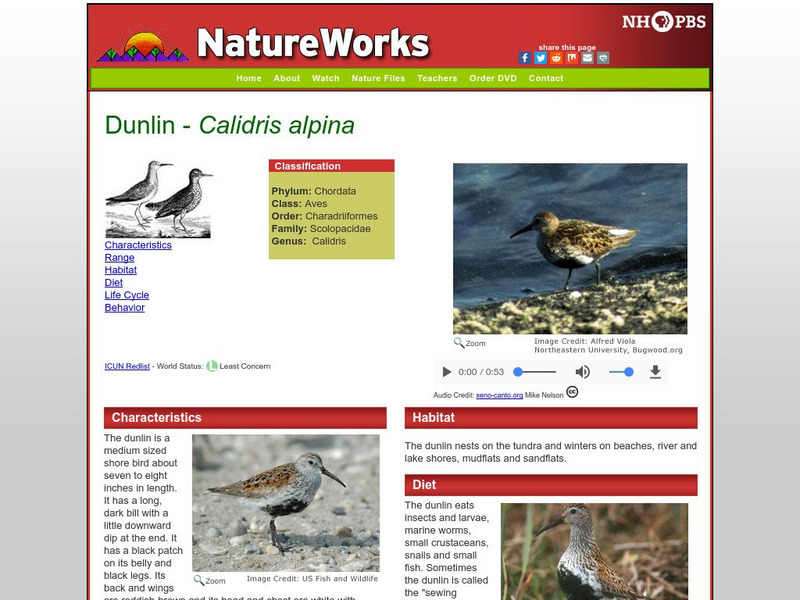
Nh Pbs: Nature Works: Dunlin
Learn more about the dunlin when you check out this educational resource. Students will discover information ranging from characteristics and range to diet and life cycle.
Enchanted Learning
Enchanted Learning: Salmon Life Cycle
Educational site offers an illustration of the salmon life cycle as well as information on salmon reproduction, adaptation to salt water, life span, diet, anatomy, predators and more.
BBC
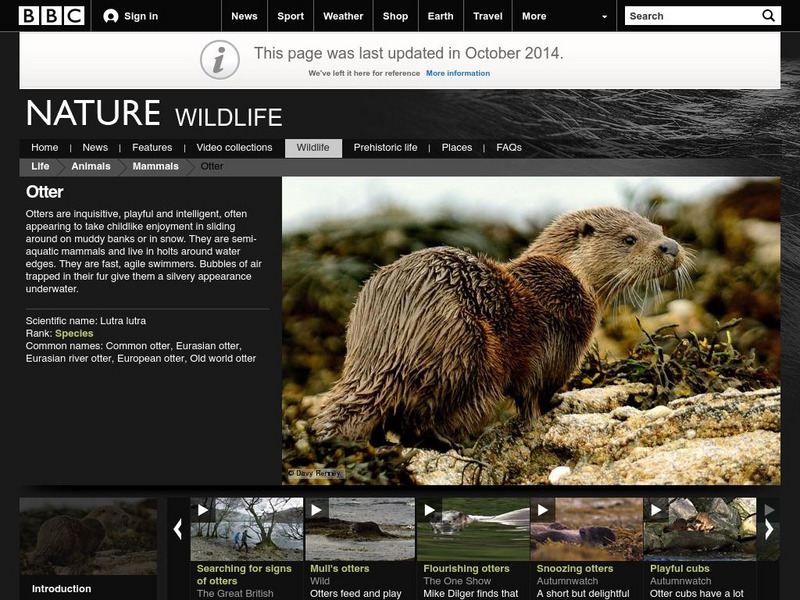
Bbc: Nature Wildfacts: Eurasian River Otter
Use this site to learn more about this playful member of the weasel family through this detailed fact sheet and these wonderful photos.
The Franklin Institute
The Franklin Institute: Living Things Families
What do centipedes and crabs have in common? What's so special about a backbone? Check this site out from The Franklin Institute if you are interested in biology and classification.
Enchanted Learning
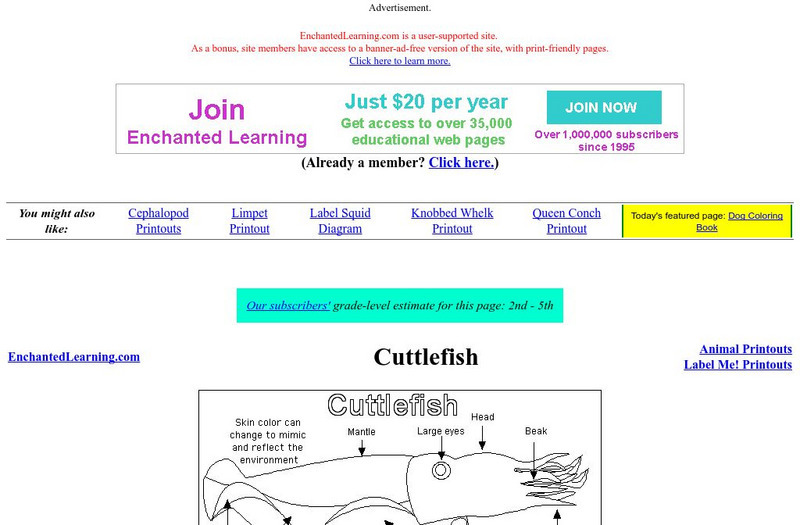
Enchanted Learning: Cuttlefish
Explore the world of the cuttlefish, a unique cephalopod. Students will gain a greater understanding of this mollusk through fun facts, information on the anatomy, diet, predators and more at this site.
PBS
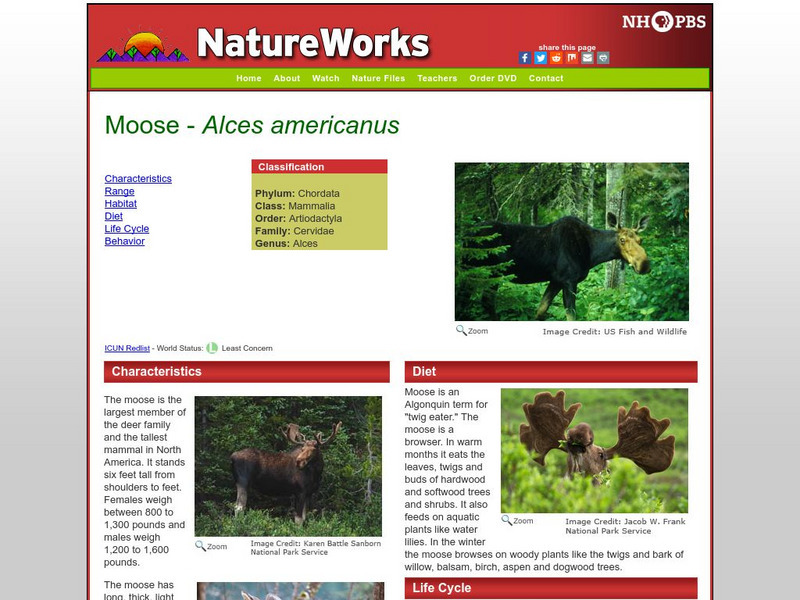
Nh Pbs: Nature Works: Moose
The moose is the largest member of the deer family and the largest mammal in North America. Students will find information on its range, habitat, life cycle, behavior, and diet.

PBS
Pbs Nature: Sharks
How many species of sharks are there in the world of water? Students will discover how and where sharks live, what they eat and how they socialize through the exploration of this resource.
Houghton Mifflin Harcourt
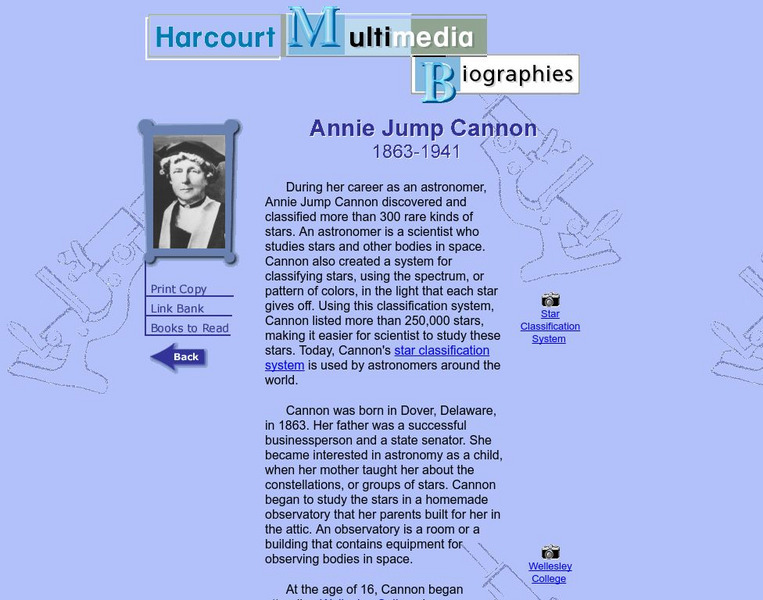
Harcourt: Biographies: Annie Jump Cannon
This is a fantastic account of the life of astronomer, Annie Jump Cannon. Included in this biography are additional links to photographs of her tools and her accomplishments.
Wonderville Media
Wonderville: Sharks
There are over 400 different species of sharks that live in the earth's oceans. Most sharks live in mild or warm parts of oceans. However, there are a few that live in cold waters, like the Greenland shark, which lives in the Arctic, and...

BBC
Bbc Nature: Wildlife: Three Toed Sloths
Examine the captivating world of the three-toed sloth by discovering facts about its distribution, habitats, behaviors, and classification through photos, videos, descriptions, and external links.
Other
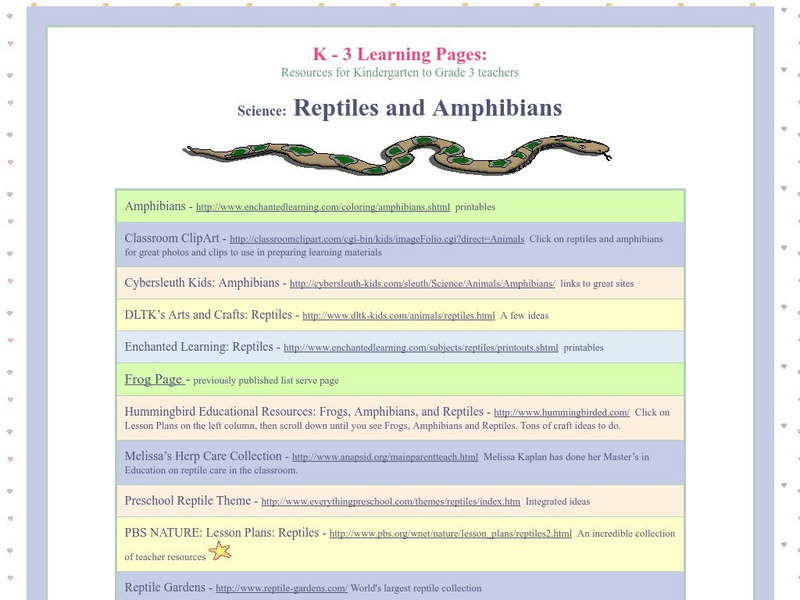
K 3 Learning Pages: Reptiles and Amphibians
Come and discover more about reptiles and amphibians when you explore this awesome resource. This site is filled with useful links.
Exploring Nature
Exploring Nature Educational Resource: Bat (Little Brown)
Learn basic facts about the little brown bat, where they live, what they eat, their reproduction patterns, their life span, and classification. A video of a live bat shows and explains its unique body traits and their functions. [1:26]