Hi, what do you want to do?





Smithsonian Institution
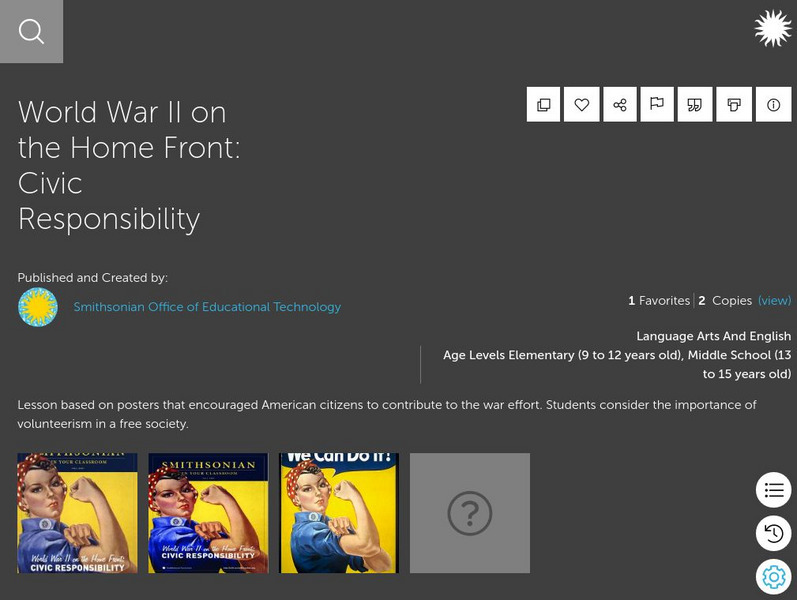
Smithsonian Learning Lab: Wwii on the Home Front: Civic Responsibility
Smithsonian Education presents a lesson covering the WWII's propaganda program which enforced the ideals of Civic Responsibility. Provides eight pages of poster examples, detailed background over the time period, and the goals of the...
Center For Civic Education
Center for Civic Education: Project Citizen
This project is intended to help students learn how to express their opinions, and how to decide which level of government and which agency is most appropriate for dealing with a problem they identify. They then gather relevant...

Center For Civic Education
Center for Civic Education: We the People: Project Citizen
This detailed lesson has students examining their community. The students then have class discussions, assignments and a portfolio to complete. A separate teacher site is available.
Center For Civic Education
Center for Civic Education: How Does Government Secure Natural Rights?
This lesson introduces students to some basic ideas the Framers used in creating the kind of government they thought would best protect the natural rights of each individual and promote the good of all. At the end of the lesson, students...

PBS
Pbs Learning Media: Making Civics Real: Electoral Politics
In this lesson from Annenberg Learner, learners divide into small groups to brainstorm and research specific community issues, prioritize the issues studied on the basis of what they have learned, present their findings to the class both...
iCivics
I Civics: Colonial Influences
Where did the American colonists get their ideas that lead to a revolution and a whole new kind of government? This instructional activity explores the Magna Carta, Mayflower Compact, English Bill of Rights, Cato's Letters, and Common...
iCivics
I Civics: Mini Lesson: Gerrymandering
Learners will try their hand at a simplified districting exercise and learn about the common gerrymandering practices of packing and cracking districts. Students then explore the media's traditional roles as gatekeeper, agenda-setter,...
iCivics
I Civics: Mini Lesson: Filibusters
Students learn about filibusters and how and why senators use them, then they take a look at how news coverage of a filibuster can be transformed through neutral, positive, or negative framing.
iCivics
I Civics: Mini Lesson: Congressional Committees
Students discover the different types of congressional committees and their responsibilities in this lesson.
iCivics
I Civics: Mini Lesson: Executive Orders
Learners discover how presidents use executive orders to wield power and how the legislative and judicial branches support and challenge these measures.
iCivics
I Civics: Got Grievances?
Learn what economic, political, and social factors led to the writing of the Declaration of Independence and the American Revolution. In this instructional activity, students learn what caused the colonies to declare independence from...
iCivics
I Civics: Foreign Policy: War & Peace and Everything in Between
Students learn the distinction between foreign and domestic policy and what role the executive branch plays in foreign policy and the primary tools it uses: foreign aid, the military, and treaties.
iCivics
I Civics: Government & the Economy
Students learn how government and the economy are related and the difference between market, command, and mixed economies.
iCivics
I Civics: Conflict and Cooperation
Countries often work together to solve problems and fall into conflict when problems cannot be resolved. After learning about motivations and conditions that lead to action (or inaction), students analyze examples of international...
iCivics
I Civics: Banks, Credit & the Economy
This lesson focuses on the relationship between money, banks, and lending in our economy.
iCivics
I Civics: Mini Lesson: Midterm Elections
Students will learn about the midterm election, its role as a referendum on the presidency, and how a shift in party control impacts the legislative and executive branches.
iCivics
I Civics: Get Counted! (The u.s. Census)
For this lesson, students learn the who, what, when, where, why, and how of the census. Students explore the importance of being informed and how the census impacts their communities.
iCivics
I Civics: The Great State
For this overview lesson, learners learn about state government structure, functions, lawmaking, and relationship with local government.
iCivics
I Civics: The Market Economy
This lesson teaches the basics about the market economy, including the relationships between consumers and producers, supply and demand, and profit and incentive. Students learn six traits of a market economy, compare the market economy...
iCivics
I Civics: Voting in Congress
n this lesson, young scholars learn what factors members of Congress consider when deciding whether to vote for a bill, including the powers given to Congress by the Constitution, what a member's constituents want, his or her political...
Center For Civic Education
Center for Civic Education: Who Can Vote in the United States?
This lesson challenges students to speculate about voting requirements. Students will begin learning vocabulary that is used when talking about voting.

Center For Civic Education
Center for Civic Education: Becoming a Voter
In this lesson, students apply their state's requirements for registering to vote. Students learn when and how to register, how to complete a voter registration form, and when and how to reregister.
Center For Civic Education
Center for Civic Education: The Ballot and Questions
This lesson focuses on a voter's need to be fully informed prior to casting a vote on Election Day and how to acquire the necessary information.
Other popular searches
- Civics and Economics
- Introduction to Civics
- Social Studies Civics
- Civics Political Cartoons
- Civics Project
- Civics Lesson Plans
- American Civics
- Civics Business
- Civics Civil War
- Civics Citizen
- U.s. American Civics
- Civics 2008 Election