Hi, what do you want to do?





Center For Civic Education
Center for Civic Education: Fall Extended Lesson Plans on Voting
An in-depth set of lessons on voting. Topics covered include voting requirements, registering to vote, voting trends, voter self-education, setting up a polling station, and simulating an election polling site that coincides with a real...

Bill of Rights Institute
Bill of Rights Institute: Justice Thomas on National Identity
An examination of a speech Justice Clarence Thomas delivered in 2009 highlighting his thoughts on the Bill of Rights as well has his views on the importance of American civic responsibility.
Center For Civic Education
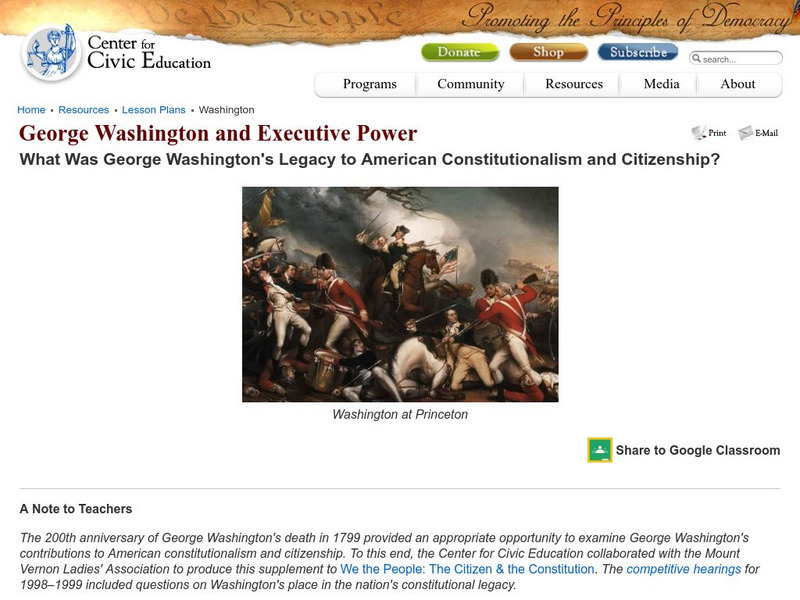
Center for Civic Education: George Washington and Executive Power
This instructional activity looks at the legacy of George Washington, perhaps the most influential leader in the creation of the American nation. Through his achievements as commander-in-chief during the Revolution, in support of the...

Center For Civic Education
Center for Civic Education: Constitution Day and Citizenship Day
September 17 is recognized in the United States as Constitution Day and Citizenship Day. The purpose of Constitution Day and Citizenship Day is to commemorate the creation and signing of the supreme law of the land and to honor and...
Center For Civic Education
Center for Civic Education: Presidents' Day Lessons
Presidents' Day lessons for Grades 10-12 on the constitutional legacies of George Washington, James Madison, Abraham Lincoln, and Ronald Reagan, and how they shaped the history and Constitution of our nation. Each lesson was written and...
Center For Civic Education
Center for Civic Education: Dr. Martin Luther King Jr. Day
Three lessons for recognizing Dr. Martin Luther King Jr Day, taken from the We the People: The Citizen & the Constitution curriculum. These materials will help inform young scholars about the national struggle for civil rights and...
Center For Civic Education
Center for Civic Education: James Madison and Executive Power
This lesson examines the legacy of the "philosopher statesman," James Madison. Madison combined the intellectual knowledge and creativity of the scholar with the practical savvy of the politician, a man of strong principles who also...
Center For Civic Education
Center for Civic Education: Black History Month
A collection of six lessons for Grades 5 and up for Black History Month. The lesson plans explore the use of nonviolence in history, particularly with respect to the civil rights movement and African American history.
Center For Civic Education
Center for Civic Education: George Washington's Legacy to America
This lesson plan from the Center for Civic Education encourages both teachers and students to learn more about George Washington's contribution to American Constitutionalism and Citizenship.

Khan Academy
Khan Academy: Legitimacy of the Judicial Branch: Lesson Overview
This lesson overview from Khan Academy discusses the legitimacy of the judicial branch. This lesson is intended for students taking high school or college level American Government and Civics courses, including the AP Government course.
Center For Civic Education
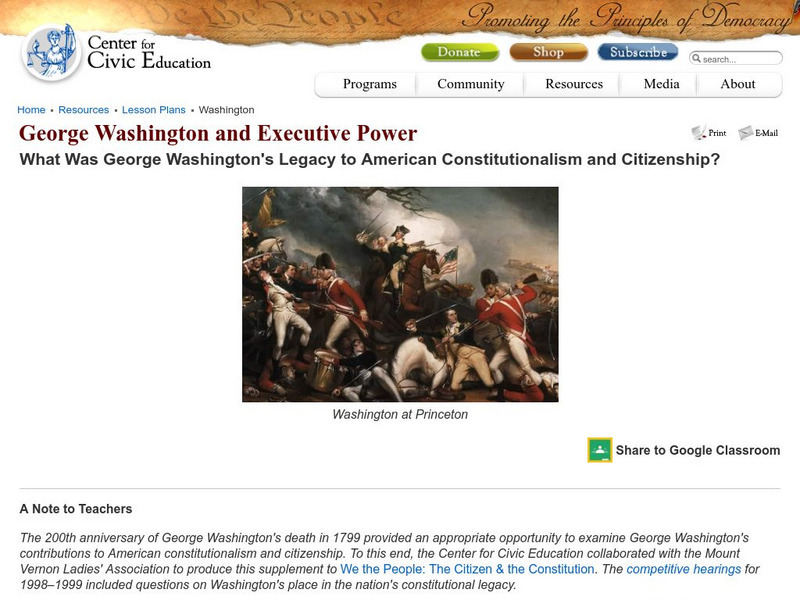
Center for Civic Education: George Washington and Executive Power
George Washington had a role in establishing our nation from the Revolutionary War through his presidency. He was a commander, a delegate to the Constitutional Convention, and a reluctant first President. Analyze his political...
Center For Civic Education
Center for Civic Education: James Madison and Executive Power
James Madison has been called the "Father of the Constitution". His ideas have shaped the role of our government, the role of political parties, the Bill of Rights and more. This lesson offers extensive background, critical thinking...
iCivics
I Civics: History of Ohio's Constitution
Learn about the history of the Ohio Constitution with this before and after lesson that looks at the original 1802 state constitution and the major changes made in the 1851 version. Students will explore the two documents and identify...
iCivics
I Civics: Students Power Elections
This guide will help kids learn about voting and elections independently and find ways to engage if they are not eligible to vote.
iCivics
I Civics: Cabinet Building
This lesson takes a look at the history of the presidential cabinet, how the cabinet is built through the confirmation process, and why this elite group of people matters to you.
iCivics
I Civics: County Government
This lesson covers the diversity in county government structure, duties, and services as well as the budgeting process.
iCivics
I Civics: Mini Lesson: Supreme Court Opinions
Learners will learn about the types of Supreme Court opinions and the influence of legal precedent.
iCivics
I Civics: Why Do We Have a House and Senate, Anyway?
Students learn why there are two houses of Congress and discover how a bicameral legislature ensures that all states have a voice in bills.
iCivics
I Civics: You've Got Rights!
Students learn about the rights guaranteed by the Bill of Rights and other important constitutional amendments.
iCivics
I Civics: A Movement in the Right Direction (Infographic)
Use this infographic to show students how two different approaches to the women's suffrage movement worked to grant women the right to vote.
iCivics
I Civics: Foundation Basics
In this lesson, students are introduced to the concepts of authority, legitimacy, and sovereignty and consider how governments establish and maintain these foundational characteristics.
iCivics
I Civics: Lessons From Antiquity
Where did democracy get its start? In this lesson, students learn about direct democracy in Athen's and Rome's republic, how each took shape, and the ideas our Founders borrowed from these great civilizations.
iCivics
I Civics: A Dive Into Democracy
The Founding Fathers had many influences. Discover how aspects of Athenian democracy shaped the structure and ideals of the U.S. government.
iCivics
I Civics: Korematsu v. United States (1944)
This mini-lesson covers the basics of the Supreme Court's decision that determined the government acted constitutionally when it detained people of Japanese ancestry inside internment camps during World War II. Learners learn what...
Other popular searches
- Civics and Economics
- Introduction to Civics
- Social Studies Civics
- Civics Political Cartoons
- Civics Project
- Civics Lesson Plans
- American Civics
- Civics Business
- Civics Civil War
- Civics Citizen
- U.s. American Civics
- Civics 2008 Election