Hi, what do you want to do?





Center For Civic Education
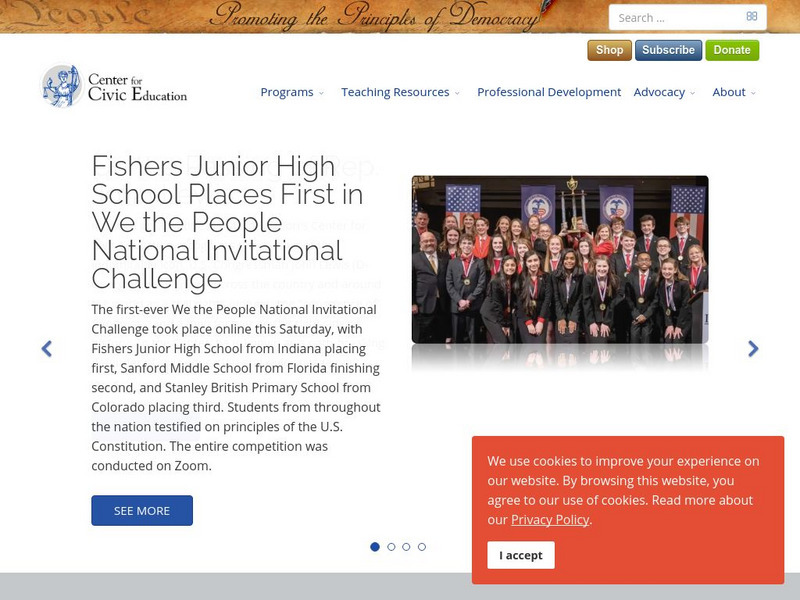
Center for Civic Education: We the People: The Citizen and the Constitution
This thought-provoking site provides a portal to many resources about citizen participation and civic literacy.
Center For Civic Education
Center for Civic Education: What Is a Republican Government?
This lesson will help you understand why the Founders thought a republican form of government was best. Students will also learn about civic virtue and the common welfare.

Khan Academy
Khan Academy: Roles and Powers of the President: Foundational
This resource from Khan Academy provides foundational practice questions the roles and powers of the president. These questions are intended for students taking high school or college level American Government and Civics courses,...

Khan Academy
Khan Academy: Expansion of Presidential Power: Foundational
This resource from Khan Academy provides foundational-level practice questions over the expansion of presidential power. These questions are intended for students taking high school or college level American Government and Civics...

Khan Academy
Khan Academy: Types of Democracy
This resource from Khan Academy provides practice questions over the types of democracy. These questions are intended for students taking high school or college level American Government and Civics courses, including the AP Government...
Center For Civic Education
Center for Civic Education: What Responsibilities Accompany Our Rights?
These are discussion topics to incorporate into your lesson on rights and responsibilities of citizens. Features questions to encourage debates or essay ideas. Also includes lesson plans.
Center For Civic Education
Center for Civic Education: What Responsibilities Accompany Our Rights?
Suppose the government does everything it can to protect people's rights. Is this enough? Will their rights be protected? Do we have any responsibility to protect not only our own rights, but each other's as well? This lesson plan looks...

Center For Civic Education
Center for Civic Education: Why Do We Need a Government?
This lesson introduces students to some of the basic ideas which were of great importance to the Founders. They used these ideas when they developed the American government. Students will learn why they thought a government was needed in...
Center For Civic Education
Center for Civic Education: What Is a Republican Government?
The founding fathers studied different forms of government throughout history to come up with the best form of government for our new nation. They decided a republic suited our nation the best. Find out the advantages of this type of...
HotChalk
Hot Chalk: Lesson Plans Page: Do Something: What Is Civic Action
This impressive lesson plan incorporates listening to music, critical thinking, collaboration and community participation for students to understand good citizenship.
iCivics
I Civics: Municipal Government
In this lesson, students will explore the varied functions and structures of local government as well as explore the services provided in their own municipality and beyond.
iCivics
I Civics: The Federalist Debate
The ratification debate between the Federalists and Anti-Federalists gives us insight into the ideas behind both sides and a better understanding of how our government developed in its early years.
iCivics
I Civics: Mini Lesson: The Incumbent Advantage
Students will learn about the electoral advantage that favors incumbents and the benefits and drawbacks of reelecting members of Congress.
iCivics
I Civics: We Got This!
In this lesson, learners explore how colonial government was both similar to and different from government in Britain and how it influenced the government we have today.
iCivics
I Civics: Diplomacy
Students will develop an understanding of negotiation, sanctions, and other elements used in diplomatic relationships.
iCivics
I Civics: Mini Lesson: Judicial Activism & Restraint
Lesson teaches the judicial philosophies of activism and restraint and also explores criteria through which students can evaluate news-related opinion pieces and practice judging the value of a Supreme Court-related opinion piece of choice.
iCivics
I Civics: Mini Lesson: Succession
In the opening activity, students are challenged to create a succession plan for their school principal. The class then reviews the official presidential line of succession and reads about its origins.
iCivics
I Civics: State Power: Got a Reservation?
Students discover that states have their own governments and powers separate from the federal government. They learn what those powers are, how they're different from the federal government's powers, and that state governments also give...
iCivics
I Civics: Being President: Play by the Rulebook
A WebQuest on what the job as President of the United States involves. Each page has a question to answer, and a link to a site with information specific to that topic.
iCivics
I Civics: Who Rules?
Learn about the different forms of government that exist, including democracy, autocracy, oligarchy, and others. Compare and contrast these forms, and look at real-life examples in the world today.
iCivics
I Civics: Judicial Review
This lesson explores the case that established the power the Supreme Court has today. Students will learn how the decision in Marbury v. Madison influenced the structure of the third branch, and how the Court's use of judicial review can...
iCivics
I Civics: Oregon Treaty (1845)
Students explore how and when we got the present day border between the United States and Canada. They learn how it happened, what tensions were involved, and how Native Americans were affected.
iCivics
I Civics: Mini Lesson: Veto Power
Explores the presidential veto and pocket veto powers, their role as a negotiating tool, and the Congressional veto override process. Students also learn how to use fact-checking and triangulation to evaluate news claims and detect...
iCivics
I Civics: No Bill of Rights, No Deal
In the debate over the Constitution, the Bill of Rights was a deal-breaker. In this lesson, young scholars learn why the federalists thought the Constitution didn't need a bill of rights and why the anti-federalists refused to accept the...
Other popular searches
- Civics and Economics
- Introduction to Civics
- Social Studies Civics
- Civics Political Cartoons
- Civics Project
- Civics Lesson Plans
- American Civics
- Civics Business
- Civics Civil War
- Civics Citizen
- U.s. American Civics
- Civics 2008 Election