Hi, what do you want to do?






Curated OER
Clues From the Past: Daily Life
Middle schoolers discover the ways different cultures gathered and made food. In groups, they read excerpts from primary sources about the food people in Mesopotamia liked to eat. They work together to make a batch of goat stew and a...

Curated OER
Hands-On! The Invention of Writing
Students are introduced to the way writing was invented in Mesopotamia. In groups, they participate in re-creations of events that occured in a traditional Mesopotamian school. They practice writing in cuneiform script on clay using...

Curated OER
The First Farmers
Young scholars show how constant irrigation, with repeated evaporation of water that left salts in the soil, eventually ruined much farming land in southern Mesopotamia. They discuss the idea that with the development of irrigation...

Curated OER
Can you find the transportation?
Students locate and name different types of transportation. They categorize types of transportation by where you find them: land, air, or water. Students graph the information collected. Additional ideas are listed for cross curriculum.

Curated OER
Journalism in the Halls
Students examine the Lane Tech murals on the Web or at the school. They conduct interviews with students and professionals as a method of researching the subjects of these murals. They write an article for a special "mural" edition of...

Curated OER
Distinguish Communities by Their Architecture
Young scholars distinguish between a rural community and a city community by observing the architecture in each one. They observe and discuss pictures of buildings. Students write a paragraph explaining the purpose of a particular...

Curated OER
The Unknown Secrets of the Rain Forest
Students explore the rain forest and where they are located. Students examine why the rain forests are important and what is happening to them. They investigate the water cycle and life cycle of a frog. Students build a rain forest in...

Curated OER
How to "Read" an Artifact
Students discuss the types of information they can get from artifacts. In groups, they practice "reading" artifacts and determining their usage. They use inferences to test against official information about certain pieces. They also...

Curated OER
Visit a Mesopotamian House
Students examine the various types of architecture used in Mesopotamia. In groups, they identify how climate, resources and cultures affect where and how people live. Using a worksheet, they compare and contrast their house to the one...

Curated OER
Murals, Memories, and Making Art
Fourth grade reading students study art works by famous artists. They use various tools for learning about the artist, and they present their information by writing and speaking about the artist. They also create artwork in the style of...

Curated OER
Murals, Memories, and Making Art
Fourth graders examine the life and works of famous artists. Using the internet, they take notes and present their information to the class in an oral presentation. They create their own original artwork in the same style of their...

Curated OER
Do Some Research
Sixth graders participate in various activities in which they must complete research. Individually, they draw a human heart and label each part along with its function. They use the internet to research an invention in Mesopotamia was...

Curated OER
Reflecting Culture Through Coins
Pupils research and recreate coins from ancient civilizations to determine how the imagery reflects the cultures which originally made them.

Curated OER
Tall Tales: Reconstructing A Personal Tell
Sixth graders discover the ways archaeologists examine artifacts and where they are found. After being introduced to new vocabulary, they use artifacts from their own lives and discover what could be told about their life from them. ...

Curated OER
Warfare and Empire
Learners discuss how changing the environment can cause conflict between two groups. In groups, they brainstorm other ways to deal with this issue without using warfare. They use the internet to research the differences in today's army...

Curated OER
Colony of Massachusetts
Third graders recall the reasons why the Pilgrims came to the New World. They ideology and compare and contrast the ideology of the Puritans and Roger iams. They study the colony of New York.

Other
Chicago History Museum: Great Chicago Stories
Read historical fiction stories that illuminate Chicago's past. Use the Interactive History Map to look closer at artifacts from the collection of the Chicago History Museum and to explore locations throughout the city from each story....
Chicago History Museum
Chicago History Museum: My Chicago
Come explore the history and culture of Chicago through this resource. There are lots of activities for kids with different sections for teachers and parents.

Other
Chicago History Museum: Louis Sullivan at 150
Visit the Chicago History Museum's retrospective about Louis Sullivan, famous Chicago architect.
Chicago History Museum
Chicago History Museum: History Files: Al Capone
Provides a thorough biographical profile and pictures of the well-known Chicago mobster, Al Capone.
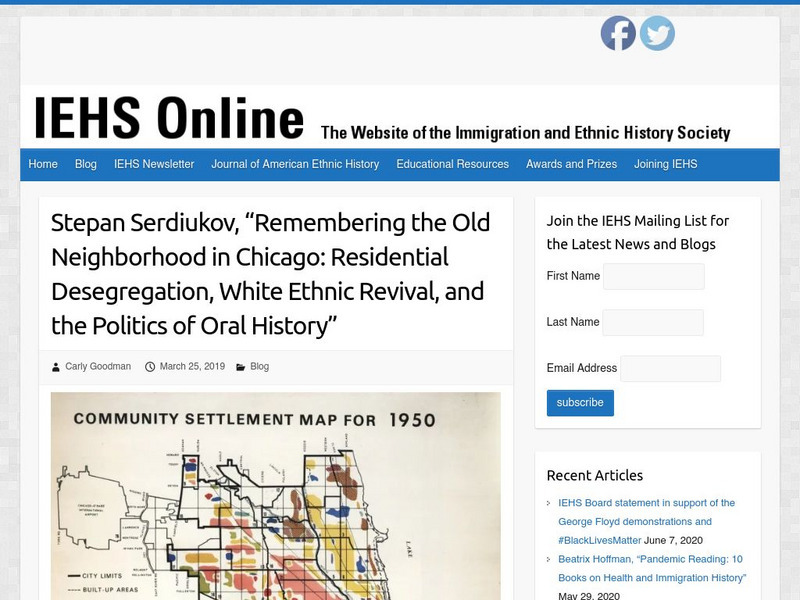
Immigration and Ethnic History Society
Iehs: Stepan Serdiukov, Remembering the Old Neighborhood in Chicago
This article focuses on the oral histories of Polish immigrants in Chicago. The Chicago History Museum's Polish American oral history archive started in 1976 under the Ethnic Heritage Studies Program Act. Researchers recorded 140...
Chicago History Museum
Chicago History Museum: History Files: The Black Sox
Media coverage of the 1919 World Series involving the players from this team and the scandal that became so well known.
Chicago History Museum
Chicago History Museum: Pullman Luxury Rail Car
Read about the luxurious rail car George Pullman introduced that made transcontinental rail travel so desirable.
Chicago History Museum
Chicago History Museum: George Pullman: Social Reformer
Click through four pages on this larger website about the Pullman Rail Car Company. Read about George Pullman's ideas about establishing a company town for his workers that would address their housing, recreation, and even moral needs.